The International Finance Corporation, a division of The World Bank, issued its 2012 Report on Doing Business: Measuring Business Regulations. It ranks all its researched nations and sub-nations (their term, not Mine) from 1 to 183 in several categories related to the how easy or difficult it is to set up and operate a business operation. If you want to know how they came to their conclusions, you can read the IFC's methodology here.
[A non-casual aside: Local economists whoring for political parties and the folks who perpetrate the "Internet Study" in Puerto Rico would be well-advised to do the same: show your work. Although I fully understand that there isn't much methodology to "Pulling numbers from one's ass."]
As you already know, Puerto Rico finished in the overall 43rd place on the list, behind those economic powerhouses the Republic of Georgia (the one without Atlanta), Macedonia, Mauritius, Estonia, Cyprus and Colombia. (Yes, Colombia.) Who were the Top 5? Singapore, Hong Kong, New Zealand, the U.S. of part of A. and Denmark.
The highlight:
We ranked 12th in "Starting a Business," whereas the U.S. of part of A. ranked 13th (tied with Ireland.) Woo. And hoo.
The midlights:
We ranked 17th in "Protecting Investors," tied with Saudi Arabia, Georgia, Japan, Macedonia, Belgium and Peru in what must be the "B-" division. Let's now crow as ranking higher than Us are Kazakhstan, Albania and the Kyrgyz Republic, which you just found out exists. And you almost certainly don't know where Kazakhstan and Albania are, either.
In "Getting Credit" We ranked 24th (meaning We're heading into debt like a crazed hyena plunges into a dead elephant's bowels), 27th in "Resolving Insolvency," good to know since We're headed for bankruptcy and 35th in "Getting Electricity"...unless you want to steal it and are a government official, in which case We rank in the Top 1.
The lowlights:
A miserable 97th place in "Enforcing Contracts," possibly due to (a) corruption, (b) a near-useless legal system, (c) an over-abundance of laws, rules and regulations or (d) all of the freaking above with hemorrhoids.
As for "Paying Taxes," We rank 113th. Our taxes and tax system are definitely not helping Us compete on the global market, but then again, We knew that. We didn't need the IFC and the World Bank to remind Us of this simple, devastating fact. And by "We" I mean "folks not in government."
How does the number "126" grab you? That's where Puerto Rico ranks in "Registering Property," the kind of slap-with-a-wet-fish wake-up call most civilized and legally-organized countries would resent...only We have a double-faceful of damp sushi when We notice Our ranking of 152nd in "Dealing with Construction Permits."
Unless, of course, you are a government official, in which case, "Permits shmermits, suckers."
I did ignore the 101st place ranking for "Trading Across Borders" because that's not Our fault, entirely. Sure, We can use the Internet to sell anything anywhere, but Our colonial status allows Us to sell to anyone so long as that anyone is the U.S of part of A. or whoever the U.S. of part of A. allows Us to. (Had to double-up on the verb to make sure commonwealthers get the hint.)
Will We see progress in the 2013 Report? I'll say it depends a lot on who wins the November elections: the candidates....or the voters.
The Jenius Has Spoken.
04 April 2012


03 April 2012
Police Lies, Stupid Remarks, We All Lose
A 29-year old woman is found unconscious off a trail on the tiny island of Vieques, a vacation hotspot municipality of Puerto Rico. The woman, visiting Vieques as a tourist, was semi-nude and may have been raped.
The blow to the left side of her head was so powerful that it caused injury to the right side, not from a fall, but from the contusion itself, requiring emergency surgery. That is horrible enough. Worse is the possibility that she was raped, for no crime short of murder is more heinous. But beyond that lies another horror: the woman may have been the third victim of a serial rapist, whose two prior attacks were hushed up.
Let Me give you some context here: Vieques proper is about the size of some suburban tracts in the U.S. of part of A., for although 21 miles long and 5 miles wide, two closed areas on the western tip and eastern half of the island are closed off, halving the island's civilian zone. Just look at the map and you'll see that the civilian area--the township itself--is quite tiny. Population: about 9,600, give or take a few hundred visiting for Spring Break or Holy Week or some other pagan ritual.
 There's two ways off the little island: boat (ferry or private vessel) or plane (local air transport or private plane). Although checking and vetting private boats and planes is not easy, it is routinely done as part of the massive(ly ridiculous) "drug war." Even with the ineffective and lackadaisical monkey squads We call police, trying to hunt a rapist on Vieques is far from impossible; in fact, the only place easier in Puerto Rico would be the tinier island-municipality of Culebra, northeast of Vieques.
So why hide the fact that two other women were attacked, one raped?
Politics. With maybe a soupçon of equally disgusting and hypocritical economics thrown in.
Rape is a violent crime that thrives when covered up. Sadly, disgustingly, Our """society""" often blames the victim rather than the perpetrator, a nauseating reversal that says too much much about Us and all of it bad.
For those of you who don't get it (mostly men who are morally and intellectually retarded, but also some stupid women), imagine someone comes up and beats the living shit out of you. Pounds you like beating a mule. (Simile intended and the shoe fits, so shut up.) Barely leaves you alive. Now imagine that YOU--YOU--get blamed for the beating because you were in the wrong place or were wearing the wrong clothes or simply because whoever beat the shit out of you gets treated with more respect than you and your broken bleeding body.
Still think it's fair? If you do, then I hope My example becomes your reality in the next 5 weeks.
Two women were attacked in Vieques prior to this third attack. Even without charges, the attacks themselves would have to be publicized to alert other women and the community that some deranged animal is on the loose. Covering up this information was not done to protect the community: it was done to protect the image of Vieques. Specifically, the political image related to tourism.
If you think the economic image to tourism is the salient factor, rather than the political, think about this: other attacks against tourists in Puerto Rico--rare, but they do happen here, just like the do around the world--are mentioned quickly and openly. The Vieques' attacks were not. So what happened in these attacks?
July 15, 2011: A man described as "thin, with dark skin," leaps out from behind a rock and strikes a young (about 27) woman several times in the head. Despite the blows, the woman fights back, screams and gets the attention of her two girlfriends who were walking further ahead. The woman was hurt, but chose to leave Vieques immediately.
December 27, 2011: A 15-year old girl goes back to the hotel to get a snorkel. Her return takes so long that her parents search for her, but don't find her. She eventually appears, "beaten, delirious and bleeding". The family leaves Vieques and days later the girl indicates she was raped.
In neither case were charges filed by the persons involved, directly or indirectly. That happens all-too-often in a society that treats rape victims like criminals; no, worse, because the """legal system""" eviscerates the victim to coddle the criminal. But the police knew about each case. They had the injury reports and testimonies. The Vieques police knew that two women were attacked, one was raped, and yet the Regional Commander, Antonio López, said "he didn't know" about the two previous attacks and "defended" the police's inaction by stating that "(T)here have been no reported rapes in Vieques since 2003."
Now here's the objective take: (1) It is entirely possible that the Regional Commander didn't know about two specific cases of essentially assault and battery in one small township of his area, even though that township is a high-profile hotspot for tourism and drug intervention; and, (2) It is entirely possible that there have been no reported rapes in Vieques since 2003.
But here's My non-objective take, aimed straight at Tony "Lip Service" López: There are times when the facts are on your side and there are times when sticking to the facts makes you an asshole. And in this case, "Lips On Ass" López, you are being an asshole.
Your job--cough-chuckle-retch--is "To Serve and Protect." Under your command, three women, one of them a minor, were attacked and beaten, almost certainly raped in two cases, and your response is basically a politically-farted, shit-for-brains version of "I don't know and I don't care."
Over three years ago, a pregnant woman was abducted and brutally murdered while vacationing here--in Ceiba, part of your command area, "Loose Lips" López. Just before her murder, terrified and anguished in the trunk of a car, the woman called her fiancé. What that must have been like for both of them staggers reason. The crime received a great deal of press and a Tourism Company executive--a woman, no less--had the unmitigated gall to say that the crime was a tragedy because it stained the tourism reputation of the Island.
Yes, crimes do stain a country's reputation, particularly for tourism. Just ask Mexico. But stupidity, product of a smelly, self-serving blend of ignorance and arrogance in the form of puke-inducing statements, does just as much damage.
Partially-lost in this mess is that local officials moved quickly to help the most-recent victim's mother arrive here within hours and have provided accommodations for them both and the victim's friends, also here on vacation. It's truly the least that could be done.
But Let's get some things straight, right now:
---Crime happens. Sometimes to tourists. But regardless of who gets hurt--tourist or resident--stop covering up the crimes for political """gain"""". To the Vieques police and anyone involved in hushing up the noted attacks and any other danger the community should be alerted to: Fuck you.
---I read comments, some from women, that these attacks and rapes happened because the victim's were "walking where they shouldn't be walking" or bullshit to that effect. In other words, they are saying that by "going there," they "invited" the crimes perpetrated against them. These women were on a tiny island where security could be enforced with relative ease. But that's beside the point. Glance up to My example again. The crime is committed because the perpetrator chooses to commit it, not because the victim """""chooses""""" it. If you can't understand that, you should be sterilized.
At a time when Our government's statistics on crime are complete, total and pestiferous hogwash, slamming cases into courts to "up" numbers and hiding crimes to "down" others, it seems obvious to anyone with a higher IQ than a turd that the energy involved in hiding the facts can be put to better use. Not that it will be, simply that it can be.
Because when it comes to facts and fibs, facts are the only ones that help Us all, while fibs only serve the fucking liars.
The Jenius Has Spoken.
The blow to the left side of her head was so powerful that it caused injury to the right side, not from a fall, but from the contusion itself, requiring emergency surgery. That is horrible enough. Worse is the possibility that she was raped, for no crime short of murder is more heinous. But beyond that lies another horror: the woman may have been the third victim of a serial rapist, whose two prior attacks were hushed up.
Let Me give you some context here: Vieques proper is about the size of some suburban tracts in the U.S. of part of A., for although 21 miles long and 5 miles wide, two closed areas on the western tip and eastern half of the island are closed off, halving the island's civilian zone. Just look at the map and you'll see that the civilian area--the township itself--is quite tiny. Population: about 9,600, give or take a few hundred visiting for Spring Break or Holy Week or some other pagan ritual.

So why hide the fact that two other women were attacked, one raped?
Politics. With maybe a soupçon of equally disgusting and hypocritical economics thrown in.
Rape is a violent crime that thrives when covered up. Sadly, disgustingly, Our """society""" often blames the victim rather than the perpetrator, a nauseating reversal that says too much much about Us and all of it bad.
For those of you who don't get it (mostly men who are morally and intellectually retarded, but also some stupid women), imagine someone comes up and beats the living shit out of you. Pounds you like beating a mule. (Simile intended and the shoe fits, so shut up.) Barely leaves you alive. Now imagine that YOU--YOU--get blamed for the beating because you were in the wrong place or were wearing the wrong clothes or simply because whoever beat the shit out of you gets treated with more respect than you and your broken bleeding body.
Still think it's fair? If you do, then I hope My example becomes your reality in the next 5 weeks.
Two women were attacked in Vieques prior to this third attack. Even without charges, the attacks themselves would have to be publicized to alert other women and the community that some deranged animal is on the loose. Covering up this information was not done to protect the community: it was done to protect the image of Vieques. Specifically, the political image related to tourism.
If you think the economic image to tourism is the salient factor, rather than the political, think about this: other attacks against tourists in Puerto Rico--rare, but they do happen here, just like the do around the world--are mentioned quickly and openly. The Vieques' attacks were not. So what happened in these attacks?
July 15, 2011: A man described as "thin, with dark skin," leaps out from behind a rock and strikes a young (about 27) woman several times in the head. Despite the blows, the woman fights back, screams and gets the attention of her two girlfriends who were walking further ahead. The woman was hurt, but chose to leave Vieques immediately.
December 27, 2011: A 15-year old girl goes back to the hotel to get a snorkel. Her return takes so long that her parents search for her, but don't find her. She eventually appears, "beaten, delirious and bleeding". The family leaves Vieques and days later the girl indicates she was raped.
In neither case were charges filed by the persons involved, directly or indirectly. That happens all-too-often in a society that treats rape victims like criminals; no, worse, because the """legal system""" eviscerates the victim to coddle the criminal. But the police knew about each case. They had the injury reports and testimonies. The Vieques police knew that two women were attacked, one was raped, and yet the Regional Commander, Antonio López, said "he didn't know" about the two previous attacks and "defended" the police's inaction by stating that "(T)here have been no reported rapes in Vieques since 2003."
Now here's the objective take: (1) It is entirely possible that the Regional Commander didn't know about two specific cases of essentially assault and battery in one small township of his area, even though that township is a high-profile hotspot for tourism and drug intervention; and, (2) It is entirely possible that there have been no reported rapes in Vieques since 2003.
But here's My non-objective take, aimed straight at Tony "Lip Service" López: There are times when the facts are on your side and there are times when sticking to the facts makes you an asshole. And in this case, "Lips On Ass" López, you are being an asshole.
Your job--cough-chuckle-retch--is "To Serve and Protect." Under your command, three women, one of them a minor, were attacked and beaten, almost certainly raped in two cases, and your response is basically a politically-farted, shit-for-brains version of "I don't know and I don't care."
Over three years ago, a pregnant woman was abducted and brutally murdered while vacationing here--in Ceiba, part of your command area, "Loose Lips" López. Just before her murder, terrified and anguished in the trunk of a car, the woman called her fiancé. What that must have been like for both of them staggers reason. The crime received a great deal of press and a Tourism Company executive--a woman, no less--had the unmitigated gall to say that the crime was a tragedy because it stained the tourism reputation of the Island.
Yes, crimes do stain a country's reputation, particularly for tourism. Just ask Mexico. But stupidity, product of a smelly, self-serving blend of ignorance and arrogance in the form of puke-inducing statements, does just as much damage.
Partially-lost in this mess is that local officials moved quickly to help the most-recent victim's mother arrive here within hours and have provided accommodations for them both and the victim's friends, also here on vacation. It's truly the least that could be done.
But Let's get some things straight, right now:
---Crime happens. Sometimes to tourists. But regardless of who gets hurt--tourist or resident--stop covering up the crimes for political """gain"""". To the Vieques police and anyone involved in hushing up the noted attacks and any other danger the community should be alerted to: Fuck you.
---I read comments, some from women, that these attacks and rapes happened because the victim's were "walking where they shouldn't be walking" or bullshit to that effect. In other words, they are saying that by "going there," they "invited" the crimes perpetrated against them. These women were on a tiny island where security could be enforced with relative ease. But that's beside the point. Glance up to My example again. The crime is committed because the perpetrator chooses to commit it, not because the victim """""chooses""""" it. If you can't understand that, you should be sterilized.
At a time when Our government's statistics on crime are complete, total and pestiferous hogwash, slamming cases into courts to "up" numbers and hiding crimes to "down" others, it seems obvious to anyone with a higher IQ than a turd that the energy involved in hiding the facts can be put to better use. Not that it will be, simply that it can be.
Because when it comes to facts and fibs, facts are the only ones that help Us all, while fibs only serve the fucking liars.
The Jenius Has Spoken.
02 April 2012
Cheating Votes, Now And In November
This won't take long...
Both major parties are contesting the State Electoral Commission's (SEC) results of the two recent primaries. Despite the fact that all registered parties have members on the SEC Boards, that at least one member of each party must be present at all voting centers, as well as at all tabulation sessions, and that each party has additional members in the SEC to assist/review recounts, the statehood party ("Idiots in Denial") and the commonwealth party ("Morons of Conformity") are saying that many of the primaries' results are wrong.
Now economist Leo Gómez--of local Twitter fame as @leojacket--showed that over 80% of the voting station results he checked (about 90-95% of them all) were "off", in some cases, registering hundreds of votes more than possible. The bigger "offs" were largely in the statehood party ("Republican" in name only), but given their track record and need to stay in power, that is not surprising. That the commonwealth party also got in on the cheating is just politics as usual in this Island of Enchantment.
What does this mean?
Simple: like some Jenius said a while back, major voter fraud in November is a-comin'. Like a runaway freight train loaded with 50 tons of lead down a ski-jump ramp angle with a tailwind in the 70s.
In other words: bet on it.
The Jenius Has Spoken.
30 March 2012
"¡Ciencia Boricua!" Rocks
Thanks to Dr. Daniel Colón-Ramos, a Yale researcher of nematodes and founder of CienciaPR.org, I received a copy of the outstanding science essays collection titled ¡Ciencia Boricua! And the best part? It was personally dedicated to Me!
Okay, to Mrs. Jenius and Jenius, Jr, too.
The purpose of the collection was to present Puerto Rican scientists and sciences in a Puerto Rican context. Now some of you gringos and other-than-Puerto-Ricans out there might think this is silly, "sciences in a Puerto Rican context." But let Me ask you this: how many plant species do you know from Brazil? How many insects can you name that are common to Japan? Can you name 3 scientists who have no direct links to the U.S. of part of A.? Go ahead: name three.
"But Jenius, who cares about Brazilian plants, Japanese bugs and scientists not from the proto-fascist U.S. of part of A.?!"
Brazilians, the Japanese and every nation that takes pride in the achievements of its people.
You see, an interest in science is developed by observation and thought, by observing the world We live in and are surrounded by, linked to a questioning, probing thought process. But if the science you are exposed to is from "somewhere else," if it doesn't connect directly with your experiences and help you answer the questions you encounter in your own environment, then you develop a sense that science is not for you, that it has nothing to say to you, and you look for other things to occupy your mind.
And that's where ¡Ciencia Boricua! comes in: it gives sciences a Puerto Rican look and feel. Every author is Puerto Rican and every essay--each about 2-4 pages long, making it a breezy read--is about an aspect of science explained with local geology, flora, fauna and examples.
The essays range from microscopic life forms to a time when the Earth was almost constantly heaving lava, from the need for improved science education to a personal exploration of what science means. The essays explain their topics simply, not in the offensive "dumbing down" way favored by modern media, but directly, almost conversationally. There's something for everyone, and better than that, it's all important.
I was so enthused by ¡Ciencia Boricua! that I offered to help turn it into an e-book. I know Dr. Colón and CienciaPR are trying to create a broader range of science-based channels to bring the wonders of science directly to the masses, from school-age children to curious adults. In this arena of creating connections, Dr. Colón received a prestigious American Association for the Advancement of Sciences (AAAS) Early Career Award for Public Engagement with Science.
The goal would be to create a series of textbooks for all grades, covering all major sciences, with a Puerto Rican-centric context. We certainly don't lack the scientists, and to those who say that "science is not cultural," My response is "Explain any science without a cultural context." Why can't you do it? Because you'd need to use a language...and where does language (word usage and terminology) come from if not a cultural context? We understand sciences better because We internalize them according to Our cultural norms and mores.
¡Ciencia Boricua! is a small book as many science texts go, but it is a giant leap for Our educational system and cultural context. It might seem odd that the the juxtaposition of "small step, giant leap" made popular by Neil Armstrong on the Moon--placed there by NASA and a huge national effort--is used in this context, but when you realize that NASA is literally jammed with Puerto Rican engineers and scientists, you see why I used it.
There's plenty of Puerto Rican presence in the sciences; the time has come to make that fact known to a wider audience and to encourage a new generation of Our scientists to discover the wonder of the Universe We live in...no matter where We choose to look for it.
The Jenius Has Spoken.
28 March 2012
Is The Tech Industry Racist?
So I'm glancing through My e-mail and I notice one from Jen Rhee.
Don't know who that is. Clicked it open.
Hi Gil,
While searching for resources about tech and social media, I came across your site and saw that you had talked about the current digital divide. I wanted to reach out with a graphic about the absence of minorities in today's booming tech industry, which I think would be a great fit for your site. Would you be interested in taking a look?
Thanks in advance,
Jen
Quick Google search satisfied My low-key "Is this spam?" filter. But I took an unconscionably long time to respond to her. Happily, she replied:
Hi Gil,
Thanks for getting back to me. The graphic I was referring to lives here: http://www.onlineitdegree.net/is-tech-racist/
I think your readers will enjoy it, so feel free to share it and let me know if you do! I’d love to get your thoughts as well.
Thanks again,
Jen
The infographic is very large, but here are two facts that are quite stunning:
Population of the U.S of part of A.: Black, 12.8%; Hispanic, 15.4%, Other, 71.8%
Silicon Valley Employment Population: Black, 1.5%; Hispanic, 4.7%, Other, 93.8%
Internet Company Founders, Nationwide: White: 87%; Asian: 12%; Black: 1%
And lest you look at these numbers and think they are merely part of the past, the infographic also reveals that although employment in the 10 largest companies of the tech industry has risen 16%, the number of Hispanics employed in those companies has dropped 11% and the number of Blacks has dropped 16%.
Racist?
Let's start with labeling. In the Silicon Valley Employment Population stat, Asians are classified as "Other," and yet they are 12% of the Internet company founders. By that measure, 99% of all Internet companies are founded by "Whites/Asians" and only 1% by Blacks. And that 99% would ostensibly include Hispanics, lumped with Whites out of carelessness, bias, negligence or because their numbers are too small to separate (in which case they should have been listed to contrast with the size of the Hispanic population.)
In short: the way the data is presented obscures or obfuscates the conclusions...but only to a certain extent. When 28.2% of a nation's population equals barely 6.2% of a major industry's workforce and barely more than 1% of its entrepreneurial founders, there has got to be more than an "oops factor" involved.
So what could they be?
1) Education: The numbers for Hispanics and Blacks are far below Whites and Asians when it comes to college degrees, even in technology-related fields. They have been for a long time.
But isn't Silicon Valley the proud poster child of the college dropout who built a company and changed the world? In fact, isn't the image of the industry one that often eschews "book learning" or "theory" in favor of "just doing it"? Since when did "doing it" have a skin color?
2) Economics: The Silicon Valley scene is rife with venture capital money, in the same way some parts of Colombia are built on cocaine. From a 2011 survey on venture capitalists comes this conclusion: "When looking at race, 86% of investors identify themselves as Caucasian, 10% as Asian and 1% as African American." [Jenius Note: Apparently 4% don't care what they are or don't want to be scrutinized too closely.]
Let Me save you the trouble of scrolling back up for the comparison:
Venture Capital Racial breakdown: White, 86%; Asian, 10%; Black, 1%.
Internet Company Founders, Nationwide: White: 87%; Asian: 12%; Black: 1%
See that? You could make a case that Whites fund Whites, Asians fund Asians (and a little more beyond that) and Blacks fund Blacks, only that Whites and Asians (but especially Whites) seem to have way more money than Blacks.
And if that has been going on for a long time--and it has, because venture capital is about investing in people more than technology or business models--then the more Whites fund Whites, the more Whites there are to fund Whites.
But. If Whites-only VC funds only funded White start-ups, We'd have a clear case of racism. I don't know if We do. If Asians-only VCs only funded Asian start-ups or Blacks-only VCs funded only Black start-ups, would it be racist of them? Couldn't they state that their investments are made to "Offset the limited opportunity (translation: racist policies) offered by Whites-only VC firms"? And would that make it right? [For the record: Exclusion of others because of skin color is racism, no matter who does it to whom. Period.]
And yet, successful VC firms, like most companies, thrive on having a variety of peoples with a variety of skills and outlooks. Racism that seeks to limit the potential of a team, group or company to "Only those that look like Me" run the very real risk of getting their asses handed back to them waxed and pounded flat by companies who know that talent, skill and energy come in all skin colors.
However, that leads to a third possible factor:
3) Social inequality: Not that Asians, Hispanics or Blacks are less capable, only that their opportunity set is smaller because society has barriers for them that don't exist for Whites.* Asians are expected to do well in school, particularly math and technology. Given their relatively small percentage of the population (4.4%), they account for a significant amount of college degrees (2008-2009): Bachelor's: 7%; Master's: 6.1%; Doctoral, 5.7%, and an impressive 10.4% of First Professional degrees. In every case, they exceed their population percentage, whereas Hispanics and Blacks are below their population percentage at every degree level.
Is that racist? I don't think so; it's merely a series of factual data points. But is the opportunity set the same? Here's a litmus test: Jeremy Lin. Apple Store Genius you want fixing your MacBook Pro or last man chosen at a pick-up basketball game...and only because he brought the ball? Most likely both, though he's really a key component of the Knicks in their run to the playoffs, a major story because he is Asian-American. And why is that? Because Asians are not really supposed to be major basketball stars, or athletes in general. Mathletes, sure. Feisty-gutsy point guards with skillz? Not so much.
The opportunity set, the potential pathways to growth in a society, are not truly equal. Never have been, anywhere. In the U.S. of part of A., Whites have advantages over Non-Whites, mainly in that they go to jail far less often though Whites commit as many crimes as Non-Whites. Education is highly-praised and touted by all races, but Asians are perceived to be tigerish about it, while Blacks and Hispanics are perceived to be trapped by a system and Whites are perceived to be gliding through it in pursuit of high grades that don't entail effort.
Those are perceptions. The realities are that Whites have more college degrees, more money and more access to both than Asians, Blacks and Hispanics. What the IT industry reflects in Silicon Valley is most likely a snapshot of nearly all other "knowledge economy" industries in the nation. I dare say that others are worse; Wall Street, for example. And beyond private enterprise, the disparity is similar, as a glance at the justice system or Homeland Security will reveal.
What the infographic doesn't touch is the male/female breakdown of Silicon Valley, the Top 10 tech companies and VC firms with their investments. Racism and sexism often go hand -in-hand, so maybe that data would help clear up the picture, though clarity may have already been achieved.
Again, does all of the above mean that the IT industry is racist? Yes, it does. There is definitely a racial component to the huge disparities, a consciously chosen set of decisions that produced these results. Just like the conscious decisions of a nation have led to the following results, a horrendously damning indictment of the entire society Silicon Valley is ultimately part of:

Notice how in this "industry," Hispanics and Blacks have truly higher percentages than Whites...which is how Whites want it.
Racist? From Silicon Valley to Wall Street and everywhere in between in this once-great "Land of the Free"?
Definitely racist.
The Jenius Has Spoken.
* If you don't think there are barriers for Non-Whites in the U.S. of part of A., you have obviously never heard of Arizona, Alabama or Georgia, don't understand the true target of "the Drug War" (hint: it has NOTHING to do with any drug) and are completely delusional. Which means you vote Republican. But I repeat Myself.
27 March 2012
My Day, Today
Drank My breakfast this morning. Had "Boost" (Cool Strawberry), a 5-hour energy drink, coffee and orange juice, in some order. Then I ate a Sloppy Joe. Breakfast of champions.
Dove headfirst into My daily infodump, a 14-website tour. Opened tabs like only an Opera user can, by the dozens, with the abandon of a carefree child hyped on sugar. Or caffeine. Slashed through the tab deck in uncharacteristic fashion, bookmarking and closing left and right. And left and right. And then again. Good. Only 16 tabs left. For now.
Sometime yesterday I passed 10,000 bookmarks. All Mine. Been collecting them since 1992, but really, the oldest one I have now is from April 9, 2001. An essay on classic board games. Typical.
Had to leave to deal with government bureaucracy, but this time it was relatively painless. The woman at the semi-empty office wore a huge green-glassed ring on her left index finger. No other rings. I wondered if the ring was advertising or camouflage. Didn't ask.
Ate too much for lunch, probably because the 5-hour energy drink barely pushed My needle up at all. Doesn't usually. Maybe I need to drink two of the little bottles, if I could somehow get past the taste of rancid donkey piss. Which reminds Me, I only had a half cup of coffee before lunch. Maybe that's why I ate too much. And no, My coffee doesn't taste like rancid donkey piss, it's just that My mind works in strange ways.
Here's a song I came up with this morning, while showering. Took all of about 15 seconds. To the tune of "Yankee Doodle":
My mother said I was a punk, and just like Yankee Doodle,
So I shot my mom again and farted on a poodle.
For the record, I love My mom. She's been wonderful to Me. And Mrs. Jenius and I don't have a poodle. Yet.
Got a phone call from a woman in Utuado who wants help in developing a day care center with community outreach services. She found Me because she downloaded a free copy of My book on getting federal grant funds. I hear it's being used as a textbook in two local university systems now, so being free, I make nothing off the book. Except phone calls. I'd forgo the phone calls if people just used the book more.
Noticed for the 58th time that I haven't posted anything here for over 2 weeks, thanks for noticing. Liquid breakfast with a Sloppy Joe chaser, oddball songs, too much lunch, random phone calls I stretch out to amuse Myself...
It's time to get back here. I don't need to draw Myself a picture...well, maybe one. Involving the poodle.
The Jenius Has Spoken.
06 March 2012
Whitewashing Racism, Sexism, Ugliness...And Incompetence
The Mayoress of Cabo Rojo is a black woman. Her name is Perza Rodríguez. Formerly the Vice-Mayor, she "ascended" to the Mayor's seat after the death of Santos Padilla.
Perza, as I said, is a black woman. She mentions that fact often, in her husky-hollow voice that makes her sound like she's talking through an empty Clorox jug. She's black. And a woman. And in her words--oft-repeated--those two facts are used to attack her.
Perza claims her critics "accuse" her of being black. She has a radio show and TV show and a local """newspaper""" (El Faro) that might as well be hers for the prostrated-at-her-feet coverage it provides. Funny, but despite a weeks-long search, I found no comment anywhere that ever referred to her race...that wasn't her own. From what I can see, it is those sources that mention her race, when she plays that card to attack "her critics."
In these pseudo-modern times, to attack a person for the color of their skin is idiotic or Republican, which are synonyms at heart. The fact is, We are sensitive to racism, and though many utter racist comments in private, in public, We are pseudo-colorblind.
Now maybe Perza is referring to attacks she receives in person, with folks coming up to her and saying racist things to her. Or maybe trying to put her down because she's not a man. If that's the case--and I doubt it from here to Uranus--then shouldn't she be turning that crass negativity into a positive, standing up for her race and gender, rather than essentially whining about how she's being attacked? Dr. Martin Luther King Jr. said "I have a dream," not "Stop it, you meanies." And I'm sure he faced more racism that Perza.
But I don't think that's it, either. Maybe I'm judging y'all by My standards (S.O.P., really), but I'd be very surprised if people frequently said anything racist to Perza or any other black person in elected office, because (a) We tend to avoid seeming racist and (b) My Brethren tend to be fearful of those in power. Now that doesn't mean that they won't say hideously racist things behind Perza's back, but if she isn't really hearing the remarks, why is she making such a fuss about it? Why give any sort of credence to voices you haven't heard, unless you're nuts?
As for sexism, she might be on the receiving end of the typical male condescension Our machista society has, but Let's be real here: Perza isn't the only woman going through that. Claiming it repeatedly is a bad strategy for it appeals to "pity" rather than ability. True, elections are decided by emotions, not intellect, but does it really help a candidate's image to be seen as pitiful rather than capable? If that were the case, The Larva would be governor-for-life.
No, I don't think Perza harps on race and gender for any good reason...except that it takes away some of the attention from the fact that she is fat and unattractive. And unhealthy.
Some of you are tut-tutting Me now. Indulge. Google pics of Perza (or click the link above) and you will see she is fat, to the point of morbid obesity. And yes, you will note she is unattractive. To describe her and leave out these two facts is to engage in "false" honesty, to not mention the--pun intended--elephant in the room.
Is Perza the only fat public official? Heavens no; check out Jenniffer "Gluttonny" González, pseudo-president of the (out)house of representatives. Is Perza the only ugly public official? Again, hell no. But without a doubt, the standards are different for mena and women, with women being gauged more strictly.
One theory, dumb as shit but that's why it might be right, claims that Pedro Stupid Rosselló was voted into the governor's mansion because women found him attractive, especially his legs. In what passes for Our media, which compares to true journalism the way pus compares to custard, a candidate's "physical appeal," if s/he has it, is relevant. How many times has pseudo-senator Evelyn Acevedo, a woman so stupid and slippery she makes dead monkish weep with shame, been described as "a former beauty queen," though rumor has it she won the title by spreading her legs? (Go ahead: tut-tut again. That is the rumor. And I'd hate to see the losers in that contest, if you know what I mean...and I think you don't.)
Good-looking candidates have an advantage; studies by the dozens have shown that to be a fact. Perza might be the victim of a double standard, holding women to some "higher level of physical beauty" than men are, but aside from feminist growlings that are often nothing more than veiled threats, "Gluttonny" doesn't "hide" behind her gender. Then again, she's white...
...As Perza is trying to be. For you see, in billboards now mucking up the scenery in Cabo Rojo, Perza appears...whitewashed. Her skin tone, a rich mahogany, has changed to some yellowish-ivory cast that resembles no race on Earth. The change is so startling that people are commenting on how much the picture doesn't look like her.
Now maybe the problem is with the printing company. They may have screwed up and processed the picture file badly, changing a black woman to a shiny-cheeked yellow-tinted paler cartoon. Even if important items such as party colors and tones are accurate--and they are--I would expect Perza to notice the marked difference in her appearance and have the billboards reprinted.
But no, that hasn't happened and it won't happen. Not because of cost, or timing or some other valid reason: it won't happen because Perza likes the look. Her frequent rants about racism are not about "them," but about herself and her own self-image. She might be happier with the billboard's look, and some proof about that will emerge as We'll see how her rants change in the coming weeks. (My guess: she tones them down...a lot.)
And there's another advantage: while the dumb masses discuss her skin tone, they'll have little time to discuss and dissect her public record, from extensive fiscal malfeasance to rampant cronyism to undermining local businesses. Or her obviously-failing health, as she waddles (don't tut: she waddles) slowly, pausing for breath after several steps or sentences. Or her family's "public" profile, suspiciously close to being related to drugs and theft.
There is racism and sexism in Puerto Rico. Perza is not being victimized all that much by either idiocy. She's whitewashing her fat mug and using racism/sexism to keep Us from uncovering truths she can't properly deal with. I don't reject her for being black or a woman; those aren't and never have been faults. I could, but don't reject her for being fat and ugly; she can (and should) fix "fat" and beauty is in the eye of the beholder, so My opinion on her physicality is either moot or worthless.
To Me it's much simpler than that, for I reject her for being the lowest life form around: a politician.
And NO amount of whitewashing will fix that.
The Jenius Has Spoken.
02 March 2012
TEDx San Juan: Daniel Colón-Ramos
Daniel is a scientist, which means he is a lover of knowledge which means he is a devotée of learning. Currently a researcher at Yale, studying neurological development in nematodes, his research may have enormous implications for genetic-based treatment of Alzheimer's or cancer. Or it may not; it might actually lead to improved nanocomputers or to properly identifying life on Mars.
We don't know. And that's where the joy, glory, challenge and fun of Science begins.
Daniel's point that the enormous increase in Our life spans--and the unprecedented explosion in scientific advancement of the 20th century--are due to the public support of science. This has to be underlined as of extreme importance, because when major corporations, organizations and governments started financing scientific research, the benefits of that research became the public's patrimony, a widespread wave of progress that We could see come to an end in the next few decades.
The problem has two evil roots. One is an increased level of attacks against science, resulting in a less-favorable funding environment, not to mention an outright rejection of scientific inquiry (stem cells, NASA, etc.) But more insidious, more dangerous to the future of science is the appalling (My word) deficiencies in the educational system.
As Daniel outlined, part of the problem is the image science has, a combination of the educational system and the media making it seem that scientific discovery occurs in isolated fashion. The focus is on the end result (polio vaccine, the Sun as the center of the Universe) rather than on the process. Science, Daniel reminds Us, is an accumulation of knowledge, an accretion, not an explosion. To oversimplify discoveries to merely a result is to lose the power and value of the process.
It also creates two more negatives: the sense that sciences are isolated from each and the notion that "everything is known". Focusing solely on a discovery, without context, makes all science (for people see so little they think they see it all) seem disconnected, when in fact, as Daniel emphasizes, everything is connected. Furthermore, the "big news of discovery" coverage, when merged with how little science We actually know about, gives the impression that "everything is known," that "there is nothing left to discover or learn."

As a scientist, Daniel knows that there are far more questions now than ever before.
That's where Our educational system is a failing badly, for the process and environment is directly opposed to asking questions and using curiosity to explore learning. It focuses on memory over questioning, on isolated facts rather than context and on subdividing topics rather than integrating them. In addition, the educational system doesn't teach critical thinking skills, creating an environment of "rushing ahead to meet standards" that don't allow Our students time to think more deeply about what they are learning.
The educational system, then, focuses on storing "knowledge" in arbitrary chunks, never teaching how to learn and generate new knowledge. Science is about asking questions, taking time to observe methodically, follow data, sift the significant from the insignificant and come to conclusions that must bear up to further experimentation. It calls for imagination and reasoning, not memorization.
A problem Science raises, part and parcel of its very existence, is that scientific advances force Us to redefine Ourselves. We once thought We were the center of the Universe; then it was the Sun, now it's any point in the Universe. We once thought We were above animals; now We know We are an animal less than 1% different from a chimp at the genetic level. The challenges that Science tosses at Us come from every direction and in huge numbers, forcing Us to re-evaluate and face often-uncomfortable truths.
A corollary issue from this complexity is that most teachers are ill-prepared for sciences, so curricula have become "dumbed down." "Dumbed down science," is an oxymoron, but then again, so is Our educational system. (My comment, not Daniel's.)
Another aspect that hurts appreciating science, at least in Puerto Rico, is that like with any body of learning, a sociocultural context is very important. As Daniel recounted, when he was a kid his textbook featured an interesting bit about maple trees. There are no maple trees in Puerto Rico, but there are plenty of other trees here that are equally or more interesting.
For those who pooh-pooh this as "rationalization" or "excuses," note this: curiosity and discovery are natural parts of a child's life. They have to be for the child to learn about the world. But even the most recalcitrant amongst you would acknowledge that not receiving the right incentives is the most common way to discourage a child from pursuing an interest or path of action, intentionally or unintentionally. You know that's true, so being unable to "connect" to sciences because the material used means little or nothing to the person is evidently far more discouraging than encouraging.
To address this issue, Daniel and many other local scientists have developed a textbook titled Ciencia Boricua. Every chapter and essay was written by a Puerto Rican scientist and the examples used, from biology to geology, are based directly on and in Puerto Rico. Already in use local schools, Ciencia Boricua is going into a second printing and it is being evaluated for island-wide use.
[Unpaid advocate here: Buy this book. Not just for your kids, but for yourself, My Brethren. You have no idea how much you'll learn and how much will astonish you. Two words, people: Sierra Bermeja. Buy the book to find out how astonishing those two words are.]
Daniel's effort for Ciencia Boricua is part of his seminal work in CienciaPR, the largest organization of Puerto Rican and Puerto Rico-based scientists in the world. With over 5,400 members, CienciaPR is seeking to develop, support and expand interest in sciences as career choices and as part of the public patrimony Daniel addresses so well. (Full disclosure: I will be joining CienciaPR in a support capacity in the coming weeks. This interview was in no way part of that process.)
Daniel points the finger in his own profession's direction when he indicates that scientists need to be more communicative about their work to and for the general public. Unfortunately, the characteristics that make a good scientist are pretty much what makes a poor communicator, so only a handful (Sagan, De Grasse, Feynmann) become iconic science proselytizers. But Daniel says that all scientists can become better communicators, not to "pander to the less capable," but to create a community that values and supports science in a more consistent way.
Daniel told Me he'd just gotten back from an event organized by the American Association for the Advancement of Sciences (AAAS), that focused on this issue of "getting the public involved" in sciences. The goal is to bridge the gap between scientific research and "pop science," the "dumbing down for headlines" trend. In that process, the Internet is a key channel, allowing for the development of "translators," people who understand the science and use their communication skills to make the science known. An example of this "translator" role can be seen here, at Download the Universe, a science writing review site.
The AAAS focus is recognition of what Daniel said, that "We are all part of the scientific dialogue." It is up to Us to define how We are going to participate. And for those of Us with school-age or pre-school age children (Daniel is the proud father of triplets, all girls), the dialogue is not theoretical: it is as practical as deciding what groceries We'll buy for them to eat.
Sadly, what We have with sciences is more theory and talk than practice. We don't do science anymore, the classroom-level exploration that led Us to look at the microscopic, mix the chemicals, watch the physics or dissect the once-living. And yet, We "do" Science every day, to deal with and understand the world. As Daniel said in closing: "We are all born scientists. We observe, experiment, ask, learn--We never lose that and it crosses all barriers, for it doesn't matter who you are or where you come from, you will do these things."
Daniel is right, for not only are We scientists-at-large, public support--Our support--of sciences, from research to education to reporting to commercialization, are at the very foundation of Our modern level of progress. We shouldn't forget that, despite the rising tide of what can only be called ignorance. If We really want the world to solve its pressing problems--some of which were created through sciences--then Our only hope, Our only proven tool for large-scale solutions, remains scientific research.
And the better the tool, the better the craftsman needs to be. Daniel is seeking ways to improve both.
The Jenius Has Spoken.
We don't know. And that's where the joy, glory, challenge and fun of Science begins.
Daniel's point that the enormous increase in Our life spans--and the unprecedented explosion in scientific advancement of the 20th century--are due to the public support of science. This has to be underlined as of extreme importance, because when major corporations, organizations and governments started financing scientific research, the benefits of that research became the public's patrimony, a widespread wave of progress that We could see come to an end in the next few decades.
The problem has two evil roots. One is an increased level of attacks against science, resulting in a less-favorable funding environment, not to mention an outright rejection of scientific inquiry (stem cells, NASA, etc.) But more insidious, more dangerous to the future of science is the appalling (My word) deficiencies in the educational system.
As Daniel outlined, part of the problem is the image science has, a combination of the educational system and the media making it seem that scientific discovery occurs in isolated fashion. The focus is on the end result (polio vaccine, the Sun as the center of the Universe) rather than on the process. Science, Daniel reminds Us, is an accumulation of knowledge, an accretion, not an explosion. To oversimplify discoveries to merely a result is to lose the power and value of the process.
It also creates two more negatives: the sense that sciences are isolated from each and the notion that "everything is known". Focusing solely on a discovery, without context, makes all science (for people see so little they think they see it all) seem disconnected, when in fact, as Daniel emphasizes, everything is connected. Furthermore, the "big news of discovery" coverage, when merged with how little science We actually know about, gives the impression that "everything is known," that "there is nothing left to discover or learn."
As a scientist, Daniel knows that there are far more questions now than ever before.
That's where Our educational system is a failing badly, for the process and environment is directly opposed to asking questions and using curiosity to explore learning. It focuses on memory over questioning, on isolated facts rather than context and on subdividing topics rather than integrating them. In addition, the educational system doesn't teach critical thinking skills, creating an environment of "rushing ahead to meet standards" that don't allow Our students time to think more deeply about what they are learning.
The educational system, then, focuses on storing "knowledge" in arbitrary chunks, never teaching how to learn and generate new knowledge. Science is about asking questions, taking time to observe methodically, follow data, sift the significant from the insignificant and come to conclusions that must bear up to further experimentation. It calls for imagination and reasoning, not memorization.
A problem Science raises, part and parcel of its very existence, is that scientific advances force Us to redefine Ourselves. We once thought We were the center of the Universe; then it was the Sun, now it's any point in the Universe. We once thought We were above animals; now We know We are an animal less than 1% different from a chimp at the genetic level. The challenges that Science tosses at Us come from every direction and in huge numbers, forcing Us to re-evaluate and face often-uncomfortable truths.
A corollary issue from this complexity is that most teachers are ill-prepared for sciences, so curricula have become "dumbed down." "Dumbed down science," is an oxymoron, but then again, so is Our educational system. (My comment, not Daniel's.)
Another aspect that hurts appreciating science, at least in Puerto Rico, is that like with any body of learning, a sociocultural context is very important. As Daniel recounted, when he was a kid his textbook featured an interesting bit about maple trees. There are no maple trees in Puerto Rico, but there are plenty of other trees here that are equally or more interesting.
For those who pooh-pooh this as "rationalization" or "excuses," note this: curiosity and discovery are natural parts of a child's life. They have to be for the child to learn about the world. But even the most recalcitrant amongst you would acknowledge that not receiving the right incentives is the most common way to discourage a child from pursuing an interest or path of action, intentionally or unintentionally. You know that's true, so being unable to "connect" to sciences because the material used means little or nothing to the person is evidently far more discouraging than encouraging.
To address this issue, Daniel and many other local scientists have developed a textbook titled Ciencia Boricua. Every chapter and essay was written by a Puerto Rican scientist and the examples used, from biology to geology, are based directly on and in Puerto Rico. Already in use local schools, Ciencia Boricua is going into a second printing and it is being evaluated for island-wide use.
[Unpaid advocate here: Buy this book. Not just for your kids, but for yourself, My Brethren. You have no idea how much you'll learn and how much will astonish you. Two words, people: Sierra Bermeja. Buy the book to find out how astonishing those two words are.]
Daniel's effort for Ciencia Boricua is part of his seminal work in CienciaPR, the largest organization of Puerto Rican and Puerto Rico-based scientists in the world. With over 5,400 members, CienciaPR is seeking to develop, support and expand interest in sciences as career choices and as part of the public patrimony Daniel addresses so well. (Full disclosure: I will be joining CienciaPR in a support capacity in the coming weeks. This interview was in no way part of that process.)
Daniel points the finger in his own profession's direction when he indicates that scientists need to be more communicative about their work to and for the general public. Unfortunately, the characteristics that make a good scientist are pretty much what makes a poor communicator, so only a handful (Sagan, De Grasse, Feynmann) become iconic science proselytizers. But Daniel says that all scientists can become better communicators, not to "pander to the less capable," but to create a community that values and supports science in a more consistent way.
Daniel told Me he'd just gotten back from an event organized by the American Association for the Advancement of Sciences (AAAS), that focused on this issue of "getting the public involved" in sciences. The goal is to bridge the gap between scientific research and "pop science," the "dumbing down for headlines" trend. In that process, the Internet is a key channel, allowing for the development of "translators," people who understand the science and use their communication skills to make the science known. An example of this "translator" role can be seen here, at Download the Universe, a science writing review site.
The AAAS focus is recognition of what Daniel said, that "We are all part of the scientific dialogue." It is up to Us to define how We are going to participate. And for those of Us with school-age or pre-school age children (Daniel is the proud father of triplets, all girls), the dialogue is not theoretical: it is as practical as deciding what groceries We'll buy for them to eat.
Sadly, what We have with sciences is more theory and talk than practice. We don't do science anymore, the classroom-level exploration that led Us to look at the microscopic, mix the chemicals, watch the physics or dissect the once-living. And yet, We "do" Science every day, to deal with and understand the world. As Daniel said in closing: "We are all born scientists. We observe, experiment, ask, learn--We never lose that and it crosses all barriers, for it doesn't matter who you are or where you come from, you will do these things."
Daniel is right, for not only are We scientists-at-large, public support--Our support--of sciences, from research to education to reporting to commercialization, are at the very foundation of Our modern level of progress. We shouldn't forget that, despite the rising tide of what can only be called ignorance. If We really want the world to solve its pressing problems--some of which were created through sciences--then Our only hope, Our only proven tool for large-scale solutions, remains scientific research.
And the better the tool, the better the craftsman needs to be. Daniel is seeking ways to improve both.
The Jenius Has Spoken.
29 February 2012
Too Stupid for Democracy
"...(A) growing body of research has revealed... that democratic elections produce mediocre leadership and policies."
Okay, first of all, the snip is accurate in meaning; you can verify that for yourself in paragraph one.
To save you time, here are the highlights that lay out the argument and conclusion:
"...(Researchers) have demonstrated again and again that people are self-delusional when it comes to their own intellectual skills..."
Corollary: Incompetent people can't see or grasp that they are incompetent, or in the researchers' words: "...(I)ncompetent people are inherently unable to judge the competence of other people, or the quality of those people's ideas."
By extension, unfortunately: "...We're just as undiscerning about the skills of others as about ourselves."
Why?: "'If you have gaps in your knowledge in a given area, then you’re not in a position to assess your own gaps or the gaps of others...'"
"...(T)ruly ignorant people may be the worst judges of candidates and ideas... but we all suffer from a degree of blindness stemming from our own personal lack of expertise..."
"'...(V)ery smart ideas are going to be hard for people to adopt, because most people don't have the sophistication to recognize how good an idea is...'"
 "As a result, no amount of information or facts about political candidates can override the inherent inability of many voters to accurately evaluate them."
Fraud, as in stealing an election, helps, too. (Glance left.)
A computer simulation assuming "leadership skills" are plotted on a bell curve was run, meaning that "...(E)ach voter was incapable of recognizing the leadership skills of a political candidate as being better than his or her own." The result?: "When such an election was simulated, candidates whose leadership skills were only slightly better than average always won." (Emphasis Mine.)
 Now here's the thing: leadership skills and thus the ability to evaluate them are not--not--distributed in a neat bell curve. They are obviously skewed strongly towards the majority of people being closer to "follower" (bad leaders) than to "good or great leader". (Don't bother arguing against this: you know it's right.)
Therefore, Our democratic election process that "always" produces a winner who is "slightly better than average" actually means that We are really electing people more skewed towards bad leader than to good.
And you know that's spot-on right. Too stupid for democracy, indeed.

The Jenius Has Spoken.
[Update: 12 March 2012: Ah, Mississippi. The brain-dead canary in the insufferable coal mine We call "democracy." According to Public Policy Polling, 52% of voters in The Magnolia State believe Obama is a Muslim and 66% don't believe in evolution. Dixie has riz!]
Okay, first of all, the snip is accurate in meaning; you can verify that for yourself in paragraph one.
To save you time, here are the highlights that lay out the argument and conclusion:
"...(Researchers) have demonstrated again and again that people are self-delusional when it comes to their own intellectual skills..."
Corollary: Incompetent people can't see or grasp that they are incompetent, or in the researchers' words: "...(I)ncompetent people are inherently unable to judge the competence of other people, or the quality of those people's ideas."
By extension, unfortunately: "...We're just as undiscerning about the skills of others as about ourselves."
Why?: "'If you have gaps in your knowledge in a given area, then you’re not in a position to assess your own gaps or the gaps of others...'"
"...(T)ruly ignorant people may be the worst judges of candidates and ideas... but we all suffer from a degree of blindness stemming from our own personal lack of expertise..."
"'...(V)ery smart ideas are going to be hard for people to adopt, because most people don't have the sophistication to recognize how good an idea is...'"
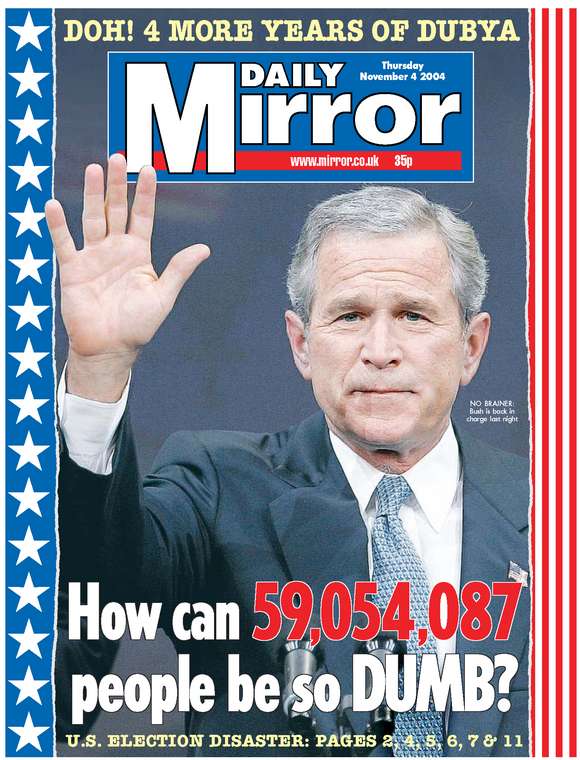
Fraud, as in stealing an election, helps, too. (Glance left.)
A computer simulation assuming "leadership skills" are plotted on a bell curve was run, meaning that "...(E)ach voter was incapable of recognizing the leadership skills of a political candidate as being better than his or her own." The result?: "When such an election was simulated, candidates whose leadership skills were only slightly better than average always won." (Emphasis Mine.)
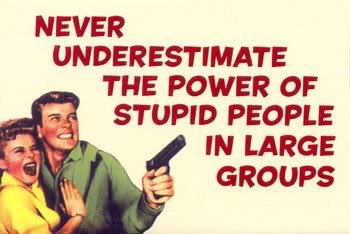
Therefore, Our democratic election process that "always" produces a winner who is "slightly better than average" actually means that We are really electing people more skewed towards bad leader than to good.
And you know that's spot-on right. Too stupid for democracy, indeed.

The Jenius Has Spoken.
[Update: 12 March 2012: Ah, Mississippi. The brain-dead canary in the insufferable coal mine We call "democracy." According to Public Policy Polling, 52% of voters in The Magnolia State believe Obama is a Muslim and 66% don't believe in evolution. Dixie has riz!]
27 February 2012
Symantec Bullshit
What two things do the capital cities of Buenos Aires and San Juan have in common?
Kudos to you if you came up with two that aren't "The primary language is Spanish." And kudos to statehooders who know (or look up) that Buenos Aires is the capital of Argentina. All six of you deserve a medal.
But I bet none of you guessed that "dangerous Internet" links both cities. According to a report by Sperling's BestPlaces and Symantec, Buenos Aires and San Juan are the two cities with the highest risk during Internet access, primarily from WiFi networks and cell phone use.
Do tell. Who benefits from this news? Going back to the report's authors, We have BestPlaces, who wants you to go "there"...and Symantec, a cyber-security company.
Do tell.
 Now the article cited goes on to say that the report is based on a projected risk, in other words, it amounts to someone's opinion that these 2 cities are dangerous for Web users. And even though the report cites the "high number of reported cyber-crimes" in Buenos Aires, they also note this is in direct relation to the high usage rate of social media, computers and broadband access that the Argentina capital has.
Tack this on: Symantec admits that the "highest risk" cities are not necessarily those "with the highest rates or instances of viruses or cyber-attacks." Oookay...
In other words, Symantec is saying: We made this shit up to scare you.
Do tell.
Are We surprised at this tactic? No. It happens all-too-frequently and for nebulous goals more atrocious than trying to sell security software and hardware. What frosts My perineum in this case is that Symantec chooses to use My Island's capital city in its bullshit report.
I've lived and worked very happily never having spent a second's notice on Symantec, and will go back to that state of bliss after this post, but for now, I call "Bullshit!" on these cyber-pests and wish that they choke to a horrible death on their idiocy in the coming tech cycle.
As for BestPlaces, I strongly suggest that in the future they avoid being drunk before getting into bed with someone. Especially one as stupid as Symantec.
The Jenius Has Spoken.
Kudos to you if you came up with two that aren't "The primary language is Spanish." And kudos to statehooders who know (or look up) that Buenos Aires is the capital of Argentina. All six of you deserve a medal.
But I bet none of you guessed that "dangerous Internet" links both cities. According to a report by Sperling's BestPlaces and Symantec, Buenos Aires and San Juan are the two cities with the highest risk during Internet access, primarily from WiFi networks and cell phone use.
Do tell. Who benefits from this news? Going back to the report's authors, We have BestPlaces, who wants you to go "there"...and Symantec, a cyber-security company.
Do tell.

Tack this on: Symantec admits that the "highest risk" cities are not necessarily those "with the highest rates or instances of viruses or cyber-attacks." Oookay...
In other words, Symantec is saying: We made this shit up to scare you.
Do tell.
Are We surprised at this tactic? No. It happens all-too-frequently and for nebulous goals more atrocious than trying to sell security software and hardware. What frosts My perineum in this case is that Symantec chooses to use My Island's capital city in its bullshit report.
I've lived and worked very happily never having spent a second's notice on Symantec, and will go back to that state of bliss after this post, but for now, I call "Bullshit!" on these cyber-pests and wish that they choke to a horrible death on their idiocy in the coming tech cycle.
As for BestPlaces, I strongly suggest that in the future they avoid being drunk before getting into bed with someone. Especially one as stupid as Symantec.
The Jenius Has Spoken.
24 February 2012
TEDx San Juan: Giovanni Rodríguez - Part One
Sometimes an interview unleashes so many angles and threads that bringing it together in one article is either an exercise in futility, unintended censorship, cherry-picking (a form of intended censorship almost indistinguishable from editing) or an article so long it becomes practically unreadable.
In the case of My conversation with Giovanni Rodríguez, social media expert, I chose to follow part of the tapestry of topics We created in one post and come back to other parts of the tapestry later.
So here We go, with Part One of Our conversation with the Parranda Man.
 Giovanni is the Chief Strategy and Marketing Officer for Deloitte Postdigital Enterprise (enabling government and business to better engage with employees, consumers, and citizens), a founding board member of LATISM and serves as advisor to the White House Initiative on Educational Excellence for Hispanics. He's also a blogger for Forbes Magazine and ClickZ. His presentation at TEDx San Juan was about the power of social media and its connection with the growing power of Hispanics.
A key point to grasp about Giovanni is that he is very much Puerto Rican, although Bronx-born and despite having not visited the Island for a couple of decades. The connection? Family. The daily give-and-take of culture and mores that make up a national feeling. That's why Giovanni's return to Puerto Rico was--in his words--such a seminal moment, for he understood the deeply-felt connection that people can have with their homelands, that yearning to go back someday.
This insight helped Giovanni recast his work in a different light, more about the connecting and less about the technology aspect. In his work, scanning and analyzing approaches to Hispanics, Giovanni has seen a change based on non-Hispanic realization that Mexicans are not Puerto Ricans are not Cubans. "Hispanics" are not all one people, and yet within that variety, there exists commonalities, primarily centered on education and immigration. (Not applicable to Puerto Ricans, but We get lumped into the debate in other ways.)
The commonalities are such that often an attack on one Hispanic group causes a ripple effect of support from other nationalities, a form of "We demand respect" unity that has profound and far-reaching repercussions. Giovanni pinpointed that reality by coining the term "metatribe" to describe what happens with Hispanic variety/commonality.
The fact is that Hispanics are now the largest minority group in the U.S. of part of A. and by 2050 could exceed being 33% of the nation's population. With that increase in numbers comes a consequent rise in buying power, as businesses have noted...and a rise in voting power, as Democrats and Republicans have noted.
It is fair and accurate to say that Barack Obama's rise to the presidency was fueled by cutting-edge integration of the Internet and social media...and Hispanic voters. The support generated by savvy new media strategies and get-out-the-vote grassroots campaigning was enormous, but the power of Hispanic votes was vital in major key states.
As Giovanni points out, it still is: the first ads of the 2012 campaign--of both parties--were targeted at Hispanic/Latino (choose your term) voters...and one was in Spanish. Imagine: a U.S. of part of A. presidential campaign ad not in English. Eso es poder, compadre.
However, Giovanni noted that the parties differ greatly in their approaches. By philosophy, the Democratic Party is more compatible with most Hispanics (Cubans being a notable exception), with the party's emphasis on broadening immigration quotas, social services, education and minority rights. The Republican Party, currently spearheading a wide series of anti-immigration laws, is seen as anti-Hispanic. Toss in their focus on reducing social services and education for minorities and you have the makings of a very interesting media experiment in "whitewashing" a party's image for a primary voter group in 2012.
For both parties, Giovanni says, the key is to merge offline and online activities. The Obama 2008 campaign success was built on that merging, but time and technology have created a greater potential platform with the concomitant greater reward/risk factor. Hispanics are very keen users of social media (ranking first in Facebook, a close second on Twitter and again first in average cell phone usage), so the improved platform allows for faster, more focused and responsive organization.
Two recent examples of this new paradigm are the reaction to a perceived slur on ABC's now-defunct "Work It"--galvanizing Puerto Ricans and Hispanics to protest vehemently and effectively--and the Susan G. Komen Foundation fallout after the breast cancer awareness group chose to stop supporting Planned Parenthood. Both ABC and the Komen Foundation were forced to back down from the fallout--and unlike previous "retractions"--these were clearly not based on profit losses, but solely on the public image of their new (recast) positions.
Giovanni said that the Hispanic's growing population, power and presence needs to be understood in order for the conversation it engenders to be guided and molded. He wasn't speaking about "manipulating" Hispanics, but about the communities themselves grasping what their power is, how they can use it and on what issues they can best take advantage of that power. In classical terms of realpolitik, Giovanni is describing the "It isn't power if you don't use it" and the "Fringe groups must move to the center to consolidate power" tenets.
If that sounds menacing, then you haven't understood what it is all based on. As Giovanni discussed, the technology that enables and enhances social media is available to "everyone" (keep this in mind; another angle below), and what it has done is to take what was once "limited" and given access to all. In the past, publishers, newspapers, radio and TV had unique channels they controlled: now We have blogs, self-publishing, aggregators, YouTube, podcasts, Twitter, Facebook and 24/7 access to the world in Our hands. The growing power of Hispanics in this new world is built on the growing power We all have. That means We all have a responsibility to use that power wisely, and Giovanni is at the forefront of that movement.
And yet, not "everyone" is equal: there does exist a digital divide, a chasm between the haves and have-nots in terms of technology and Internet access. At first, that digital divide was structured around economic classes, poor versus rich. Technology and Internet access is now so cheap and ubiquitous that the digital divide is reframed as "levels of use," non-user versus power user. And as Giovanni wrote about a year ago, guess who leads the nation in "power use"?
Again, the implications are enormous. If the education divide between minorities/poor and the non-minority/wealthy (very real, very pernicious) continues, but the digital divide "flips" the equation, what does that mean for the nation's future? An obvious point: most of the content is non-Hispanic in origin, so crossing this "digital divide" into content production is a key step. What would a more "Hispanic" Web or social media environment be like? What would it mean for marketers, businesses, industries and consumers? What would it mean in terms of public debate and policy?
Neither those questions nor a responsible conversation on the use of this growing power will happen unless commitments are made and kept. Giovanni is working with LATISM and the White House to partner with communities and organizations nationwide to develop that broad-based, effective network for the future. In essence, the focus is on learning to navigate what is an often confusing mélange of data, trends, technologies and opinions. It is the landscape of the early 21st century, it is disruptive and chaotic...and yet it is created by Us. Non-participation won't change it. Only by actively and intelligently slicing and dicing can anyone have a true impact. In Giovanni's words, "Even a tiny slice can yield great results...the challenge is to figure out how and how to do it consistently."
There's more to this topic and a whole new set of topics touched on and discussed by Giovanni that will become posts here in the near future. For now, keep this in mind: the event that galvanized and launched an entirely new social media reality with truly global implications is happening again this year: the Presidential elections. Only this time, the toolkit is larger, the strategies are sharper, the stakes are higher and Hispanics are bigger players on this stage.
And Giovanni is spotlighted on that stage. Cool, huh?
The Jenius Has Spoken.
[Update: 7 March 2012: From Foreign Policy, an eye-opening examination of how the Republican Party is driving Hispanic votes towards Presdient Obama.]
In the case of My conversation with Giovanni Rodríguez, social media expert, I chose to follow part of the tapestry of topics We created in one post and come back to other parts of the tapestry later.
So here We go, with Part One of Our conversation with the Parranda Man.

A key point to grasp about Giovanni is that he is very much Puerto Rican, although Bronx-born and despite having not visited the Island for a couple of decades. The connection? Family. The daily give-and-take of culture and mores that make up a national feeling. That's why Giovanni's return to Puerto Rico was--in his words--such a seminal moment, for he understood the deeply-felt connection that people can have with their homelands, that yearning to go back someday.
This insight helped Giovanni recast his work in a different light, more about the connecting and less about the technology aspect. In his work, scanning and analyzing approaches to Hispanics, Giovanni has seen a change based on non-Hispanic realization that Mexicans are not Puerto Ricans are not Cubans. "Hispanics" are not all one people, and yet within that variety, there exists commonalities, primarily centered on education and immigration. (Not applicable to Puerto Ricans, but We get lumped into the debate in other ways.)
The commonalities are such that often an attack on one Hispanic group causes a ripple effect of support from other nationalities, a form of "We demand respect" unity that has profound and far-reaching repercussions. Giovanni pinpointed that reality by coining the term "metatribe" to describe what happens with Hispanic variety/commonality.
The fact is that Hispanics are now the largest minority group in the U.S. of part of A. and by 2050 could exceed being 33% of the nation's population. With that increase in numbers comes a consequent rise in buying power, as businesses have noted...and a rise in voting power, as Democrats and Republicans have noted.
It is fair and accurate to say that Barack Obama's rise to the presidency was fueled by cutting-edge integration of the Internet and social media...and Hispanic voters. The support generated by savvy new media strategies and get-out-the-vote grassroots campaigning was enormous, but the power of Hispanic votes was vital in major key states.
As Giovanni points out, it still is: the first ads of the 2012 campaign--of both parties--were targeted at Hispanic/Latino (choose your term) voters...and one was in Spanish. Imagine: a U.S. of part of A. presidential campaign ad not in English. Eso es poder, compadre.
However, Giovanni noted that the parties differ greatly in their approaches. By philosophy, the Democratic Party is more compatible with most Hispanics (Cubans being a notable exception), with the party's emphasis on broadening immigration quotas, social services, education and minority rights. The Republican Party, currently spearheading a wide series of anti-immigration laws, is seen as anti-Hispanic. Toss in their focus on reducing social services and education for minorities and you have the makings of a very interesting media experiment in "whitewashing" a party's image for a primary voter group in 2012.
For both parties, Giovanni says, the key is to merge offline and online activities. The Obama 2008 campaign success was built on that merging, but time and technology have created a greater potential platform with the concomitant greater reward/risk factor. Hispanics are very keen users of social media (ranking first in Facebook, a close second on Twitter and again first in average cell phone usage), so the improved platform allows for faster, more focused and responsive organization.
Two recent examples of this new paradigm are the reaction to a perceived slur on ABC's now-defunct "Work It"--galvanizing Puerto Ricans and Hispanics to protest vehemently and effectively--and the Susan G. Komen Foundation fallout after the breast cancer awareness group chose to stop supporting Planned Parenthood. Both ABC and the Komen Foundation were forced to back down from the fallout--and unlike previous "retractions"--these were clearly not based on profit losses, but solely on the public image of their new (recast) positions.
Giovanni said that the Hispanic's growing population, power and presence needs to be understood in order for the conversation it engenders to be guided and molded. He wasn't speaking about "manipulating" Hispanics, but about the communities themselves grasping what their power is, how they can use it and on what issues they can best take advantage of that power. In classical terms of realpolitik, Giovanni is describing the "It isn't power if you don't use it" and the "Fringe groups must move to the center to consolidate power" tenets.
If that sounds menacing, then you haven't understood what it is all based on. As Giovanni discussed, the technology that enables and enhances social media is available to "everyone" (keep this in mind; another angle below), and what it has done is to take what was once "limited" and given access to all. In the past, publishers, newspapers, radio and TV had unique channels they controlled: now We have blogs, self-publishing, aggregators, YouTube, podcasts, Twitter, Facebook and 24/7 access to the world in Our hands. The growing power of Hispanics in this new world is built on the growing power We all have. That means We all have a responsibility to use that power wisely, and Giovanni is at the forefront of that movement.
And yet, not "everyone" is equal: there does exist a digital divide, a chasm between the haves and have-nots in terms of technology and Internet access. At first, that digital divide was structured around economic classes, poor versus rich. Technology and Internet access is now so cheap and ubiquitous that the digital divide is reframed as "levels of use," non-user versus power user. And as Giovanni wrote about a year ago, guess who leads the nation in "power use"?
Again, the implications are enormous. If the education divide between minorities/poor and the non-minority/wealthy (very real, very pernicious) continues, but the digital divide "flips" the equation, what does that mean for the nation's future? An obvious point: most of the content is non-Hispanic in origin, so crossing this "digital divide" into content production is a key step. What would a more "Hispanic" Web or social media environment be like? What would it mean for marketers, businesses, industries and consumers? What would it mean in terms of public debate and policy?
Neither those questions nor a responsible conversation on the use of this growing power will happen unless commitments are made and kept. Giovanni is working with LATISM and the White House to partner with communities and organizations nationwide to develop that broad-based, effective network for the future. In essence, the focus is on learning to navigate what is an often confusing mélange of data, trends, technologies and opinions. It is the landscape of the early 21st century, it is disruptive and chaotic...and yet it is created by Us. Non-participation won't change it. Only by actively and intelligently slicing and dicing can anyone have a true impact. In Giovanni's words, "Even a tiny slice can yield great results...the challenge is to figure out how and how to do it consistently."
There's more to this topic and a whole new set of topics touched on and discussed by Giovanni that will become posts here in the near future. For now, keep this in mind: the event that galvanized and launched an entirely new social media reality with truly global implications is happening again this year: the Presidential elections. Only this time, the toolkit is larger, the strategies are sharper, the stakes are higher and Hispanics are bigger players on this stage.
And Giovanni is spotlighted on that stage. Cool, huh?
The Jenius Has Spoken.
[Update: 7 March 2012: From Foreign Policy, an eye-opening examination of how the Republican Party is driving Hispanic votes towards Presdient Obama.]
20 February 2012
Collage of My Island's (Crappy) Issues
First Clipping: From the venerable Christian Science Monitor, a report on how Puerto Rico's violent drug trade is "seeping" into the U.S. of part of A., and how Washington must act to face this issue. A few lowlights:
--Our homicide rate, a record-high 1,136 for 2011, exceeds evens Mexico's appalling drug violence-fueled murder rate.
--A 76% increase in cocaine seizures in Puerto Rico and the U.S. Virgin Islands during 2009 and 2010. Proof that cocaine is flooding the Islands: the street price has dropped substantially.
--The 17,000-member police force is overwhelmed, dispirited and under investigation for widespread corruption by the U.S. of part of A. Justice Department.
--Puerto Rico has become a major money-laundering center for drug monies, in conjunction with the Dominican Republic.
Second Clipping: The son of a noted local businessman was arrested with others in the Dominican Republic, with 122 kilos of cocaine. They were about to board a private plane, owned by Omar Díaz, to return to Puerto Rico. The Dominican authorities thus concluded an 18-month investigation into the activities of Omar Díaz, son of Santos Díaz, with the confiscation of several properties, including a $20 million mansion in La Romana, a resort city in the Dominican Republic. A few tie-ins:
--Santos says his son was "a model worthy of emulation," for he ran the Díaz Enterprises. The mansion in La Romana was one of three confiscated properties "owned" by a Díaz corporation registered in the British Virgin Islands.
--Santos Díaz was a prominent member of the notorious "Businessmen for Rosselló" bribery scheme, where company owners and executives paid $20,000 or more for "access" to government officials.
--Santos Díaz had a company known as Data Research Corporation (DRC), that was awarded a $100 million E-Rate contract to provide Internet access to Our schools. The contract was granted by the now-imprisoned, then-secretary of (mis)education Victor "Delictor" Fajardo, back in the 1990s, during Pedro Stupid Rossellós run as (un)governor. After several years, DRC had "wired" a grand total of 9--NINE--schools and the contract was investigated by the Federal government. That investigation served as the basis for the continuing U.S. Department of Education magnifying glass and reduced funding for technology programs.
Third Clipping: CTIA-The Wireless Association, is suing the (non)government of Puerto Rico over Law 280, which would require a registry for pre-paid cell phone purchases. The law seeks to curtail the use of pre-paid units in the drug trade, but the CTIA points out that the measure "violates the Supremacy Clause of the U.S. Constitution and is preempted by federal law." And the CTIA is right. Local telcos have said that the law would be unenforceable, what with over 800,000 of these phones in use and would violate rights to privacy for "battered women and crime victims." The local telcos are right. By the numbers, even if as many as 30% of the phones were used for drug trafficking, why should 70% of the legitimate users be subjected to intrusion, or in the maybe 10% of battered women and crime victims, dangerous exposure?
Here's why: to establish a precedent. Let's not forget that Puerto Rico has been lauded in Republican Party circles as a "model of conservative" government, what with cutting government jobs and creating more stringent laws. But the reality is different: there are MORE government workers now than when The Darling Larva took office and crime is skyrocketing. But if some inroads could be made in further undermining rights in the """name of security,""" then maybe a little GOP oomph would come The Larva's pathetic way.
 Fourth Clipping: Research done on recent statistics by local economist Rosario Rivera (@econrivera) shows that the amount of money transferred by the U.S. of part of A to Puerto Rico totals $13.5 billion, but that the amount taken OUT of Puerto Rico is $58.1 billion. Notice the $34 billion figure next to "Rendimientos de Capital"? That is the estimated amount of PROFIT taken out of the Island by U.S.-based companies. According to Rivera and fellow economists, that is the largest amount of profit removed from ANY economy, roughly 2/3 of the total profit generated on the Island. That this situation is exactly the same as it was in 1901, when it was first addressed, despite the changes made in citizenship and political status (from "war booty" to "colony" to "colony is now called commonwealth") goes to show that when it comes to the business of the U.S. of part of A., the bottom line is above everything else.
Fifth Clipping: In a strong candidate for 2012 "Duh!(nces) of the Year" award, the Center for the New Economy, also known as the Keynestones Kops, "concludes" that social imbalance in Puerto Rico "stumps growth and limits opportunities." How We ever got along without the CNE just boggles My everlovin' mind...Whatever other conclusions the CNE may have stolen from actual researchers, thinkers and analysts might be relevant, but the fact is, the CNE isn't.
That My Island has limited opportunities for economic growth is patently evident and has been since the 1970s. That the chances for social advancement are limited is equally evident; just notice the increase in welfare recipients since the 1980s. That there is a severe reduction in social trust is obvious, becoming crystal-clear in the corruption-fueled, hack-Our-economic-tax-benefits limp-wristed push for statehood of the 1990s.
The CNE has the IQ of spoiled cabbage and is less tasty. Their output is pathetic at best and ridiculously useless at worst. The problems My Island has are very real, very severe and very frightening. But fat-assed """thinking""" paid for by fat-assed fatcats is nothing more than a fatbag of crap.
Which is what this collage is about: crap. Crappy drug war, crappy ethics, crappy policies and crappy economy.
Isn't modern art wonderful?
The Jenius Has Spoken.
--Our homicide rate, a record-high 1,136 for 2011, exceeds evens Mexico's appalling drug violence-fueled murder rate.
--A 76% increase in cocaine seizures in Puerto Rico and the U.S. Virgin Islands during 2009 and 2010. Proof that cocaine is flooding the Islands: the street price has dropped substantially.
--The 17,000-member police force is overwhelmed, dispirited and under investigation for widespread corruption by the U.S. of part of A. Justice Department.
--Puerto Rico has become a major money-laundering center for drug monies, in conjunction with the Dominican Republic.
Second Clipping: The son of a noted local businessman was arrested with others in the Dominican Republic, with 122 kilos of cocaine. They were about to board a private plane, owned by Omar Díaz, to return to Puerto Rico. The Dominican authorities thus concluded an 18-month investigation into the activities of Omar Díaz, son of Santos Díaz, with the confiscation of several properties, including a $20 million mansion in La Romana, a resort city in the Dominican Republic. A few tie-ins:
--Santos says his son was "a model worthy of emulation," for he ran the Díaz Enterprises. The mansion in La Romana was one of three confiscated properties "owned" by a Díaz corporation registered in the British Virgin Islands.
--Santos Díaz was a prominent member of the notorious "Businessmen for Rosselló" bribery scheme, where company owners and executives paid $20,000 or more for "access" to government officials.
--Santos Díaz had a company known as Data Research Corporation (DRC), that was awarded a $100 million E-Rate contract to provide Internet access to Our schools. The contract was granted by the now-imprisoned, then-secretary of (mis)education Victor "Delictor" Fajardo, back in the 1990s, during Pedro Stupid Rossellós run as (un)governor. After several years, DRC had "wired" a grand total of 9--NINE--schools and the contract was investigated by the Federal government. That investigation served as the basis for the continuing U.S. Department of Education magnifying glass and reduced funding for technology programs.
Third Clipping: CTIA-The Wireless Association, is suing the (non)government of Puerto Rico over Law 280, which would require a registry for pre-paid cell phone purchases. The law seeks to curtail the use of pre-paid units in the drug trade, but the CTIA points out that the measure "violates the Supremacy Clause of the U.S. Constitution and is preempted by federal law." And the CTIA is right. Local telcos have said that the law would be unenforceable, what with over 800,000 of these phones in use and would violate rights to privacy for "battered women and crime victims." The local telcos are right. By the numbers, even if as many as 30% of the phones were used for drug trafficking, why should 70% of the legitimate users be subjected to intrusion, or in the maybe 10% of battered women and crime victims, dangerous exposure?
Here's why: to establish a precedent. Let's not forget that Puerto Rico has been lauded in Republican Party circles as a "model of conservative" government, what with cutting government jobs and creating more stringent laws. But the reality is different: there are MORE government workers now than when The Darling Larva took office and crime is skyrocketing. But if some inroads could be made in further undermining rights in the """name of security,""" then maybe a little GOP oomph would come The Larva's pathetic way.
Fifth Clipping: In a strong candidate for 2012 "Duh!(nces) of the Year" award, the Center for the New Economy, also known as the Keynestones Kops, "concludes" that social imbalance in Puerto Rico "stumps growth and limits opportunities." How We ever got along without the CNE just boggles My everlovin' mind...Whatever other conclusions the CNE may have stolen from actual researchers, thinkers and analysts might be relevant, but the fact is, the CNE isn't.
That My Island has limited opportunities for economic growth is patently evident and has been since the 1970s. That the chances for social advancement are limited is equally evident; just notice the increase in welfare recipients since the 1980s. That there is a severe reduction in social trust is obvious, becoming crystal-clear in the corruption-fueled, hack-Our-economic-tax-benefits limp-wristed push for statehood of the 1990s.
The CNE has the IQ of spoiled cabbage and is less tasty. Their output is pathetic at best and ridiculously useless at worst. The problems My Island has are very real, very severe and very frightening. But fat-assed """thinking""" paid for by fat-assed fatcats is nothing more than a fatbag of crap.
Which is what this collage is about: crap. Crappy drug war, crappy ethics, crappy policies and crappy economy.
Isn't modern art wonderful?
The Jenius Has Spoken.
16 February 2012
TEDx San Juan: Ramphis Castro
Ramphis Castro, a computer engineer in his non-secret identity, is a key member of the TEDx San Juan event group. Through him, I learned about the effort to do a TEDx conference on the Island and We talked about that, as well as the entrepreneurial environment of Our Island.
For the TEDx San Juan team, the goals for the event were to reveal the people who were doing noteworthy projects, get them and the invited audience to meet and hopefully establish new collaborations. In those respects, Ramphis feels that the event was truly a major success. However, getting there was not so easy.
The search for sponsorships to secure funding for the event started with, reasonably, major companies. What the TEDx San Juan group discovered was that these big corporations didn't really understand the TED concept and were more concerned with the group's "track record" than anything else. Their general take was "Have the event and if it succeeds, then We'll be interested." In addition, there was a sense that these "established entities"--maybe We can call them the "Establishment"--were less-than-keen to support an event that didn't fit their limited "box" of ideas or didn't seem to directly support their "agenda."
 The cold-calling slog at that level was quickly replaced with a new strategy: approaching small businesses and non-profits. The amount of money needed to hold the event was not that much; as Ramphis pointed out, many of the large companies spent many times the TEDx San Juan budget on crap (My word). It wasn't like TEDx was a "break the bank" (pun intended) risk.
[Aside: I've decided not to mention the companies Ramphis and I talked about, not because they deserve anonymity--they don't--but because TEDx San Juan is about synergy and collaboration: dissing anybody at this early stage amounts to closing doors needlessly. But you can call Me to ask who We talked about.]
What was slow bureaucratic protocol based on "Who are you?" and "Why do you want to do this event?" in the Establishment was replaced by quick acceptance and support from small companies and non-profits, who didn't care that Ramphis, Marcos Polanco and the rest of the TEDx team had never done this event before, or that the event had a global focus rather than a local one: what mattered to them was that it was a potential lever for change.
Ramphis discussed how what the Establishment has is power, and though they could make great changes with that power, their focus above all is self-preservation; the status quo must be defended. For the rest of us, isolated from the progress We should be able to achieve because those with the responsibility of helping changes emerge refuse to "open certain doors," shredding the status quo is a good thing. As Ramphis pointed out, We search for options for progress, and in the TEDx case, the smaller companies are not only more nimble to react, they are more willing to embrace change. And they did, usually with one just call.
TEDx San Juan hit the local scene like a flash-bomb of creativity and passion. Ramphis noted that the most important results would be seen post-event, as the ideas and collaborations start spreading their influences. He replied to My observation about the "high energy" at the event with, "It was one thing to anticipate it, because We did, but it was another to actually see it."
Switching gears, I asked Ramphis for his overview of the entrepreneurial environment here. His first observation was that although We do have an entrepreneurial streak in Our culture, most of Our entrepreneurs are "accidental," i.e., folks who've lost their jobs and are forced to start a business to secure income. In Ramphis' view, We aren't taught how to be entrepreneurs and the resources at hand are not truly geared to helping a business get off the ground. For one, there's protectionism by larger established companies, limited financial supports and though there has been some reduction in government red tape, there's still an often-bewildering array of steps to complete to just start a business. Faced with that panorama, Ramphis says, many of Us just "give up and sit in a corner to cry."
But Ramphis goes on to say that "Everywhere is hostile to entrepreneurs." Starting a business is not easy and that's simply a fact. Those who succeed don't care that it's difficult because their focus is on change. In Our case, Our reliance on "the government" is a barrier because, Ramphis notes, they don't know how to change the system to create an environment of true economic progress. For example, the government looks to big companies to increase jobs, but 2/3 of new jobs are created by start-ups and new companies. If a big company does add 400-500 jobs, it's because they cut 2,000 jobs someplace else, and the same can and does happen to Us when We're (increasingly) on the losing end.
Once again, the Establishment serves more as obstacle than as facilitator, self-preservation trumping "a rising tide to lift all boats," for fear of sinking the ship. But Ramphis notes that entrepreneurialism is not a "magic bullet": it will not "cure" an economy nor is it to be some isolated tool for economic progress. It has to be coordinated with other changes to create a support system that helps create more opportunities across the board, rather than just for new companies.
To Ramphis, the biggest change for economic progress is the Internet because it drastically lowers entry barriers for nearly all businesses. However, by itself, it doesn't change the need for financial support or the reliance on knowledge, specifically education on being an entrepreneur, a subject Our school system doesn't even glance at. And yet, for knowledge, the Internet is its own solution, and thus there's no excuse for anyone to say they can't learn about a product, service, market or industry: it's within keyboard reach.
However, to sell to foreign markets, Ramphis acknowledges We have an "island mentality" that doesn't look outward very often, but he points out that face-to-face, feet-on-the-ground contact is still a key component to secure sales. He notes that local entrepreneurs are missing the point with a strictly-local focus, or a vaguely "global" one, when he points out that We have 4.7 million of Our Brethren populating the States, more than doubling Our Island population. Selling and marketing to them is as easy as being Ourselves with people like Us who want to support Puerto Rico. Ignoring that market is short-sighted and the sooner companies realize that, the better.
As Ramphis discussed, being an entrepreneur is not about just creating companies, it's about creating wealth. Not in the sense of "I'm going to be rich!", but in the sense of creating an ecosystem of value that benefits more than a handful of people. The lack of vision about this key point is seen in that the only major local "offering" for venture capital funding is basically a business plan competition, where a "home run with one swing" mentality is backed by a limp-wristed $5,000 "pledge" based on a document and process that are largely irrelevant to cutting-edge start-ups. Yes, planning is important, but planning for a year is much less a wealth creator than actually doing the business for most of that year. That myopia is not enough for a powerful vision of progress and never will be.
To My remark about the underground economy flourishing as evidenced by the huge expansion of (permanent) flea markets, Ramphis feels that more than anything else, this is a symptom reflecting the failure of public economic policy, which is lost and confused. What this underground economy does is serve as a "safety net" for those who are left out of the economic loop, but it also traps them there, unable to grow. Few start-ups in Puerto Rico grow to be big, but the flea market environment won't change that reality. What Ramphis does see is that start-up processes at this level are lightning-quick, with clear and simple procedures. Although a government has to be aware of more details, it also has more resources to do so, so streamlining red tape and simplifying procedures should be a true economic boost, as has been shown several hundred times around the world.
A deeper look at economic progress and synergy can also be seen in Ramphis' work with Startups of Puerto Rico, a tech-centric push for entrepreneurial development on Our Island. The goal is to create the environment that start-ups can thrive in. In a nod at the Establishment, Startups of Puerto Rico has a focus where older companies help the newer ones make progress. Although the focus is tech-centric, agility is also a vital trait, so non-tech companies with emerging or created markets can also benefit from the group's expertise.
As for TEDx San Juan, the tentative date for 2012 is December 14. Ramphis indicated that the entire group was not only revved up for this year, but also to support any and all TED-type events that might be held locally. The support gos beyond logistical to include sponsorships, so that the synergy and collaboration can spread even wider.
On a closing note, Ramphis and I agreed to collaborate on highlighting noteworthy projects that barely missed the cut for TEDx San Juan and within Startups of Puerto Rico. Synergy and collaboration.
It's so good to be back in that flow.
The Jenius Has Spoken.
For the TEDx San Juan team, the goals for the event were to reveal the people who were doing noteworthy projects, get them and the invited audience to meet and hopefully establish new collaborations. In those respects, Ramphis feels that the event was truly a major success. However, getting there was not so easy.
The search for sponsorships to secure funding for the event started with, reasonably, major companies. What the TEDx San Juan group discovered was that these big corporations didn't really understand the TED concept and were more concerned with the group's "track record" than anything else. Their general take was "Have the event and if it succeeds, then We'll be interested." In addition, there was a sense that these "established entities"--maybe We can call them the "Establishment"--were less-than-keen to support an event that didn't fit their limited "box" of ideas or didn't seem to directly support their "agenda."

[Aside: I've decided not to mention the companies Ramphis and I talked about, not because they deserve anonymity--they don't--but because TEDx San Juan is about synergy and collaboration: dissing anybody at this early stage amounts to closing doors needlessly. But you can call Me to ask who We talked about.]
What was slow bureaucratic protocol based on "Who are you?" and "Why do you want to do this event?" in the Establishment was replaced by quick acceptance and support from small companies and non-profits, who didn't care that Ramphis, Marcos Polanco and the rest of the TEDx team had never done this event before, or that the event had a global focus rather than a local one: what mattered to them was that it was a potential lever for change.
Ramphis discussed how what the Establishment has is power, and though they could make great changes with that power, their focus above all is self-preservation; the status quo must be defended. For the rest of us, isolated from the progress We should be able to achieve because those with the responsibility of helping changes emerge refuse to "open certain doors," shredding the status quo is a good thing. As Ramphis pointed out, We search for options for progress, and in the TEDx case, the smaller companies are not only more nimble to react, they are more willing to embrace change. And they did, usually with one just call.
TEDx San Juan hit the local scene like a flash-bomb of creativity and passion. Ramphis noted that the most important results would be seen post-event, as the ideas and collaborations start spreading their influences. He replied to My observation about the "high energy" at the event with, "It was one thing to anticipate it, because We did, but it was another to actually see it."
Switching gears, I asked Ramphis for his overview of the entrepreneurial environment here. His first observation was that although We do have an entrepreneurial streak in Our culture, most of Our entrepreneurs are "accidental," i.e., folks who've lost their jobs and are forced to start a business to secure income. In Ramphis' view, We aren't taught how to be entrepreneurs and the resources at hand are not truly geared to helping a business get off the ground. For one, there's protectionism by larger established companies, limited financial supports and though there has been some reduction in government red tape, there's still an often-bewildering array of steps to complete to just start a business. Faced with that panorama, Ramphis says, many of Us just "give up and sit in a corner to cry."
But Ramphis goes on to say that "Everywhere is hostile to entrepreneurs." Starting a business is not easy and that's simply a fact. Those who succeed don't care that it's difficult because their focus is on change. In Our case, Our reliance on "the government" is a barrier because, Ramphis notes, they don't know how to change the system to create an environment of true economic progress. For example, the government looks to big companies to increase jobs, but 2/3 of new jobs are created by start-ups and new companies. If a big company does add 400-500 jobs, it's because they cut 2,000 jobs someplace else, and the same can and does happen to Us when We're (increasingly) on the losing end.
Once again, the Establishment serves more as obstacle than as facilitator, self-preservation trumping "a rising tide to lift all boats," for fear of sinking the ship. But Ramphis notes that entrepreneurialism is not a "magic bullet": it will not "cure" an economy nor is it to be some isolated tool for economic progress. It has to be coordinated with other changes to create a support system that helps create more opportunities across the board, rather than just for new companies.
To Ramphis, the biggest change for economic progress is the Internet because it drastically lowers entry barriers for nearly all businesses. However, by itself, it doesn't change the need for financial support or the reliance on knowledge, specifically education on being an entrepreneur, a subject Our school system doesn't even glance at. And yet, for knowledge, the Internet is its own solution, and thus there's no excuse for anyone to say they can't learn about a product, service, market or industry: it's within keyboard reach.
However, to sell to foreign markets, Ramphis acknowledges We have an "island mentality" that doesn't look outward very often, but he points out that face-to-face, feet-on-the-ground contact is still a key component to secure sales. He notes that local entrepreneurs are missing the point with a strictly-local focus, or a vaguely "global" one, when he points out that We have 4.7 million of Our Brethren populating the States, more than doubling Our Island population. Selling and marketing to them is as easy as being Ourselves with people like Us who want to support Puerto Rico. Ignoring that market is short-sighted and the sooner companies realize that, the better.
As Ramphis discussed, being an entrepreneur is not about just creating companies, it's about creating wealth. Not in the sense of "I'm going to be rich!", but in the sense of creating an ecosystem of value that benefits more than a handful of people. The lack of vision about this key point is seen in that the only major local "offering" for venture capital funding is basically a business plan competition, where a "home run with one swing" mentality is backed by a limp-wristed $5,000 "pledge" based on a document and process that are largely irrelevant to cutting-edge start-ups. Yes, planning is important, but planning for a year is much less a wealth creator than actually doing the business for most of that year. That myopia is not enough for a powerful vision of progress and never will be.
To My remark about the underground economy flourishing as evidenced by the huge expansion of (permanent) flea markets, Ramphis feels that more than anything else, this is a symptom reflecting the failure of public economic policy, which is lost and confused. What this underground economy does is serve as a "safety net" for those who are left out of the economic loop, but it also traps them there, unable to grow. Few start-ups in Puerto Rico grow to be big, but the flea market environment won't change that reality. What Ramphis does see is that start-up processes at this level are lightning-quick, with clear and simple procedures. Although a government has to be aware of more details, it also has more resources to do so, so streamlining red tape and simplifying procedures should be a true economic boost, as has been shown several hundred times around the world.
A deeper look at economic progress and synergy can also be seen in Ramphis' work with Startups of Puerto Rico, a tech-centric push for entrepreneurial development on Our Island. The goal is to create the environment that start-ups can thrive in. In a nod at the Establishment, Startups of Puerto Rico has a focus where older companies help the newer ones make progress. Although the focus is tech-centric, agility is also a vital trait, so non-tech companies with emerging or created markets can also benefit from the group's expertise.
As for TEDx San Juan, the tentative date for 2012 is December 14. Ramphis indicated that the entire group was not only revved up for this year, but also to support any and all TED-type events that might be held locally. The support gos beyond logistical to include sponsorships, so that the synergy and collaboration can spread even wider.
On a closing note, Ramphis and I agreed to collaborate on highlighting noteworthy projects that barely missed the cut for TEDx San Juan and within Startups of Puerto Rico. Synergy and collaboration.
It's so good to be back in that flow.
The Jenius Has Spoken.
15 February 2012
Colonialism? Let's Keep It!
Jenial Friend Kevin Shockey, over at Dondequiera, touched on this topic as I was developing this post... Great minds do think alike.
In short, for the upcoming "status plebiscite," scheduled to be voted on the same day as the 2012 general elections (My take on that timing here), the Popular Democratic Party--neither one nor the other nor the other--have decided that they will make no changes in their definition of the commonwealth status that has shackled Puerto Rico since July 25, 1952.
Yes, I said "shackled."
Big deal, right? Okay, add this: the PDP has been pushing for "enhanced commonwealth" since the mid-1970s, primarily under the banner of 3-time governor Rafael "Spain Is My True Home" Hernández Colón (I toss in the matronymic to avoid confusion with the truly-talented composer born where I was born). Good old Rafito even went so far as to seclude himself in various favored locations (nearly all outside of Puerto Rico) to develop his "New Thesis," where he would once and for all define "enhanced commonwealth" in a vision so pure and perfect that rocks would weep and birds would be stunned in mid-air.
Or maybe it was "birds would weep and rocks would be stunned in mid-air"?
No matter. What did Rafitito come up with for his "New Thesis," to boldly advance commonwealth to launch a new Puerto Rico? Some 400+ pages that amounted to "Give Us more money and more autonomy and We'll do nothing in exchange."
"Enhanced" commonwealth, a.k.a, a whiny brat puling for more and offering less.
Since the Rafititito fiasco, the discussion about "enhanced commonwealth" is like trying to dissect the magic system in the world of Harry Potter: it all sounds stupid because the magic works. But the analogy breaks down because unlike Harry's magic, commonwealth doesn't work. And enhanced commonwealth is an even bigger fantasy than Hogwarts.
We are a colony. Dress up the word with the longer "commonwealth," We are still a colony. The most basic definition says that a colony sends raw materials as exports and receives finished goods as imports, with the requirement that both imprts and exports are controlled by another nation.
Bingo.
So the PDP, with four decades plus of sniveling smarmy lip service to a colonial status and even smarmier fetid verbal diarrhea about "enhancing" it, when faced with the opportunity--or requirement--to put their definition where their money is, have """opted""" for a gutless "The usual, not shaken, not stirred."
Again.
In 1997, the PDP used a tactical error in the plebiscite set-up to push the idea of voting for "None of the above," and succeeded in exposing the mockery these "electoral" events really are. But this time, there was no wriggle room: the parties themselves got to define their status offers. And this time, what's being exposed is that the PDP has nothing.
Nothing. Not a damn thing.
Call it political bankruptcy, or moral bankruptcy, the reality remains that the PDP and its commonwealth status are empty shells. The status is colonial. Period. The commonwealth party has no solution to offer. Period.
And to top it off, the plebiscite means nothing whatsoever for it is as binding as invoking any of Harry Potter's spells to change Our status.
Welcome to the slow-motion train wreck of Puerto Rico politics, 2012 edition.
The Jenius Has Spoken.
In short, for the upcoming "status plebiscite," scheduled to be voted on the same day as the 2012 general elections (My take on that timing here), the Popular Democratic Party--neither one nor the other nor the other--have decided that they will make no changes in their definition of the commonwealth status that has shackled Puerto Rico since July 25, 1952.
Yes, I said "shackled."
Big deal, right? Okay, add this: the PDP has been pushing for "enhanced commonwealth" since the mid-1970s, primarily under the banner of 3-time governor Rafael "Spain Is My True Home" Hernández Colón (I toss in the matronymic to avoid confusion with the truly-talented composer born where I was born). Good old Rafito even went so far as to seclude himself in various favored locations (nearly all outside of Puerto Rico) to develop his "New Thesis," where he would once and for all define "enhanced commonwealth" in a vision so pure and perfect that rocks would weep and birds would be stunned in mid-air.
 |
| "Enhanced commonwealth"? HAHAHAahahahacolony |
No matter. What did Rafitito come up with for his "New Thesis," to boldly advance commonwealth to launch a new Puerto Rico? Some 400+ pages that amounted to "Give Us more money and more autonomy and We'll do nothing in exchange."
"Enhanced" commonwealth, a.k.a, a whiny brat puling for more and offering less.
Since the Rafititito fiasco, the discussion about "enhanced commonwealth" is like trying to dissect the magic system in the world of Harry Potter: it all sounds stupid because the magic works. But the analogy breaks down because unlike Harry's magic, commonwealth doesn't work. And enhanced commonwealth is an even bigger fantasy than Hogwarts.
We are a colony. Dress up the word with the longer "commonwealth," We are still a colony. The most basic definition says that a colony sends raw materials as exports and receives finished goods as imports, with the requirement that both imprts and exports are controlled by another nation.
Bingo.
So the PDP, with four decades plus of sniveling smarmy lip service to a colonial status and even smarmier fetid verbal diarrhea about "enhancing" it, when faced with the opportunity--or requirement--to put their definition where their money is, have """opted""" for a gutless "The usual, not shaken, not stirred."
Again.
In 1997, the PDP used a tactical error in the plebiscite set-up to push the idea of voting for "None of the above," and succeeded in exposing the mockery these "electoral" events really are. But this time, there was no wriggle room: the parties themselves got to define their status offers. And this time, what's being exposed is that the PDP has nothing.
Nothing. Not a damn thing.
Call it political bankruptcy, or moral bankruptcy, the reality remains that the PDP and its commonwealth status are empty shells. The status is colonial. Period. The commonwealth party has no solution to offer. Period.
And to top it off, the plebiscite means nothing whatsoever for it is as binding as invoking any of Harry Potter's spells to change Our status.
Welcome to the slow-motion train wreck of Puerto Rico politics, 2012 edition.
The Jenius Has Spoken.
14 February 2012
Plunging Us Deeper Into The Toilet
Back in November, 2011, it was widely announced that Our (non)government had basically maxed out the amount of money it could borrow to fund its pillaging campaign. The (non)administration made tiny puling noises that amounted to feeble "Uh-uhs," unable to hide the devastating increase in Our public debt to within a few percentage points of Our Gross Domestic Product (GDP). What that means, statehooders, is that We owe almost as much money as Our production capacity; when it happens to you as an individual, your income is equal to or less than your total debt and the next step is bankruptcy.
Now, the local Aqueduct and Sewer Authority (ASA), the informal nickname of the statehood party in some wittier circles, is poised to issue $1.25 billion in tax-exempt bonds, the largest such offering scheduled in 2012. The ASA is also issuing another $350 million in taxable debt to Us, the rape victims. Isn't that special?
But wait, there's more. The ASA has the lowest possible investment rating issued by Standard & Poors. The only thing worse is junk bond status, a level The Larva wishes his political capital could reach if somehow he could multiply what he has by 8,529.
What does this mean? It means that for investors to put cash into these bonds, they need to offer a high interest rate; in this case, 5%. With Our GDP dropping--statehooders, that means We're "making" less money--guess who's going to pay that 5% interest rate to the lucky vultures who buy Our sewage bonds?
Us.
And as Bloomberg points out, We're really good at it: "Puerto Rico debt has returned 3.61 percent this year, the most of any U.S. state or territory and more than the total market, general obligations and revenue bonds, according to Barclays Capital Indexes..."
Yes, We're paying Our debts, but is it with higher productivity, i.e., more jobs, more companies, more businesses, more exports? HAHAHAHAHAAAhahahahaafuckno: We're doing it with taxes. IVU Loto, anyone? (The sales tax has yet to make even the slightest dent in any program it was supposed to support.)
Instead of Our progress, here's what's happening: the current hyena horde that pretends to be a government is issuing billions upon billions of dollars in debt, getting money from investors with promises of interest rates that come from Our pockets. But is the money being used to improve roads, fund sensible projects , fix Our infrastructure or somehow make Us more competitive?
HAHAHAHAHAAAhahahahaafuckno.
 Even Bloomberg tactfully touches on that failing. "(Standard & Poors) rates the bonds BBB-, one level above so-called junk status, citing the authority’s unwillingness to raise rates and its deferred capital needs..."
In other words, the (non)administration doesn't charge what the water service is worth (raising rates means losing votes) and "deferred capital needs" means that what's been needing to be done for decades to fix the water system has been set aside to line other pockets. Hence a BBB- rating.
Now Let's be fair: that problem goes back to the late 1960s, so every pestiferous administration since 1968 is pretty much to blame.
But wait, there's more: THIS little fillip is clear evidence of the merry-go-round hustle that highlights how this (non)administration is cleaning Us out with no thought beyond November 2012: "Proceeds of the sale will be used primarily to refinance lines of credit extended by the Government Development Bank, according to a preliminary official statement. The authority may also fund the capital-improvement needs for the next fiscal year..."
"Refinance lines of credit." You and I would call that "Using one credit card to pay off another." Savvy financial management? Hell no. A hustle? You bet.
Then this: "The authority may also fund the capital-improvement needs for the next fiscal year..."
HAHAHAHAHAAAhahahahaafuckno.
The next fiscal year, 2012-2013, will only be "theirs" if The Larva wins. When he loses, the ASA agency heads and other political shafters in on this deal know they'll be gone, so """promising""" to "fund capital-improvement needs" in some never-happening future is like borrowing money when you kwow you're going to declare bankruptcy and move to Barbados.
Which is exactly what's happening here, as the hyena horde impels Us to greater profundity into a personal-use sewage access system.
We should have flushed them out long ago.
The Jenius Has Spoken.
Now, the local Aqueduct and Sewer Authority (ASA), the informal nickname of the statehood party in some wittier circles, is poised to issue $1.25 billion in tax-exempt bonds, the largest such offering scheduled in 2012. The ASA is also issuing another $350 million in taxable debt to Us, the rape victims. Isn't that special?
But wait, there's more. The ASA has the lowest possible investment rating issued by Standard & Poors. The only thing worse is junk bond status, a level The Larva wishes his political capital could reach if somehow he could multiply what he has by 8,529.
What does this mean? It means that for investors to put cash into these bonds, they need to offer a high interest rate; in this case, 5%. With Our GDP dropping--statehooders, that means We're "making" less money--guess who's going to pay that 5% interest rate to the lucky vultures who buy Our sewage bonds?
Us.
And as Bloomberg points out, We're really good at it: "Puerto Rico debt has returned 3.61 percent this year, the most of any U.S. state or territory and more than the total market, general obligations and revenue bonds, according to Barclays Capital Indexes..."
Yes, We're paying Our debts, but is it with higher productivity, i.e., more jobs, more companies, more businesses, more exports? HAHAHAHAHAAAhahahahaafuckno: We're doing it with taxes. IVU Loto, anyone? (The sales tax has yet to make even the slightest dent in any program it was supposed to support.)
Instead of Our progress, here's what's happening: the current hyena horde that pretends to be a government is issuing billions upon billions of dollars in debt, getting money from investors with promises of interest rates that come from Our pockets. But is the money being used to improve roads, fund sensible projects , fix Our infrastructure or somehow make Us more competitive?
HAHAHAHAHAAAhahahahaafuckno.

In other words, the (non)administration doesn't charge what the water service is worth (raising rates means losing votes) and "deferred capital needs" means that what's been needing to be done for decades to fix the water system has been set aside to line other pockets. Hence a BBB- rating.
Now Let's be fair: that problem goes back to the late 1960s, so every pestiferous administration since 1968 is pretty much to blame.
But wait, there's more: THIS little fillip is clear evidence of the merry-go-round hustle that highlights how this (non)administration is cleaning Us out with no thought beyond November 2012: "Proceeds of the sale will be used primarily to refinance lines of credit extended by the Government Development Bank, according to a preliminary official statement. The authority may also fund the capital-improvement needs for the next fiscal year..."
"Refinance lines of credit." You and I would call that "Using one credit card to pay off another." Savvy financial management? Hell no. A hustle? You bet.
Then this: "The authority may also fund the capital-improvement needs for the next fiscal year..."
HAHAHAHAHAAAhahahahaafuckno.
The next fiscal year, 2012-2013, will only be "theirs" if The Larva wins. When he loses, the ASA agency heads and other political shafters in on this deal know they'll be gone, so """promising""" to "fund capital-improvement needs" in some never-happening future is like borrowing money when you kwow you're going to declare bankruptcy and move to Barbados.
Which is exactly what's happening here, as the hyena horde impels Us to greater profundity into a personal-use sewage access system.
We should have flushed them out long ago.
The Jenius Has Spoken.
13 February 2012
Media Manipulation, Retards Reacting
[Very Jenial thanks to Global Voices Online for picking up My interview with Andrea Pérez (the post beneath this one.) Learn more about Andrea's work with her Silent Grace Foundation and please look into supporting her efforts for sustainable development in Haiti.]
You have noticed, I'm sure, that when the fecal matter hits the rotating oscillator in a big way, the media almost invariably finds some dumb-as-manure "story" to focus on. Now a part of that pattern might be the natural human tendency to want to be distracted from what makes Us anxious, leading to the widespread use of alcohol, drugs and cartoons to keep the fears away. But another part is sheer manipulation, the naked attempt by "media moguls" from top CEOs to your local dumb-as-day-old-dirt reporter to feel power in the simple act of "Focus on what I say you should focus on."
What this pattern boils down to is that the moronic media acts in an un-concerted way to manipulate Us and We, in an un-concerted way, mainly react like retarded children pursuing soap bubbles. The end result is that We are largely misinformed and the media defends itself by mewling "But it's what the people want!"
And the reason they have been able to puke that garbage excuse for decades is that there's more truth than crap in the statement: We generally do want the media to give Us turds rather than turquoise.
You see, by and large, We are lazy. To the vast majority of Us, thinking is like competing in a decathlon: an effort too complex and lengthy to even consider. We don't want to think, so We like to have someone tell Us what to think; hence the "success" of talk radio and FOX """News""" with its fanatics and lunatics garnering huge audiences.
Bypassing thought, just make Us feel something, and if that something helps Us feel "better" than We normally do--even if it is false--then bring it on! Thus the "success" of scandal stories, preferably involving the humiliating downfall of someone "famous" or "noteworthy." Their media-engineered rise to fame/success was a good story (in the "See? We can all do it!" mode), but their fall from grace--also media-engineered--is a great story. And We get to feel "superior" to the fallen bum/tramp, even when the vast majority of Us will never amount to 1% of some of their positive achievements.
For those of you more on the media-savvy side, I am talking about the proverbial "lowest common denominator," the subjective point at which most of Us will "bond" or "react" to a story. The President violated the Constitution and committed major crimes? To most of Us, that rates no response. The President committed an ethical lapse? That barely rates a look. The President committed a moral lapse? Well, okay, but make it snappy. The President had sex with an intern? Hell yeah, tell Me more!
Some pundits claim that explaining how a murderous moron violated the Constitution to the extent Huns raped nuns is too complex a story to get people interested; the "don't make Me think" corollary introduced above. But what's to explain about an intern performing oral sex on the President? Not much, except to answer "Why couldn't 'the most powerful man in the world' pick a better-looking fellatrix?"
No one can argue that a story involving the deaths of thousands of citizens and hundreds of thousands of non-citizens because of a war based on lies is more important in every way than a sperm-stained dress. But that's exactly how it's playing out, not for the first time, not for the last.
Is the problem the media? Yes. Is the problem Us? Yes. Is the problem solvable? Of course it is. But We'd have to think about it, right?
And there's your answer, right there.
The Jenius Has Spoken,
Subscribe to:
Posts (Atom)