Thanks to Dr. Daniel Colón-Ramos, a Yale researcher of nematodes and founder of CienciaPR.org, I received a copy of the outstanding science essays collection titled ¡Ciencia Boricua! And the best part? It was personally dedicated to Me!
Okay, to Mrs. Jenius and Jenius, Jr, too.
The purpose of the collection was to present Puerto Rican scientists and sciences in a Puerto Rican context. Now some of you gringos and other-than-Puerto-Ricans out there might think this is silly, "sciences in a Puerto Rican context." But let Me ask you this: how many plant species do you know from Brazil? How many insects can you name that are common to Japan? Can you name 3 scientists who have no direct links to the U.S. of part of A.? Go ahead: name three.
"But Jenius, who cares about Brazilian plants, Japanese bugs and scientists not from the proto-fascist U.S. of part of A.?!"
Brazilians, the Japanese and every nation that takes pride in the achievements of its people.
You see, an interest in science is developed by observation and thought, by observing the world We live in and are surrounded by, linked to a questioning, probing thought process. But if the science you are exposed to is from "somewhere else," if it doesn't connect directly with your experiences and help you answer the questions you encounter in your own environment, then you develop a sense that science is not for you, that it has nothing to say to you, and you look for other things to occupy your mind.
And that's where ¡Ciencia Boricua! comes in: it gives sciences a Puerto Rican look and feel. Every author is Puerto Rican and every essay--each about 2-4 pages long, making it a breezy read--is about an aspect of science explained with local geology, flora, fauna and examples.
The essays range from microscopic life forms to a time when the Earth was almost constantly heaving lava, from the need for improved science education to a personal exploration of what science means. The essays explain their topics simply, not in the offensive "dumbing down" way favored by modern media, but directly, almost conversationally. There's something for everyone, and better than that, it's all important.
I was so enthused by ¡Ciencia Boricua! that I offered to help turn it into an e-book. I know Dr. Colón and CienciaPR are trying to create a broader range of science-based channels to bring the wonders of science directly to the masses, from school-age children to curious adults. In this arena of creating connections, Dr. Colón received a prestigious American Association for the Advancement of Sciences (AAAS) Early Career Award for Public Engagement with Science.
The goal would be to create a series of textbooks for all grades, covering all major sciences, with a Puerto Rican-centric context. We certainly don't lack the scientists, and to those who say that "science is not cultural," My response is "Explain any science without a cultural context." Why can't you do it? Because you'd need to use a language...and where does language (word usage and terminology) come from if not a cultural context? We understand sciences better because We internalize them according to Our cultural norms and mores.
¡Ciencia Boricua! is a small book as many science texts go, but it is a giant leap for Our educational system and cultural context. It might seem odd that the the juxtaposition of "small step, giant leap" made popular by Neil Armstrong on the Moon--placed there by NASA and a huge national effort--is used in this context, but when you realize that NASA is literally jammed with Puerto Rican engineers and scientists, you see why I used it.
There's plenty of Puerto Rican presence in the sciences; the time has come to make that fact known to a wider audience and to encourage a new generation of Our scientists to discover the wonder of the Universe We live in...no matter where We choose to look for it.
The Jenius Has Spoken.
Showing posts with label science. Show all posts
Showing posts with label science. Show all posts
30 March 2012


02 March 2012
TEDx San Juan: Daniel Colón-Ramos
Daniel is a scientist, which means he is a lover of knowledge which means he is a devotée of learning. Currently a researcher at Yale, studying neurological development in nematodes, his research may have enormous implications for genetic-based treatment of Alzheimer's or cancer. Or it may not; it might actually lead to improved nanocomputers or to properly identifying life on Mars.
We don't know. And that's where the joy, glory, challenge and fun of Science begins.
Daniel's point that the enormous increase in Our life spans--and the unprecedented explosion in scientific advancement of the 20th century--are due to the public support of science. This has to be underlined as of extreme importance, because when major corporations, organizations and governments started financing scientific research, the benefits of that research became the public's patrimony, a widespread wave of progress that We could see come to an end in the next few decades.
The problem has two evil roots. One is an increased level of attacks against science, resulting in a less-favorable funding environment, not to mention an outright rejection of scientific inquiry (stem cells, NASA, etc.) But more insidious, more dangerous to the future of science is the appalling (My word) deficiencies in the educational system.
As Daniel outlined, part of the problem is the image science has, a combination of the educational system and the media making it seem that scientific discovery occurs in isolated fashion. The focus is on the end result (polio vaccine, the Sun as the center of the Universe) rather than on the process. Science, Daniel reminds Us, is an accumulation of knowledge, an accretion, not an explosion. To oversimplify discoveries to merely a result is to lose the power and value of the process.
It also creates two more negatives: the sense that sciences are isolated from each and the notion that "everything is known". Focusing solely on a discovery, without context, makes all science (for people see so little they think they see it all) seem disconnected, when in fact, as Daniel emphasizes, everything is connected. Furthermore, the "big news of discovery" coverage, when merged with how little science We actually know about, gives the impression that "everything is known," that "there is nothing left to discover or learn."

As a scientist, Daniel knows that there are far more questions now than ever before.
That's where Our educational system is a failing badly, for the process and environment is directly opposed to asking questions and using curiosity to explore learning. It focuses on memory over questioning, on isolated facts rather than context and on subdividing topics rather than integrating them. In addition, the educational system doesn't teach critical thinking skills, creating an environment of "rushing ahead to meet standards" that don't allow Our students time to think more deeply about what they are learning.
The educational system, then, focuses on storing "knowledge" in arbitrary chunks, never teaching how to learn and generate new knowledge. Science is about asking questions, taking time to observe methodically, follow data, sift the significant from the insignificant and come to conclusions that must bear up to further experimentation. It calls for imagination and reasoning, not memorization.
A problem Science raises, part and parcel of its very existence, is that scientific advances force Us to redefine Ourselves. We once thought We were the center of the Universe; then it was the Sun, now it's any point in the Universe. We once thought We were above animals; now We know We are an animal less than 1% different from a chimp at the genetic level. The challenges that Science tosses at Us come from every direction and in huge numbers, forcing Us to re-evaluate and face often-uncomfortable truths.
A corollary issue from this complexity is that most teachers are ill-prepared for sciences, so curricula have become "dumbed down." "Dumbed down science," is an oxymoron, but then again, so is Our educational system. (My comment, not Daniel's.)
Another aspect that hurts appreciating science, at least in Puerto Rico, is that like with any body of learning, a sociocultural context is very important. As Daniel recounted, when he was a kid his textbook featured an interesting bit about maple trees. There are no maple trees in Puerto Rico, but there are plenty of other trees here that are equally or more interesting.
For those who pooh-pooh this as "rationalization" or "excuses," note this: curiosity and discovery are natural parts of a child's life. They have to be for the child to learn about the world. But even the most recalcitrant amongst you would acknowledge that not receiving the right incentives is the most common way to discourage a child from pursuing an interest or path of action, intentionally or unintentionally. You know that's true, so being unable to "connect" to sciences because the material used means little or nothing to the person is evidently far more discouraging than encouraging.
To address this issue, Daniel and many other local scientists have developed a textbook titled Ciencia Boricua. Every chapter and essay was written by a Puerto Rican scientist and the examples used, from biology to geology, are based directly on and in Puerto Rico. Already in use local schools, Ciencia Boricua is going into a second printing and it is being evaluated for island-wide use.
[Unpaid advocate here: Buy this book. Not just for your kids, but for yourself, My Brethren. You have no idea how much you'll learn and how much will astonish you. Two words, people: Sierra Bermeja. Buy the book to find out how astonishing those two words are.]
Daniel's effort for Ciencia Boricua is part of his seminal work in CienciaPR, the largest organization of Puerto Rican and Puerto Rico-based scientists in the world. With over 5,400 members, CienciaPR is seeking to develop, support and expand interest in sciences as career choices and as part of the public patrimony Daniel addresses so well. (Full disclosure: I will be joining CienciaPR in a support capacity in the coming weeks. This interview was in no way part of that process.)
Daniel points the finger in his own profession's direction when he indicates that scientists need to be more communicative about their work to and for the general public. Unfortunately, the characteristics that make a good scientist are pretty much what makes a poor communicator, so only a handful (Sagan, De Grasse, Feynmann) become iconic science proselytizers. But Daniel says that all scientists can become better communicators, not to "pander to the less capable," but to create a community that values and supports science in a more consistent way.
Daniel told Me he'd just gotten back from an event organized by the American Association for the Advancement of Sciences (AAAS), that focused on this issue of "getting the public involved" in sciences. The goal is to bridge the gap between scientific research and "pop science," the "dumbing down for headlines" trend. In that process, the Internet is a key channel, allowing for the development of "translators," people who understand the science and use their communication skills to make the science known. An example of this "translator" role can be seen here, at Download the Universe, a science writing review site.
The AAAS focus is recognition of what Daniel said, that "We are all part of the scientific dialogue." It is up to Us to define how We are going to participate. And for those of Us with school-age or pre-school age children (Daniel is the proud father of triplets, all girls), the dialogue is not theoretical: it is as practical as deciding what groceries We'll buy for them to eat.
Sadly, what We have with sciences is more theory and talk than practice. We don't do science anymore, the classroom-level exploration that led Us to look at the microscopic, mix the chemicals, watch the physics or dissect the once-living. And yet, We "do" Science every day, to deal with and understand the world. As Daniel said in closing: "We are all born scientists. We observe, experiment, ask, learn--We never lose that and it crosses all barriers, for it doesn't matter who you are or where you come from, you will do these things."
Daniel is right, for not only are We scientists-at-large, public support--Our support--of sciences, from research to education to reporting to commercialization, are at the very foundation of Our modern level of progress. We shouldn't forget that, despite the rising tide of what can only be called ignorance. If We really want the world to solve its pressing problems--some of which were created through sciences--then Our only hope, Our only proven tool for large-scale solutions, remains scientific research.
And the better the tool, the better the craftsman needs to be. Daniel is seeking ways to improve both.
The Jenius Has Spoken.
We don't know. And that's where the joy, glory, challenge and fun of Science begins.
Daniel's point that the enormous increase in Our life spans--and the unprecedented explosion in scientific advancement of the 20th century--are due to the public support of science. This has to be underlined as of extreme importance, because when major corporations, organizations and governments started financing scientific research, the benefits of that research became the public's patrimony, a widespread wave of progress that We could see come to an end in the next few decades.
The problem has two evil roots. One is an increased level of attacks against science, resulting in a less-favorable funding environment, not to mention an outright rejection of scientific inquiry (stem cells, NASA, etc.) But more insidious, more dangerous to the future of science is the appalling (My word) deficiencies in the educational system.
As Daniel outlined, part of the problem is the image science has, a combination of the educational system and the media making it seem that scientific discovery occurs in isolated fashion. The focus is on the end result (polio vaccine, the Sun as the center of the Universe) rather than on the process. Science, Daniel reminds Us, is an accumulation of knowledge, an accretion, not an explosion. To oversimplify discoveries to merely a result is to lose the power and value of the process.
It also creates two more negatives: the sense that sciences are isolated from each and the notion that "everything is known". Focusing solely on a discovery, without context, makes all science (for people see so little they think they see it all) seem disconnected, when in fact, as Daniel emphasizes, everything is connected. Furthermore, the "big news of discovery" coverage, when merged with how little science We actually know about, gives the impression that "everything is known," that "there is nothing left to discover or learn."
As a scientist, Daniel knows that there are far more questions now than ever before.
That's where Our educational system is a failing badly, for the process and environment is directly opposed to asking questions and using curiosity to explore learning. It focuses on memory over questioning, on isolated facts rather than context and on subdividing topics rather than integrating them. In addition, the educational system doesn't teach critical thinking skills, creating an environment of "rushing ahead to meet standards" that don't allow Our students time to think more deeply about what they are learning.
The educational system, then, focuses on storing "knowledge" in arbitrary chunks, never teaching how to learn and generate new knowledge. Science is about asking questions, taking time to observe methodically, follow data, sift the significant from the insignificant and come to conclusions that must bear up to further experimentation. It calls for imagination and reasoning, not memorization.
A problem Science raises, part and parcel of its very existence, is that scientific advances force Us to redefine Ourselves. We once thought We were the center of the Universe; then it was the Sun, now it's any point in the Universe. We once thought We were above animals; now We know We are an animal less than 1% different from a chimp at the genetic level. The challenges that Science tosses at Us come from every direction and in huge numbers, forcing Us to re-evaluate and face often-uncomfortable truths.
A corollary issue from this complexity is that most teachers are ill-prepared for sciences, so curricula have become "dumbed down." "Dumbed down science," is an oxymoron, but then again, so is Our educational system. (My comment, not Daniel's.)
Another aspect that hurts appreciating science, at least in Puerto Rico, is that like with any body of learning, a sociocultural context is very important. As Daniel recounted, when he was a kid his textbook featured an interesting bit about maple trees. There are no maple trees in Puerto Rico, but there are plenty of other trees here that are equally or more interesting.
For those who pooh-pooh this as "rationalization" or "excuses," note this: curiosity and discovery are natural parts of a child's life. They have to be for the child to learn about the world. But even the most recalcitrant amongst you would acknowledge that not receiving the right incentives is the most common way to discourage a child from pursuing an interest or path of action, intentionally or unintentionally. You know that's true, so being unable to "connect" to sciences because the material used means little or nothing to the person is evidently far more discouraging than encouraging.
To address this issue, Daniel and many other local scientists have developed a textbook titled Ciencia Boricua. Every chapter and essay was written by a Puerto Rican scientist and the examples used, from biology to geology, are based directly on and in Puerto Rico. Already in use local schools, Ciencia Boricua is going into a second printing and it is being evaluated for island-wide use.
[Unpaid advocate here: Buy this book. Not just for your kids, but for yourself, My Brethren. You have no idea how much you'll learn and how much will astonish you. Two words, people: Sierra Bermeja. Buy the book to find out how astonishing those two words are.]
Daniel's effort for Ciencia Boricua is part of his seminal work in CienciaPR, the largest organization of Puerto Rican and Puerto Rico-based scientists in the world. With over 5,400 members, CienciaPR is seeking to develop, support and expand interest in sciences as career choices and as part of the public patrimony Daniel addresses so well. (Full disclosure: I will be joining CienciaPR in a support capacity in the coming weeks. This interview was in no way part of that process.)
Daniel points the finger in his own profession's direction when he indicates that scientists need to be more communicative about their work to and for the general public. Unfortunately, the characteristics that make a good scientist are pretty much what makes a poor communicator, so only a handful (Sagan, De Grasse, Feynmann) become iconic science proselytizers. But Daniel says that all scientists can become better communicators, not to "pander to the less capable," but to create a community that values and supports science in a more consistent way.
Daniel told Me he'd just gotten back from an event organized by the American Association for the Advancement of Sciences (AAAS), that focused on this issue of "getting the public involved" in sciences. The goal is to bridge the gap between scientific research and "pop science," the "dumbing down for headlines" trend. In that process, the Internet is a key channel, allowing for the development of "translators," people who understand the science and use their communication skills to make the science known. An example of this "translator" role can be seen here, at Download the Universe, a science writing review site.
The AAAS focus is recognition of what Daniel said, that "We are all part of the scientific dialogue." It is up to Us to define how We are going to participate. And for those of Us with school-age or pre-school age children (Daniel is the proud father of triplets, all girls), the dialogue is not theoretical: it is as practical as deciding what groceries We'll buy for them to eat.
Sadly, what We have with sciences is more theory and talk than practice. We don't do science anymore, the classroom-level exploration that led Us to look at the microscopic, mix the chemicals, watch the physics or dissect the once-living. And yet, We "do" Science every day, to deal with and understand the world. As Daniel said in closing: "We are all born scientists. We observe, experiment, ask, learn--We never lose that and it crosses all barriers, for it doesn't matter who you are or where you come from, you will do these things."
Daniel is right, for not only are We scientists-at-large, public support--Our support--of sciences, from research to education to reporting to commercialization, are at the very foundation of Our modern level of progress. We shouldn't forget that, despite the rising tide of what can only be called ignorance. If We really want the world to solve its pressing problems--some of which were created through sciences--then Our only hope, Our only proven tool for large-scale solutions, remains scientific research.
And the better the tool, the better the craftsman needs to be. Daniel is seeking ways to improve both.
The Jenius Has Spoken.
29 February 2012
Too Stupid for Democracy
"...(A) growing body of research has revealed... that democratic elections produce mediocre leadership and policies."
Okay, first of all, the snip is accurate in meaning; you can verify that for yourself in paragraph one.
To save you time, here are the highlights that lay out the argument and conclusion:
"...(Researchers) have demonstrated again and again that people are self-delusional when it comes to their own intellectual skills..."
Corollary: Incompetent people can't see or grasp that they are incompetent, or in the researchers' words: "...(I)ncompetent people are inherently unable to judge the competence of other people, or the quality of those people's ideas."
By extension, unfortunately: "...We're just as undiscerning about the skills of others as about ourselves."
Why?: "'If you have gaps in your knowledge in a given area, then you’re not in a position to assess your own gaps or the gaps of others...'"
"...(T)ruly ignorant people may be the worst judges of candidates and ideas... but we all suffer from a degree of blindness stemming from our own personal lack of expertise..."
"'...(V)ery smart ideas are going to be hard for people to adopt, because most people don't have the sophistication to recognize how good an idea is...'"
 "As a result, no amount of information or facts about political candidates can override the inherent inability of many voters to accurately evaluate them."
Fraud, as in stealing an election, helps, too. (Glance left.)
A computer simulation assuming "leadership skills" are plotted on a bell curve was run, meaning that "...(E)ach voter was incapable of recognizing the leadership skills of a political candidate as being better than his or her own." The result?: "When such an election was simulated, candidates whose leadership skills were only slightly better than average always won." (Emphasis Mine.)
 Now here's the thing: leadership skills and thus the ability to evaluate them are not--not--distributed in a neat bell curve. They are obviously skewed strongly towards the majority of people being closer to "follower" (bad leaders) than to "good or great leader". (Don't bother arguing against this: you know it's right.)
Therefore, Our democratic election process that "always" produces a winner who is "slightly better than average" actually means that We are really electing people more skewed towards bad leader than to good.
And you know that's spot-on right. Too stupid for democracy, indeed.

The Jenius Has Spoken.
[Update: 12 March 2012: Ah, Mississippi. The brain-dead canary in the insufferable coal mine We call "democracy." According to Public Policy Polling, 52% of voters in The Magnolia State believe Obama is a Muslim and 66% don't believe in evolution. Dixie has riz!]
Okay, first of all, the snip is accurate in meaning; you can verify that for yourself in paragraph one.
To save you time, here are the highlights that lay out the argument and conclusion:
"...(Researchers) have demonstrated again and again that people are self-delusional when it comes to their own intellectual skills..."
Corollary: Incompetent people can't see or grasp that they are incompetent, or in the researchers' words: "...(I)ncompetent people are inherently unable to judge the competence of other people, or the quality of those people's ideas."
By extension, unfortunately: "...We're just as undiscerning about the skills of others as about ourselves."
Why?: "'If you have gaps in your knowledge in a given area, then you’re not in a position to assess your own gaps or the gaps of others...'"
"...(T)ruly ignorant people may be the worst judges of candidates and ideas... but we all suffer from a degree of blindness stemming from our own personal lack of expertise..."
"'...(V)ery smart ideas are going to be hard for people to adopt, because most people don't have the sophistication to recognize how good an idea is...'"

Fraud, as in stealing an election, helps, too. (Glance left.)
A computer simulation assuming "leadership skills" are plotted on a bell curve was run, meaning that "...(E)ach voter was incapable of recognizing the leadership skills of a political candidate as being better than his or her own." The result?: "When such an election was simulated, candidates whose leadership skills were only slightly better than average always won." (Emphasis Mine.)
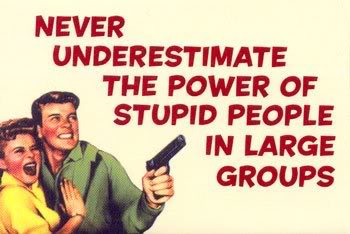
Therefore, Our democratic election process that "always" produces a winner who is "slightly better than average" actually means that We are really electing people more skewed towards bad leader than to good.
And you know that's spot-on right. Too stupid for democracy, indeed.

The Jenius Has Spoken.
[Update: 12 March 2012: Ah, Mississippi. The brain-dead canary in the insufferable coal mine We call "democracy." According to Public Policy Polling, 52% of voters in The Magnolia State believe Obama is a Muslim and 66% don't believe in evolution. Dixie has riz!]
20 June 2011
C-Sections Get An F
Mrs. Jenius is going to be a pediatrician...ostensibly to deal better with The Jenius.
Sigh.
So when it comes to health issues, especially those related to children, My mild attention to them is now enhanced. (As to why it was mild, it just was: I have many interests and millions of things I don't care about.) From this report comes another confirmation of a long-standing problem in Puerto Rico: 48% of Our births are by cesarean section, the highest rate in the world.
According to the The Unnecesarean blog (great name), the ideal number (percentage) of C-Sections is 15%, a reflection of the ratio of difficult deliveries, where the operation is needed, to normal ones, where vaginal delivery is possible. That Puerto Rico has over 3 times that percentage has been a problem for at least four decades, but especially so since the 1990s, when the "health deform" (yes, I wrote "deform"; you get the joke) basically turned treating patients into something akin to a sausage factory.
As noted in the original article--from local fish-wrapper Primera Hora--the two trends that moved C-sections into unconscionable frequency were the baseless notion that vaginal deliveries were unsafe after a C-section and the need to tend to "dozens" of births a month, forcing doctors to "cut the babies out" rather than wait for Nature to deliver. That second trend is also behind the common tendency of inducing labor, to speed it up, so that a majority of babies are born on Mondays, Tuesdays and Wednesdays, between 8 AM and 5 PM. Office hours for Nature's greatest gift.
Notice that neither "trend"--no vaginal deliveries and mass production--is reasonable: the first is based on bad science and thus bad health practices and the second is based on bad politics becoming bad economies of scale, thus leading to bad health practices. In other words, this is not an inherent problem My Island has--like lacking even one reasonably intelligent politician--but a created one, by lazy doctors, stupid politicians (redundant) and ill-informed patients.
Now a system that forces doctors to choose between having a life outside of the hospital or providing quality health care is idiotic; it's what We got and doctors have to choose in their best interests. No problem there. But the blame for the "no vaginal deliveries after C-sections" claptrap falls squarely on the medical community.
Their argument that "C-sections are safer"--usually linked with "insurance costs"--is self-interest of the worst kind: self-serving and deceitful. Mothers know that giving birth is not at all easy, but a C-section is the deliberate slicing open of a woman's body, through muscle and fascia, to remove a baby who--according to the statistics-- 2/3 of the time would have been born safely anyway. Yes, there's physical damage in a natural delivery, but ask women who have had both birth methods which one left them weaker and less capable of tending to themselves and their baby.
The human body is incredible, and what women go through to bring Life to the world is an astounding process, one men cannot duplicate. Even though Nature has pushed human childbirth to an extreme (again, ask a mother), the process is--pardon the pun--natural. Millions of women give birth every day; it doesn't diminish an iota from the wonder of it all. To think that cutting a body to get to another is a frequent "improvement" over Nature is hubris and idiocy of the highest order. That a so-called "health reform" makes a C-section a coin flip decision is moronic, like calling "heads" on whether a heart attack patient should be treated or left untreated.
Think about that...
Puerto Rico must also face its own blinders, the idea that "they" are the experts and "We" do what "they" say. Doctors and other professionals hate when their clients come in with incomplete information and act as if they have all of it. Neither party benefits from that. But the best professionals love it when their clients come in with some knowledge and the curiosity to learn more, by asking relevant questions and listening critically to the answers.
If your doctor hates to explain and won't listen to your concerns, change doctors. And as patients, We have to learn to take charge of Our responsibilities, to ask good questions, to confirm opinions with outside and secondary sources and to understand that if We don't do it, the system doesn't care and most professionals barely take the time to care. If We find a good one, then by all means, stick with him or her.
Motherhood is a beautiful part of Life. That too many of Our babies are coming into the world through needless slashing is criminal. Our health care system is failing Us in this very crucial aspect, and however difficult it may be to fight the system, Our future children--and their mothers--absolutely deserve that We strive for their greatest welfare, rather than settling to merely serve the system.
The Jenius Has Spoken.
[Update: 26 June 2011: From the Daily Mail, the idea that women choose C-sections for "image", a "too posh to push" option.]
[Update: 8 July 2011: According to local Health Department statistics, Our birth-related numbers suck when compared to U.S. of part of A. averages, which suck when compared to other industrialized nations. Some of Our lowlights:
--18% of Our births are from teenage moms; the average is closer to 8%.
--57% of the births are from single mothers; the average is closer to 24%.
--In 2007, 49% were C-section births; the average should be 15%, as noted above.
--19.4% are premature babies; other industrialized nations average less than 5%.
--12.5% are underweight babies; other industrialized nations average less than 3%.
--Our infant mortality rate is 9.1 per 1,000 births; the U.S. of part of A. averages 6.9; the top 10 industrialized nations average 1.8.
Affordable health care? Ha. We're more concerned with gossip..."up there" and "down here." We can't be bothered to vote right where it counts, and in any case, malformed and dead babies don't vote for "American Idol," "Nace una estrella" or any of the literal motherfuckers who keep trashing Our health system.]
Sigh.
So when it comes to health issues, especially those related to children, My mild attention to them is now enhanced. (As to why it was mild, it just was: I have many interests and millions of things I don't care about.) From this report comes another confirmation of a long-standing problem in Puerto Rico: 48% of Our births are by cesarean section, the highest rate in the world.
According to the The Unnecesarean blog (great name), the ideal number (percentage) of C-Sections is 15%, a reflection of the ratio of difficult deliveries, where the operation is needed, to normal ones, where vaginal delivery is possible. That Puerto Rico has over 3 times that percentage has been a problem for at least four decades, but especially so since the 1990s, when the "health deform" (yes, I wrote "deform"; you get the joke) basically turned treating patients into something akin to a sausage factory.
As noted in the original article--from local fish-wrapper Primera Hora--the two trends that moved C-sections into unconscionable frequency were the baseless notion that vaginal deliveries were unsafe after a C-section and the need to tend to "dozens" of births a month, forcing doctors to "cut the babies out" rather than wait for Nature to deliver. That second trend is also behind the common tendency of inducing labor, to speed it up, so that a majority of babies are born on Mondays, Tuesdays and Wednesdays, between 8 AM and 5 PM. Office hours for Nature's greatest gift.
Notice that neither "trend"--no vaginal deliveries and mass production--is reasonable: the first is based on bad science and thus bad health practices and the second is based on bad politics becoming bad economies of scale, thus leading to bad health practices. In other words, this is not an inherent problem My Island has--like lacking even one reasonably intelligent politician--but a created one, by lazy doctors, stupid politicians (redundant) and ill-informed patients.
Now a system that forces doctors to choose between having a life outside of the hospital or providing quality health care is idiotic; it's what We got and doctors have to choose in their best interests. No problem there. But the blame for the "no vaginal deliveries after C-sections" claptrap falls squarely on the medical community.
Their argument that "C-sections are safer"--usually linked with "insurance costs"--is self-interest of the worst kind: self-serving and deceitful. Mothers know that giving birth is not at all easy, but a C-section is the deliberate slicing open of a woman's body, through muscle and fascia, to remove a baby who--according to the statistics-- 2/3 of the time would have been born safely anyway. Yes, there's physical damage in a natural delivery, but ask women who have had both birth methods which one left them weaker and less capable of tending to themselves and their baby.
The human body is incredible, and what women go through to bring Life to the world is an astounding process, one men cannot duplicate. Even though Nature has pushed human childbirth to an extreme (again, ask a mother), the process is--pardon the pun--natural. Millions of women give birth every day; it doesn't diminish an iota from the wonder of it all. To think that cutting a body to get to another is a frequent "improvement" over Nature is hubris and idiocy of the highest order. That a so-called "health reform" makes a C-section a coin flip decision is moronic, like calling "heads" on whether a heart attack patient should be treated or left untreated.
Think about that...
Puerto Rico must also face its own blinders, the idea that "they" are the experts and "We" do what "they" say. Doctors and other professionals hate when their clients come in with incomplete information and act as if they have all of it. Neither party benefits from that. But the best professionals love it when their clients come in with some knowledge and the curiosity to learn more, by asking relevant questions and listening critically to the answers.
If your doctor hates to explain and won't listen to your concerns, change doctors. And as patients, We have to learn to take charge of Our responsibilities, to ask good questions, to confirm opinions with outside and secondary sources and to understand that if We don't do it, the system doesn't care and most professionals barely take the time to care. If We find a good one, then by all means, stick with him or her.
Motherhood is a beautiful part of Life. That too many of Our babies are coming into the world through needless slashing is criminal. Our health care system is failing Us in this very crucial aspect, and however difficult it may be to fight the system, Our future children--and their mothers--absolutely deserve that We strive for their greatest welfare, rather than settling to merely serve the system.
The Jenius Has Spoken.
[Update: 26 June 2011: From the Daily Mail, the idea that women choose C-sections for "image", a "too posh to push" option.]
[Update: 8 July 2011: According to local Health Department statistics, Our birth-related numbers suck when compared to U.S. of part of A. averages, which suck when compared to other industrialized nations. Some of Our lowlights:
--18% of Our births are from teenage moms; the average is closer to 8%.
--57% of the births are from single mothers; the average is closer to 24%.
--In 2007, 49% were C-section births; the average should be 15%, as noted above.
--19.4% are premature babies; other industrialized nations average less than 5%.
--12.5% are underweight babies; other industrialized nations average less than 3%.
--Our infant mortality rate is 9.1 per 1,000 births; the U.S. of part of A. averages 6.9; the top 10 industrialized nations average 1.8.
Affordable health care? Ha. We're more concerned with gossip..."up there" and "down here." We can't be bothered to vote right where it counts, and in any case, malformed and dead babies don't vote for "American Idol," "Nace una estrella" or any of the literal motherfuckers who keep trashing Our health system.]
29 October 2009
Monkey Business (Plan)
Have you heard the one about monkeys being used as lab animals for scientific experiments? Seems that a company called Bioculture Puerto Rico Inc. wants to set-up a research facility in Guayama (east of Ponce; look it up) that will breed monkeys and test drugs on them, including vaccines like that used for/against the swine flu. In the hullabaloo, PETA got involved and may have duped Oscar-winner Benicio Del Toro into signing a letter pledging to engage in civil disobedience to fight this facility, petitions abound and no one with any real government authority wants to go on record about this matter.
Hoo boy. Where to start?
Okay, Let's start here: I bet the only freaking link you clicked on was about Benicio Del Toro. If that's so: screw you.
Second of all, I usually think of PETA as rabid cretins, but I support them in this effort. No, monkeys don't have rights, but We don't have any right to haul their hairless asses from Mauritius to Puerto Rico for lab experiments. Especially since...
We've got thousands of monkeys running amok in Puerto Rico. Most of them work for the government (shut up: you knew that was coming), but years ago, macaques and rhesus monkeys escaped from a university facility and have been living large on the southwest side of the Island. Where I live.
Coincidence, I assure you.
The monkeys cause severe crop damage, more severe when you consider We have the agricultural production of the Gobi Desert's rock plains. They've been a problem for years and many people--Me included--have come out in favor of hunting them down and exterminating them as a non-native, harmful species.
And before you get on your high horse and abuse it, the monkeys are known to harbor hepatitis and herpes. We know that because that's what they were infected with when they escaped.
But one man's monkey on his back is another's mon(k)ey maker. (Took Me nine seconds to come up with that. Please hold your applause as I'm busy right now.) Look down at the very bottom of this article to find the following quote:
"The increasing lab demand for macaques meanwhile has encouraged Puerto Rican trappers to intensify efforts to capture feral rhesus macaques and red monkeys. The monkeys were introduced to Puerto Rico to be bred for research more than 80 years ago. The National Humane Review, formerly published by the American Humane Association, mentioned efforts to extirpate them in the 1930s.
Estimating the present monkey population to be about 1,000, the Puerto Rican government has invested $450,000 in the present capture campaign, according to Danica Coto of Associated Press."
By some estimates, the (real) monkey population is in the several thousands, not a mere thousand. Reports of monkey sightings have been made in Cataño, just west of San Juan and site of a recent refinery explosion. (Coincidence, I assure you.) That the government wants to throw money at the problem is (a) about time and (b) as useful as monkeys pissing on the CAPECO fire. The government can't handle its own monkeys, so it should just turn the handling of these monkeys to private industry.
Yes, that's right: Let's legalize capturing monkeys in Puerto Rico to sell to labs. I'll bullet My list:
A) We need to get rid of monkeys that don't belong here. I say We do that with Our politicians, too.
B) Capturing the monkeys generates revenue and produces tangible benefits to farmers, labs and monkeys in Africa, who get to stay home.
C) A monkey's life is less valuable than a human's. Disagree? Okay, who should We protect: the person who can get bitten and savaged by a monkey with herpes or hepatitis or the monkey? Don't say "both" because the monkey doesn't belong here.
D) Best-case scenario is the captured monkeys go back to Africa. Okay, PETA, put your money where your howling mouth is and pay for that. Uh-huh, I thought so.
E) My Plan: Round up 100-110 monkeys, throw them into a session of the legislature and lock all the doors. Last monkey standing wins.
The Jenius Has Spoken.
P.S. And on the subject of animals, dead or otherwise, here's this about tons of dead fish in one of Our lagoons. Coincidence, I assure you.
12 August 2009
Orphan Cure Research Center
No, this isn't about sick orphans. But it could be.
Dichloroacetate. Bacteriophages. Copper. Scorpion venom. A list such as this could go on and on, with each element being a potentially world-altering treatment against disease. And the other factor that binds these elements together is that none--none--is being studied by pharmaceuticals because they cannot be patented.
I understand pharmaceutical companies are businesses and they need to make a profit. Let them. But to leave potential cures as orphans because the investment cannot be fenced for profitability is a chasm that business and industry may not bridge...but can be bridged, nonetheless.
I wrote several times about dichloroacetate, also known as DCA. I suggested We undertake the clinical trials of DCA's effects, of "switching on" cancer cells to make them extremely vulnerable to radiation and chemotherapy, here in Puerto Rico as a national project and make it a gift to the world. I now say We should do so for "orphan cures" of all types, cures that pharmaceutical companies will not touch because the ROI is too low for their stockholders.
Bacteriophages are microorganisms that eat bacteria. The eaters eat only specific bacteria, so if you need to eliminate Bacteria A, you get an A-Eating Bacteriophage and once the Bacteria A is gone, the A-Eater dies. Has done so for millions of years. And the bacteria have no defense...unlike antibiotics.
Phage therapy, as its called, is a big deal in Eastern Europe and the former Soviet Union. Has been for decades because antibiotic research was out of reach. To this day, you can take a sample of your infection to a local drug store, get it analyzed and you'll receive a phage blend specifically blended for you. Cost: about $3.00.
Although phage therapy is gaining adepts in the U.S. of part of A., most of the research is academic, i.e., not aimed at medical treatment of diseases in humans. The cost of shepherding a drug--or just one bacteriophage--through the near-endless hoops of the FDA easily exceeds a few hundred million dollars. Imagine trying to do that with thousands of bacteriophages.
Phage therapy works, but it won't become a powerful new weapon in medical centers unless it gets researched and proven. As antibiotics lose potency, phage therapy is the clear low-cost alternative. But low-cost also means low or no profit.
Copper reduces the potency of bacterias and viruses. Yes, viruses, particularly H1N1, known as "politician's flu." (Swine, hogs, pigs, politicians, same species.) Copper's myriad effects could revolutionize sanitation in hospitals and clinics, not to mention daily life. But it remains outside the realm of patents, so Big Pharma won't care.
Scorpion venom, a powerful neurotoxin, has been found to be very effective at reducing brain cancer tumors. But you can't patent scorpion venom unless you isolate the specific chemical and make that your wonder drug. (Digitalis, anyone?) But since anyone can get scorpion venom, Big Pharma won't dare.
There are other examples and more will emerge as researchers comb the Earth and its details with new eyes. But where can this research be supported, with government money so that the profit motive is sidestepped in favor of broader results?
I say Puerto Rico should be that Orphan Cure Research Center. As I wrote before: One doesn't become an adult until one achieves what is considered "adult" things. Lacking a war, nations must rise to their levels of adulthood by taking on unique challenges. Puerto Rico's imposed transformation from economic rut to world-class prosperity ended some 25 years ago. We can now stand on Our own...if We only believed enough in Ourselves. And that belief cannot--will not--be built by winning beauty crowns, boxing belts, statuettes or rings. It will be built by creating something larger than an individual or a sports team, something larger than one institution, agency or company, something so large that other nations turn to Us and recognize that not only are We putting forth an admirable effort, We are capable of achieving such a worthy goal.
LIke I said before, it will take money. But one of the irrefutable axioms of economics (one of the very few) is that goverment investment in research has invariably high ROIs, in the range of 50% to 150%. So altruism can also lead to pure profit in terms of economic growth. And the impact of Puerto Rico taking center stage in such an effort is inspiring, an affirmation, a step forward for a nation that too often has waited for the world to act in its favor.
It won't be easy; nothing truly worth doing ever is. We have to do something, We have to be something more than what We are now and unless We strive, We will shrivel, more and faster than We have up to now. And if not this, then something else, but it has to be a goal that stretches Us to reach Our potential and not a goal that has Us throwing away what's left in the mindlews pursuit of the unearned.
The Jenius Has Spoken.
Update: 17 August--We can add bug repellants, too...
22 December 2008
Rhoads to Hell
From Mercola.com: (1931:) Cornelius Rhoads, a pathologist from the Rockefeller Institute for Medical Research, purposely infects human test subjects in Puerto Rico with cancer cells; 13 of them die. Though Rhoads gives a written testimony stating he believes that all Puerto Ricans should be killed, he later goes on to establish the U.S. Army Biological Warfare facilities in Maryland, Utah and Panama, and is named to the U.S. Atomic Energy Commission, where he begins a series of radiation exposure experiments on American soldiers and civilian hospital patients.
From Wikipedia: When asked about the reasons for the study on Puerto Ricans, Rhoades replied: “The Porto Ricans (sic) are the dirtiest, laziest, most degenerate and thievish race of men ever to inhabit this sphere... I have done my best to further the process of extermination by killing off eight and transplanting cancer into several more... All physicians take delight in the abuse and torture of the unfortunate subjects."
From the same Wikipedia article: Later, Rhoads was given a seat on the United States Atomic Energy Commission. It is reported he performed radiation experiments on human beings there. He was also awarded the U.S. Legion of Merit by the government for his research.
Many people still criticize the lack of action taken against Rhoads for his experiments.
In 2003, controversy arose again as to the letter and the alleged experiments and the AACR Cornelius P. Rhoads Memorial Award would no longer be associated with his name. The award was not presented that year.
From "America Betrayed," by Rhawn Joseph, downloadable as a PDF file: With regard to the people of Puerto Rico, Dr. Rhoads wrote: “What the island needs is not public health work, but a tidal wave or something to totally exterminate the population.” Dr. Rhoads is alleged to have injected hundreds of Puerto Ricans with cancer. Cornelius Rhoads later became a founder and first director of the Memorial Sloan- Kettering Institute, which specializes in research on cancer.
The American Association of Cancer Research gave out the Cornelius P. Rhoads award for new researchers between 1979 and 2002, renaming and relaunching the award in 2004.
Woo-hoo.
Here's a headline for you: Admitted Mass Murderer Rewarded, Lionized.
The past is dead and buried, right? Remember: He killed Puerto Ricans and almost certainly other "American soldiers and civilians."
Or is it that the past is prologue? Admitted murderers getting away with it, under "sanction" of broken laws and war, whether they be some Rhoads or a Bush.
Hell if I know.
The Jenius Has Spoken.
P.S. From the same Mercola.com article quoted above: (1963:) Chester M. Southam, who injected Ohio State Prison inmates with live cancer cells in 1952, performs the same procedure on 22 senile, African-American female patients at the Brooklyn Jewish Chronic Disease Hospital in order to watch their immunological response. Southam tells the patients that they are receiving "some cells," but leaves out the fact that they are cancer cells. He claims he doesn't obtain informed consent from the patients because he does not want to frighten them by telling them what he is doing, but he nevertheless temporarily loses his medical license because of it. Ironically, he eventually becomes president of the American Cancer Society.
Seems the formula for success in the cancer-doctor groups is (was?) to kill unsuspecting people and then wait for the accolades and prestige to follow...
10 December 2008
10-Item Lists...Really?
Around here, it's been all Me lately, and for this significant post, I'll return to a Jenius staple: quoting. Here are two pieces worth reading.
The first by Jen Angel, of YES! Magazine is 10 Things Science Says Will Make You Happy:
In the last few years, psychologists and researchers have been digging up hard data on a question previously left to philosophers: What makes us happy? Researchers like the father-son team Ed Diener and Robert Biswas-Diener, Stanford psychologist Sonja Lyubomirsky, and ethicist Stephen Post have studied people all over the world to find out how things like money, attitude, culture, memory, health, altruism, and our day-to-day habits affect our well-being. The emerging field of positive psychology is bursting with new findings that suggest your actions can have a significant effect on your happiness and satisfaction with life. Here are 10 scientifically proven strategies for getting happy.
1. Savor Everyday Moments
2. Avoid Comparisons
3. Put Money Low on the List
4. Have Meaningful Goals
5. Take Initiative at Work
6. Make Friends, Treasure Family
7. Smile Even When You Don’t Feel Like It
8. Say Thank You Like You Mean It
9. Get Out and Exercise
10. Give It Away, Give It Away Now!
Seems to Me science is nailing down the wisdom of the ages just about... now.
And since Top 10 lists clutter up the end of the year, here's another 10-item list: 10 Things We Can't Have Without the Other:
1) Money without Labor – We do not value what we do not earn.
2) Loyalty without Trust – Loyalty will vanish in the absence of trust.
3) Appreciation without Education – We cannot fully appreciate what we do not fully understand.
4) Wisdom without Experience – True wisdom is the product of many life experiences.
5) Power without Checks and Balances – Unfettered power leads to greed and corruption.
6) Business without Sincerity – Crooked businessmen are prison bound… if they’re lucky.
7) Success without Sacrifice – Success doesn’t find us, we find it.
8) Policy without Justification – Without justification, policy is just another form of tyranny.
9) Happiness without Peace of Mind – A mind at ease is already pleased.
10) Beginnings without Endings – A great, new beginning rises from another beginning’s end.
There's more to the science-happiness article and you can make comments on the "without" post at the site. Have fun. Think about what you've read. And I've given My pen (keyboard) a bit of a rest. Not that it needed one, come to think about it...
The Jenius Has Quoted.
08 September 2008
Update on "Turbine Farm" Ideas
I wrote about a couple of ideas some time ago, added new angles and have now found new material to provide another update.
Caution: Jenius At Work.
From one of the harshest, most oppressive urban environments in the world comes an idea so magnificent in its simplicity and excecution it makes "elegant" seem like faint praise:
Kibera is a tiny slum shantytown on the outskirts of Nairobi, Kenya. Over a million people live here, jammed together amidst piles of garbage and openly running sewage. However, by clearing garbage to uncover the soil, using the worms found there to create compost and creating a simple pipe-based irrigation system, Kibera residents have developed "patch farms" capable of sustaining up to 30 people in only three months.
The process is easily-replicated and has even been adapted for "barrel farming" (tiny vegetable gardens in large containers) and low-cost variations of vertical farming. A kicker: It's organic farming, a health boon in a toehold of Hell.
As for wind power, urban locations aren't exactly compatible with large slashing blades, and though vertical windmills do the trick, they lack in that all-important "esthetics" category. Say hello to The Energy Ball, a stylish, highly-efficient windmill best described as "an eggbeater to power the future." The shape and design allow it to operate in low and cross-current winds typical of urban settings while creating a pleasing visual effect (if you can imagine dozens of these "swimming" atop a city setting.)
Given that We in Puerto Rico produce an enormous amount of garbage that, given Our limited land area, ends up reducing usable land, the idea of Kibera-type farming makes tons of sense. And flat-topped concrete houses in what can be best-described as a "trade winds corridor" Island make perfect platforms for Energy Balls. Imagine changing a garbage-strewn, energy-deficient Island into an urban farming energy-producing Island in five years. It can be done.
Like I said: Jenius At Work.
The Jenius Has Spoken.
30 July 2008
Growing Up
Four million people, give or take a hundred thousand, living on roughly 3,600 square miles. At 2 pounds of food per person per day, that's 8 million pounds of food to feed the population. (Non-humans also eat, but let's keep this simple, okay?) How much of that 8 million pounds is produced locally?
About 3%.
Agriculture in Puerto Rico is a thing of the past, as in basically dead and buried. For almost six decades, the Island's faux leadership has focused on machines and buildings, ignoring the reality of a small island with a burgeoming population, or trusting in the kindness of a friendly stranger We've known for over a hundred years.
Cut to the chase: Very little agriculture at present, not enough arable land to bring the produced food percentage to a sustainable 35-55% of total local consumption and economic restrictions up the wazoo. Solution: Vertical farming.
The primary advocate for vertical farming is Dickson Despommier, a professor at Columbia University. His idea is simple to explain: Use urban areas to erect "farmscrapers," high towers to raise crops, fish, livestock and even algae as close to population centers as possible.
The benefits are obvious: Year-round food production, efficient use of land, reduction of transportation costs, reduced use of pesticides and in Our case, decreased dependency on imports. As food production declines in the face of a world population increase, vertical farming is an idea whose time is now.
And for Puerto Rico, the urgency is even stronger. Farmscrapers in the deserts of Las Vegas and Dubai are good ideas, but they smack of something akin to opening a whorehouse in The Vatican. With Our tropical climate, abundant rainfall and ocean access, Our farmscrapers could quickly have Us becoming food exporters to the Caribbean, a position We lost so very long ago.
You might not care to calculate what 3% of 8,000,000 pounds is, so let Me simplify what that really means: Imagine eating 48 ounces of food a day all your life... then having to live on only one and a half ounces a day.
Time to think vertically.
The Jenius Has Spoken.
29 October 2007
Security Solutions - Part 2
Following Part 1, comes Part 2 (You're welcome, statehooders.)
Privatize both utilities: In terms of electricity and water, Puerto Rico has long teetered on the brink of disaster. Our water pipes are 50 years behind the current demand, the current Sewage-headed Authority in charge of it plays monkey-butt with "estimated" water bills and the government keeps allowing this decrepit slug to give away water, both legally (subsidies) and illegally. (The other decrepit slug gives away electricity. Huzzah!)
So it's time to privatize the right way. And the right way doesn't mean "Protect the vegetables in their cushy jobs," it means "Transform the system from chaos to order."
Here's how:
1) Place both utilities "on the market" so that private companies can present their plans and bids.
2) The government establishes the objectives and expected results for the duration of the initial 5-year contract. These objectives DO NOT include "job protection," "minimum employee retention" or any some-such crap. A smart business is run with the people needed: Let the winning bidder establish its operational team.
3) The winning bidder takes over the utility and is on the clock. The company starts its transformation plan and the government clears the way. The "stick" to keep the utility in line is the loss of the contract if objectives aren't met. The "stick" only works if the government clears the way properly. (To the Fools: You can control the utility better by targeting long-term profit potential than you can by shoving useless employees down their throats. Ask Verizon.)
4) The government has oversight powers on rate changes, in its role as protector of the citizenry. (Excuse Me: I just cackled a tear here.) Rate changes must be tied into completed infrastructure changes.
5) If the company falls short of objectives, it incurs a fine equal to the transition cost for another company to take over. If objectives are met, the company receives another 5-year contract, or a longer one that voters decide on. That's right, I said voters, the people who pay the bills. The Fools will quickly try to arrange for a long-term butt-buddy deal; there's no stopping that. With this system, the company must do its job right. If they want to stick around for more than 5 years, it's not the Fools who decide.
Sub-clause solution: Establish two new energy plants: This can be a stand-alone measure, but as part of a utility revamp, it's absolutely necessary. Let's cut to the chase: These plants need to be established, by fiat, use of eminent domain or simple fait accompli machinations. What I'm saying here is that the government needs to make this happen without regard to the knee-jerk "not in My backyard" reactions it will engender.
With over 1,000 persons on average per square mile and more along the coastal regions, there is no way a new energy plant can be placed on this island if We let tiny groups sway decisions against it. This tyranny-by-minorities is arguably acceptable when it comes to a tourist resort, but it no longer has a place when the economic and security potential of Puerto Rico is so compromised by an overburdened, outdated and collapsing infrastructure.
The Jenius Has Spoken.
Privatize both utilities: In terms of electricity and water, Puerto Rico has long teetered on the brink of disaster. Our water pipes are 50 years behind the current demand, the current Sewage-headed Authority in charge of it plays monkey-butt with "estimated" water bills and the government keeps allowing this decrepit slug to give away water, both legally (subsidies) and illegally. (The other decrepit slug gives away electricity. Huzzah!)
So it's time to privatize the right way. And the right way doesn't mean "Protect the vegetables in their cushy jobs," it means "Transform the system from chaos to order."
Here's how:
1) Place both utilities "on the market" so that private companies can present their plans and bids.
2) The government establishes the objectives and expected results for the duration of the initial 5-year contract. These objectives DO NOT include "job protection," "minimum employee retention" or any some-such crap. A smart business is run with the people needed: Let the winning bidder establish its operational team.
3) The winning bidder takes over the utility and is on the clock. The company starts its transformation plan and the government clears the way. The "stick" to keep the utility in line is the loss of the contract if objectives aren't met. The "stick" only works if the government clears the way properly. (To the Fools: You can control the utility better by targeting long-term profit potential than you can by shoving useless employees down their throats. Ask Verizon.)
4) The government has oversight powers on rate changes, in its role as protector of the citizenry. (Excuse Me: I just cackled a tear here.) Rate changes must be tied into completed infrastructure changes.
5) If the company falls short of objectives, it incurs a fine equal to the transition cost for another company to take over. If objectives are met, the company receives another 5-year contract, or a longer one that voters decide on. That's right, I said voters, the people who pay the bills. The Fools will quickly try to arrange for a long-term butt-buddy deal; there's no stopping that. With this system, the company must do its job right. If they want to stick around for more than 5 years, it's not the Fools who decide.
Sub-clause solution: Establish two new energy plants: This can be a stand-alone measure, but as part of a utility revamp, it's absolutely necessary. Let's cut to the chase: These plants need to be established, by fiat, use of eminent domain or simple fait accompli machinations. What I'm saying here is that the government needs to make this happen without regard to the knee-jerk "not in My backyard" reactions it will engender.
With over 1,000 persons on average per square mile and more along the coastal regions, there is no way a new energy plant can be placed on this island if We let tiny groups sway decisions against it. This tyranny-by-minorities is arguably acceptable when it comes to a tourist resort, but it no longer has a place when the economic and security potential of Puerto Rico is so compromised by an overburdened, outdated and collapsing infrastructure.
The Jenius Has Spoken.
05 October 2007
Think Your Own Way
I confess that I can't pinpoint where I found this, but it's well worth reading. This anecdote dates from a long time ago, but its message is even more relevant now: Think your own way.
Some time ago I received a call from a colleague. He was about to give a student a zero for his answer to a physics question, while the student claimed a perfect score. The instructor and the student agreed to an impartial arbiter, and I was selected.
I read the examination question: "SHOW HOW IT IS POSSIBLE TO DETERMINE THE HEIGHT OF A TALL BUILDING WITH THE AID OF A BAROMETER." The student had answered, "Take the barometer to the top of the building, attach a long rope to it, lower it to the street, and then bring it up, measuring the length of the rope. The length of the rope is the height of the building."
The student really had a strong case for full credit since he had really answered the question completely and correctly! On the other hand, if full credit were given, it could well contribute to a high grade in his physics course and to certify competence in physics, but the answer did not confirm this. I suggested that the student have another try.
I gave the student six minutes to answer the question with the warning that the answer should show some knowledge of physics. At the end of five minutes, he had not written anything. I asked if he wished to give up, but he said he had many answers to this problem; he was just thinking of the best one. I excused myself for interrupting him and asked him to please go on.
In the next minute, he dashed off his answer which read: "Take the barometer to the top of the building and lean over the edge of the roof. Drop the barometer, timing its fall with a stopwatch.Then, using the formula x=0.5*a*t^^2, calculate the height of the building."
At this point, I asked my colleague if he would give up. He conceded and gave the student almost full credit. While leaving my colleague's office, I recalled that the student had said that he had other answers to the problem, so I asked him what they were.
"Well," said the student, "there are many ways of getting the height of a tall building with the aid of a barometer. For example, you could take the barometer out on a sunny day and measure the height of the barometer, the length of its shadow, and the length of the shadow of the building, and by the use of simple proportion, determine the height of the building."
"Fine," I said, "and others?"
"Yes," said the student, "there is a very basic measurement method you will like. In this method, you take the barometer and begin to walk up the stairs. As you climb the stairs, you mark off the length of the barometer along the wall. You then count the number of marks, and this will give you the height of the building in barometer units."
"A very direct method."
"Of course. If you want a more sophisticated method, you can tie the barometer to the end of a string, swing it as a pendulum, and determine the value of g at the street level and at the top of the building. From the difference between the two values of g, the height of the building, in principle, can be calculated. On this same tack, you could take the barometer to the top of the building, attach a long rope to it, lower it to just above the street, and then swing it as a pendulum. You could then calculate the height of the building by the period of the precession."
"Finally," he concluded, "there are many other ways of solving the problem. Probably the best is to take the barometer to the basement and knock on the superintendent's door. When the superintendent answers, you speak to him as follows: 'Mr. Superintendent, here is a fine barometer. If you will tell me the height of the building, I will give you this barometer."
At this point, I asked the student if he really did not know the conventional answer to this question. He admitted that he did, but said that he was fed up with high school and college instructors trying to teach him how to think.
The student was Neils Bohr.
Look him up if the name means nothing to you. His birthday is October 7th, so think of this as My way of celebrating your own way of thinking.
(The "correct" method is to measure barometric pressure at street level and rooftop level and convert the difference into height based on their relative pressures. Three other methods I could suggest: (1) Measure the barometer, then measure the apparent height of the barometer from a known distance. Measure the apparent height of the building from the same distance. Simple math will give the approximate height of the building. (2) Throw or fire the barometer, tied with string, to the rooftop. Measure the string. Variation: Tie the barometer to a helium balloon that floats to the rooftop. (3) Find the final building plans; use the barometer to make sure the plans don't roll up as you write down the answer.)
The Jenius Has Spoken.
Some time ago I received a call from a colleague. He was about to give a student a zero for his answer to a physics question, while the student claimed a perfect score. The instructor and the student agreed to an impartial arbiter, and I was selected.
I read the examination question: "SHOW HOW IT IS POSSIBLE TO DETERMINE THE HEIGHT OF A TALL BUILDING WITH THE AID OF A BAROMETER." The student had answered, "Take the barometer to the top of the building, attach a long rope to it, lower it to the street, and then bring it up, measuring the length of the rope. The length of the rope is the height of the building."
The student really had a strong case for full credit since he had really answered the question completely and correctly! On the other hand, if full credit were given, it could well contribute to a high grade in his physics course and to certify competence in physics, but the answer did not confirm this. I suggested that the student have another try.
I gave the student six minutes to answer the question with the warning that the answer should show some knowledge of physics. At the end of five minutes, he had not written anything. I asked if he wished to give up, but he said he had many answers to this problem; he was just thinking of the best one. I excused myself for interrupting him and asked him to please go on.
In the next minute, he dashed off his answer which read: "Take the barometer to the top of the building and lean over the edge of the roof. Drop the barometer, timing its fall with a stopwatch.Then, using the formula x=0.5*a*t^^2, calculate the height of the building."
At this point, I asked my colleague if he would give up. He conceded and gave the student almost full credit. While leaving my colleague's office, I recalled that the student had said that he had other answers to the problem, so I asked him what they were.
"Well," said the student, "there are many ways of getting the height of a tall building with the aid of a barometer. For example, you could take the barometer out on a sunny day and measure the height of the barometer, the length of its shadow, and the length of the shadow of the building, and by the use of simple proportion, determine the height of the building."
"Fine," I said, "and others?"
"Yes," said the student, "there is a very basic measurement method you will like. In this method, you take the barometer and begin to walk up the stairs. As you climb the stairs, you mark off the length of the barometer along the wall. You then count the number of marks, and this will give you the height of the building in barometer units."
"A very direct method."
"Of course. If you want a more sophisticated method, you can tie the barometer to the end of a string, swing it as a pendulum, and determine the value of g at the street level and at the top of the building. From the difference between the two values of g, the height of the building, in principle, can be calculated. On this same tack, you could take the barometer to the top of the building, attach a long rope to it, lower it to just above the street, and then swing it as a pendulum. You could then calculate the height of the building by the period of the precession."
"Finally," he concluded, "there are many other ways of solving the problem. Probably the best is to take the barometer to the basement and knock on the superintendent's door. When the superintendent answers, you speak to him as follows: 'Mr. Superintendent, here is a fine barometer. If you will tell me the height of the building, I will give you this barometer."
At this point, I asked the student if he really did not know the conventional answer to this question. He admitted that he did, but said that he was fed up with high school and college instructors trying to teach him how to think.
The student was Neils Bohr.
Look him up if the name means nothing to you. His birthday is October 7th, so think of this as My way of celebrating your own way of thinking.
(The "correct" method is to measure barometric pressure at street level and rooftop level and convert the difference into height based on their relative pressures. Three other methods I could suggest: (1) Measure the barometer, then measure the apparent height of the barometer from a known distance. Measure the apparent height of the building from the same distance. Simple math will give the approximate height of the building. (2) Throw or fire the barometer, tied with string, to the rooftop. Measure the string. Variation: Tie the barometer to a helium balloon that floats to the rooftop. (3) Find the final building plans; use the barometer to make sure the plans don't roll up as you write down the answer.)
The Jenius Has Spoken.
28 September 2007
DCA On The Way
Thanks to My Special Friend, María, good news landed in My inbox: The clinical trials for dichloracetate (DCA) are beginning in Canada.
I wrote about this back in January, 2007, about how researchers at the University of Alberta discovered that DCA was extremely effective at "de-zombifying" the mitochondria of cancer cells, in effect, making them very vulnerable to radio- and chemotherapy. Basically, DCA makes cancer cells "live" so that treatment can kill them much more easily.
The repercussions are staggering on three levels:
1) Enhanced treatment of a wide range of cancers, including those cases where tumors are too close to delicate tissues for surgery.
2) Substantial decreases in medical costs and side-effects for patients.
3) DCA is so inexpensive it can be produced for as little as $2.00 a dose; it is a generic chemical that is very easy to manufacture to medical quality.
And as explained before, therein lies the rub: No pharmaceutical company would touch DCA because there's no true profit margin in developing it. I postulated that Puerto Rico could offer to put up the $600-$700 million needed to run the clinical trials, making of it Our version of the U.S.'s Lunar Landing project. A gift to the world, I called it.
A gift We never even bothered to consider giving.
My voice was too small, too insignificant to make this gift a reality. But think of this: The Canadian researchers are moving ahead although their entire budget so far is a little over $800,000. In other words, they are proceeding despite having barely 0.1% of the needed funding.
One-tenth of one percent.
Many people say scientists lack faith, but what other concept applies to this kind of effort? In their journey of a thousand miles, they have decidedly taken a first step. And there is no doubt--there can be no doubt--that they are doing so because they absolutely believe the DCA clinical trials are the right thing to do.
Conviction. Faith. Belief. Determination. Courage. Inspiration.
How I wish those words were about Us, rather than Canada. Maybe they still can be. I sure hope they can be.
The Jenius Has Spoken.
Postscript: I encountered this story on how private citizens in the Alberta area are giving money to help the funding of these clinical trials. Nothing We couldn't do if We chose to.
I wrote about this back in January, 2007, about how researchers at the University of Alberta discovered that DCA was extremely effective at "de-zombifying" the mitochondria of cancer cells, in effect, making them very vulnerable to radio- and chemotherapy. Basically, DCA makes cancer cells "live" so that treatment can kill them much more easily.
The repercussions are staggering on three levels:
1) Enhanced treatment of a wide range of cancers, including those cases where tumors are too close to delicate tissues for surgery.
2) Substantial decreases in medical costs and side-effects for patients.
3) DCA is so inexpensive it can be produced for as little as $2.00 a dose; it is a generic chemical that is very easy to manufacture to medical quality.
And as explained before, therein lies the rub: No pharmaceutical company would touch DCA because there's no true profit margin in developing it. I postulated that Puerto Rico could offer to put up the $600-$700 million needed to run the clinical trials, making of it Our version of the U.S.'s Lunar Landing project. A gift to the world, I called it.
A gift We never even bothered to consider giving.
My voice was too small, too insignificant to make this gift a reality. But think of this: The Canadian researchers are moving ahead although their entire budget so far is a little over $800,000. In other words, they are proceeding despite having barely 0.1% of the needed funding.
One-tenth of one percent.
Many people say scientists lack faith, but what other concept applies to this kind of effort? In their journey of a thousand miles, they have decidedly taken a first step. And there is no doubt--there can be no doubt--that they are doing so because they absolutely believe the DCA clinical trials are the right thing to do.
Conviction. Faith. Belief. Determination. Courage. Inspiration.
How I wish those words were about Us, rather than Canada. Maybe they still can be. I sure hope they can be.
The Jenius Has Spoken.
Postscript: I encountered this story on how private citizens in the Alberta area are giving money to help the funding of these clinical trials. Nothing We couldn't do if We chose to.
30 July 2007
Learning Life
Just recently, My special friend María did something very few students ever do: She paid to learn.
Instead of having mommy and daddy, or Uncle Sam, pay for the dubious privilege of sitting in a classroom filled with buffoons (and students), María took money from her savings and paid for a 5-week stay in the mountains and rain forests of Ecuador, performing health-related clinical and research duties.
This was not a vacation in some Third World resort: This was staying in a sponsor's home, with cross-country travel amidst heavy mudslides, slogging through a rainy jungle to reach distant villages and spending time in the most powerful educational activity there is: doing.
The program is sponsored by Child Family Health International, who's been recruiting pre-med and medical students to support eastern Ecuadorian communities since 1998. CFHI does the same in other countries spanning three continents, focusing on hands-on, direct contact with the people in order to seek major improvement in their health.
When María told Me what she was going to do, I was all for it. But I asked her how many people thought she was nuts for doing it and her reply was the expected "Almost all of them." You're going to Ecuador? To do work on your vacation? And you're going to pay for it? Most of these same people are either stuck in a rut or looking for the limo lane to Easy Street...and thus they are closer to death than the village dwellers of Puya and Mumbai.
María understands that becoming a doctor is much more than theory: It takes the practice of human interaction to truly have a chance at becoming a great doctor. To achieve greatness in any field means taking risks, whether that risk is as physical as fighting hypothermia in a rain-swept jungle or as emotional as seeing "how the other half lives"--and living with them. When both can be done to further your growth and goals, added to the deep satisfaction of helping others, you are going to the ultimate limit of learning: You are living.
What María acquired during her experiences in Ecuador will serve her for life. For the many who complain that what they learn in the classroom they'll never use again, think about this: María's investment will serve her every day of her life. Would you rather have someone pay for you to waste your time--now and in the future--or would you rather pay to learn something of lifelong value?
Your answer will eventually define you, your life and your level of success. María is already on her way.
The Jenius Has Spoken.
Instead of having mommy and daddy, or Uncle Sam, pay for the dubious privilege of sitting in a classroom filled with buffoons (and students), María took money from her savings and paid for a 5-week stay in the mountains and rain forests of Ecuador, performing health-related clinical and research duties.
This was not a vacation in some Third World resort: This was staying in a sponsor's home, with cross-country travel amidst heavy mudslides, slogging through a rainy jungle to reach distant villages and spending time in the most powerful educational activity there is: doing.
The program is sponsored by Child Family Health International, who's been recruiting pre-med and medical students to support eastern Ecuadorian communities since 1998. CFHI does the same in other countries spanning three continents, focusing on hands-on, direct contact with the people in order to seek major improvement in their health.
When María told Me what she was going to do, I was all for it. But I asked her how many people thought she was nuts for doing it and her reply was the expected "Almost all of them." You're going to Ecuador? To do work on your vacation? And you're going to pay for it? Most of these same people are either stuck in a rut or looking for the limo lane to Easy Street...and thus they are closer to death than the village dwellers of Puya and Mumbai.
María understands that becoming a doctor is much more than theory: It takes the practice of human interaction to truly have a chance at becoming a great doctor. To achieve greatness in any field means taking risks, whether that risk is as physical as fighting hypothermia in a rain-swept jungle or as emotional as seeing "how the other half lives"--and living with them. When both can be done to further your growth and goals, added to the deep satisfaction of helping others, you are going to the ultimate limit of learning: You are living.
What María acquired during her experiences in Ecuador will serve her for life. For the many who complain that what they learn in the classroom they'll never use again, think about this: María's investment will serve her every day of her life. Would you rather have someone pay for you to waste your time--now and in the future--or would you rather pay to learn something of lifelong value?
Your answer will eventually define you, your life and your level of success. María is already on her way.
The Jenius Has Spoken.
21 February 2007
Pledge to the World - Part IV
Several years earlier, the surgical-oncology department at U.C.L.A. had devised an experimental treatment for osteosarcoma, a cancerous growth, around the end of the femur, just above the knee. (It involved) a new chemotherapy drug called Adriamycin. Oncologists had nicknamed Adriamycin “the red death,” because of its cranberry color and its toxicity. Not only did it cause severe nausea, vomiting, mouth blisters, and reduced blood counts; repeated doses could injure cardiac muscle and lead to heart failure.
Imagine treating a patient--imagine having your loved one treated--by a drug called "the red death." A drug that kills you only slightly slower than it kills the cancer cells that will kill you, too. And all this comes about because cancer cells have a zombie-like immunity that dichloroacetate (DCA) can strip away. Once that happens, drugs far less lethal than "the red death" can wipe out cancer cells with fewer damage to the patient whose life is being saved.
The quote above is from a New Yorker article, by Jerome Groopman, about the way doctors make decisions. Time and again doctors must make quick judgments that can have a seriously beneficial or serously damaging effect on a patient's health. But when it comes to cancer, many of the decisions are made murkier by the simple fact that treating the disease is only slightly better--in terms of adverse health impact--than letting the problem continue unchecked.
The path of science has been the reduction of uncertainty, the clearing away of doubts and speculation in favor of certainty. Maybe not full certainty, but at least the reduction of ignorance and risk. When something as simple as DCA proves science is on the right path, anything that can be done to make its potential erupt is worth doing. Anybody who can step up to make the process reach fruition is doing the right thing. And for a nation to do so is not only the right thing to do, it is the only thing to do.
And there's no reason why that nation can't be Ours. It's Puerto Rico's choice to step up on a global stage and make its mark on--and for--the world.
The Jenius Has Spoken.
Imagine treating a patient--imagine having your loved one treated--by a drug called "the red death." A drug that kills you only slightly slower than it kills the cancer cells that will kill you, too. And all this comes about because cancer cells have a zombie-like immunity that dichloroacetate (DCA) can strip away. Once that happens, drugs far less lethal than "the red death" can wipe out cancer cells with fewer damage to the patient whose life is being saved.
The quote above is from a New Yorker article, by Jerome Groopman, about the way doctors make decisions. Time and again doctors must make quick judgments that can have a seriously beneficial or serously damaging effect on a patient's health. But when it comes to cancer, many of the decisions are made murkier by the simple fact that treating the disease is only slightly better--in terms of adverse health impact--than letting the problem continue unchecked.
The path of science has been the reduction of uncertainty, the clearing away of doubts and speculation in favor of certainty. Maybe not full certainty, but at least the reduction of ignorance and risk. When something as simple as DCA proves science is on the right path, anything that can be done to make its potential erupt is worth doing. Anybody who can step up to make the process reach fruition is doing the right thing. And for a nation to do so is not only the right thing to do, it is the only thing to do.
And there's no reason why that nation can't be Ours. It's Puerto Rico's choice to step up on a global stage and make its mark on--and for--the world.
The Jenius Has Spoken.
07 February 2007
Pledge to the World - Part III
Part One: What We can do to help dichloroacetate (DCA) become a common anti-cancer treatment.
Part Two: A general direction for making the Pledge happen.
Part Three: Why?
I've partially answered this question already, but the fact remains that emotional appeals--no matter how grounded in rationality--will not work. For a nation (and I have no doubt We are a nation) to pledge the budgetary equivalent of one existing and necessary social program to back an experiment is asking a lot.
Or is it? Puerto Rico's internal budget hovers around $9.7 billion a year. It seems simple to take the ".7" out of the budget and We have the money for The DCA Pledge. But that $700 million represents about 7% of Our internal revenue, which according to almost every Fool, economist, analyst and statistical report, has long been badly over-strained. We need certainty, not risk, for any process as badly overmanaged and politically-laden as the FDA's is a risk, especially for outsiders trying to buck the fetid tide. So why would We take money We obviously need and place it in the hands of a risky process such as that of FDA treatment certification?
Because doing so will turn Puerto Rico around.
Guaranteed.
We are a nation without a goal, without enough unity to decide on goals and without a vision to help foster unity. We wave Our flags and sing Our anthem with the fervor of hubris when one of Our beauties comes in first or one of Our actors gets an award or one of Our athletes makes a name for himself or herself on a playing field. But aside from those moments of duly-earned pride, that's all We have: moments. We don't have--We refuse to have--an enduring process by which We define Ourselves. If We are defined at all it is by Our indifference to focus on anything other than Our smallness, Our physical smallness, using it as excuse, lament and--for those brief moments--as an "In your face" motivator .
We are so much more. We can be so much more. But We don't believe it. Like a teenager with a keen mind, a kind heart and a yearning desire to do more, We keep waiting for someone--anyone--to tell Us what We are, what to do and even how to do it. Lacking that "parent" or "uncle", We blaze around, all energy and passion, without direction, without a sense of proportion, without a point of view other than "Me." And just like teenagers, We make mountains out of Our molehills, see only the short term, get wrapped up in emotional webs and wake up every once in a while to the realization that "We are going nowhere and We don't know what to do about it."
One doesn't become an adult until one achieves what is considered "adult" things. Lacking a war, nations must rise to their levels of adulthood by taking on unique challenges. Puerto Rico's imposed transformation from economic rut to world-class prosperity ended some 25 years ago. We can now stand on Our own...if We only believed enough in Ourselves. And that belief cannot--will not--be built by winning beauty crowns, boxing belts, statuettes or rings. It will be built by creating something larger than an individual or a sports team, something larger than one institution, agency or company, something so large that other nations turn to Us and recognize that not only are We putting forth an admirable effort, We are capable of achieving such a worthy goal.
It will take money. We have it, for it will only require a tiny sacrifice on Our part to make it happen.
It will take knowledge. We have it, for We will not achieve this alone. No one achieves anything worthwhile alone, and trying to do so is not a sign of maturity, but of childish insecurity.
It will take persistence. No worthy goal comes from instant gratification. Being able to contribute a major step in curing cancer has been a challenge for decades. We can do Our part, even if takes longer than expected.
It will take pride. Not the jubilant vanity of "Me-ness", but the deep self-respect earned through conscious effort. It is this journey that The Pledge to the World sets Us on.
It will take a choice; OUR choice. For if not now...when?
The Jenius Has Spoken.
Part Two: A general direction for making the Pledge happen.
Part Three: Why?
I've partially answered this question already, but the fact remains that emotional appeals--no matter how grounded in rationality--will not work. For a nation (and I have no doubt We are a nation) to pledge the budgetary equivalent of one existing and necessary social program to back an experiment is asking a lot.
Or is it? Puerto Rico's internal budget hovers around $9.7 billion a year. It seems simple to take the ".7" out of the budget and We have the money for The DCA Pledge. But that $700 million represents about 7% of Our internal revenue, which according to almost every Fool, economist, analyst and statistical report, has long been badly over-strained. We need certainty, not risk, for any process as badly overmanaged and politically-laden as the FDA's is a risk, especially for outsiders trying to buck the fetid tide. So why would We take money We obviously need and place it in the hands of a risky process such as that of FDA treatment certification?
Because doing so will turn Puerto Rico around.
Guaranteed.
We are a nation without a goal, without enough unity to decide on goals and without a vision to help foster unity. We wave Our flags and sing Our anthem with the fervor of hubris when one of Our beauties comes in first or one of Our actors gets an award or one of Our athletes makes a name for himself or herself on a playing field. But aside from those moments of duly-earned pride, that's all We have: moments. We don't have--We refuse to have--an enduring process by which We define Ourselves. If We are defined at all it is by Our indifference to focus on anything other than Our smallness, Our physical smallness, using it as excuse, lament and--for those brief moments--as an "In your face" motivator .
We are so much more. We can be so much more. But We don't believe it. Like a teenager with a keen mind, a kind heart and a yearning desire to do more, We keep waiting for someone--anyone--to tell Us what We are, what to do and even how to do it. Lacking that "parent" or "uncle", We blaze around, all energy and passion, without direction, without a sense of proportion, without a point of view other than "Me." And just like teenagers, We make mountains out of Our molehills, see only the short term, get wrapped up in emotional webs and wake up every once in a while to the realization that "We are going nowhere and We don't know what to do about it."
One doesn't become an adult until one achieves what is considered "adult" things. Lacking a war, nations must rise to their levels of adulthood by taking on unique challenges. Puerto Rico's imposed transformation from economic rut to world-class prosperity ended some 25 years ago. We can now stand on Our own...if We only believed enough in Ourselves. And that belief cannot--will not--be built by winning beauty crowns, boxing belts, statuettes or rings. It will be built by creating something larger than an individual or a sports team, something larger than one institution, agency or company, something so large that other nations turn to Us and recognize that not only are We putting forth an admirable effort, We are capable of achieving such a worthy goal.
It will take money. We have it, for it will only require a tiny sacrifice on Our part to make it happen.
It will take knowledge. We have it, for We will not achieve this alone. No one achieves anything worthwhile alone, and trying to do so is not a sign of maturity, but of childish insecurity.
It will take persistence. No worthy goal comes from instant gratification. Being able to contribute a major step in curing cancer has been a challenge for decades. We can do Our part, even if takes longer than expected.
It will take pride. Not the jubilant vanity of "Me-ness", but the deep self-respect earned through conscious effort. It is this journey that The Pledge to the World sets Us on.
It will take a choice; OUR choice. For if not now...when?
The Jenius Has Spoken.
31 January 2007
Pledge to the World - Part II
Part One: Puerto Rico can--should--undertake the clinical trials for developing dichloroacetate, known as DCA, as a cancer-fighting treatment. Call it "Our Space Mission," a national project to benefit the world.
Part Two: How?
Let's start with the key physical component: qualified laboratories. These would run from pharmaceutical-grade to clinical, from sheer equipment to patient-oriented. At present, Puerto Rico has around 18 world-class pharmaceutical laboratories (private and university-based). Although having one or more dedicated laboratories would speed up the clinical trials, We could "timeshare" these labs and use the overall proximity the Island's small size imposes to keep all the research teams "connected."
If you think face-to-face doesn't matter in these things, you're wrong. Human beings are very much social animals that thrive on personal contact. Scientific endeavors with millions of lives at stake must have the greatest possible contact levels to ensure the best results.
As for patient-oriented labs, at the clinical level, Puerto Rico has a second-tier hospital network (lacks world-class cancer treatment centers), but this is actually a plus because it keeps the DCA trial simple: Chemo- and radiotherapy are the methods most likely to reflect DCA effects.
With a population density of over 1,000 persons per square mile (the U.S. averages about 240), Puerto Rico can offer up--sadly--a wide range of cancer patients coming from a variety of backgrounds, from the controversial Vieques bombing area to the Agent Orange-strewn west central mountain region, not to mention other rural and heavily-populated urban centers.
And as hosts, We have three distinct university systems--two are private--that could jump at the opportunity, not to mention several teaching hospitals who could see this project as a way to make themselves an international beacon for students of oncology.
Now, the intangibles: Do We have the will?
Pardon the pun, but the answer is: Not now, but We will.
For one, hardly anyone on the Island knows about this idea. That will change.
Second, although We tend to wait for the government to step in and take the lead, in this case, the government is clearly in second position. Although they will provide some or even most of the $400-$600 million tab, once private industry, academia and the general public come together, the government will have no choice but to provide some level of support. The DCA Pledge to the World is exactly what the government has been trying to create locally for economic growth: a tripartite fusion led by industry and academia. Backing away from this DCA Project would be tantamount to slamming the door on future progress, but more importantly, would leave The Fools out of the white-hot limelight this Project would generate.
And if there's one thing Fools love almost as much as money, it's white-hot limelight.
And third: We have a clear-cut potential spokesman, leader and rallying point for The DCA Pledge to the World, a former Health Secretary with impeccable credentials, excellent presence and passionate vision. His name is Dr. Johnny Rullán. His integrity and drive would spearhead the effort to take The DCA Pledge from idea to conceptual plan to final reality. With Dr. Rullán and dozens, maybe even hundreds of Our best professionals behind The DCA Pledge, We can give the world a life-enhancing gift unlike any other ever given.
One that Dr. Rullán can personally appreciate better than most of Us as he continues his own battle against cancer.
And finally, for those of you who simply have to have some "Uncle Sam" connection, the former Surgeon General of the U.S., Dr. Richard Carmona, is Puerto Rican and has been very public about his opposition to cancer-inducing products. His inspiring and unique climb from poverty to Surgeon General along with his engaging public personna could add plenty of influence in the development of The DCA Pledge.
When Jack Kennedy challenged the U.S. to reach the Moon, the nation was barely a hundredth of the way there. For The DCA Pledge, We--Puerto Rico--are better prepared. And what We can achieve could surpass even the vaunted windfall of "One small step for Man."
The Jenius Has Spoken.
Part Two: How?
Let's start with the key physical component: qualified laboratories. These would run from pharmaceutical-grade to clinical, from sheer equipment to patient-oriented. At present, Puerto Rico has around 18 world-class pharmaceutical laboratories (private and university-based). Although having one or more dedicated laboratories would speed up the clinical trials, We could "timeshare" these labs and use the overall proximity the Island's small size imposes to keep all the research teams "connected."
If you think face-to-face doesn't matter in these things, you're wrong. Human beings are very much social animals that thrive on personal contact. Scientific endeavors with millions of lives at stake must have the greatest possible contact levels to ensure the best results.
As for patient-oriented labs, at the clinical level, Puerto Rico has a second-tier hospital network (lacks world-class cancer treatment centers), but this is actually a plus because it keeps the DCA trial simple: Chemo- and radiotherapy are the methods most likely to reflect DCA effects.
With a population density of over 1,000 persons per square mile (the U.S. averages about 240), Puerto Rico can offer up--sadly--a wide range of cancer patients coming from a variety of backgrounds, from the controversial Vieques bombing area to the Agent Orange-strewn west central mountain region, not to mention other rural and heavily-populated urban centers.
And as hosts, We have three distinct university systems--two are private--that could jump at the opportunity, not to mention several teaching hospitals who could see this project as a way to make themselves an international beacon for students of oncology.
Now, the intangibles: Do We have the will?
Pardon the pun, but the answer is: Not now, but We will.
For one, hardly anyone on the Island knows about this idea. That will change.
Second, although We tend to wait for the government to step in and take the lead, in this case, the government is clearly in second position. Although they will provide some or even most of the $400-$600 million tab, once private industry, academia and the general public come together, the government will have no choice but to provide some level of support. The DCA Pledge to the World is exactly what the government has been trying to create locally for economic growth: a tripartite fusion led by industry and academia. Backing away from this DCA Project would be tantamount to slamming the door on future progress, but more importantly, would leave The Fools out of the white-hot limelight this Project would generate.
And if there's one thing Fools love almost as much as money, it's white-hot limelight.
And third: We have a clear-cut potential spokesman, leader and rallying point for The DCA Pledge to the World, a former Health Secretary with impeccable credentials, excellent presence and passionate vision. His name is Dr. Johnny Rullán. His integrity and drive would spearhead the effort to take The DCA Pledge from idea to conceptual plan to final reality. With Dr. Rullán and dozens, maybe even hundreds of Our best professionals behind The DCA Pledge, We can give the world a life-enhancing gift unlike any other ever given.
One that Dr. Rullán can personally appreciate better than most of Us as he continues his own battle against cancer.
And finally, for those of you who simply have to have some "Uncle Sam" connection, the former Surgeon General of the U.S., Dr. Richard Carmona, is Puerto Rican and has been very public about his opposition to cancer-inducing products. His inspiring and unique climb from poverty to Surgeon General along with his engaging public personna could add plenty of influence in the development of The DCA Pledge.
When Jack Kennedy challenged the U.S. to reach the Moon, the nation was barely a hundredth of the way there. For The DCA Pledge, We--Puerto Rico--are better prepared. And what We can achieve could surpass even the vaunted windfall of "One small step for Man."
The Jenius Has Spoken.
19 January 2007
A Pledge to the World
It's called dichloroacetate, or DCA for short. It repairs the damage cancer cells do to their own mitochondria, which means that cancer cells can get their "engines" back on-line for other treatments to be effective. Cancer cells--those with inactive mitochondria--are essentially like zombies: there's no easy way to hurt them. With DCA, you can make them vulnerable and kill them off.
This isn't theory. Researchers at the University of Alberta have run extensive trials on animals and human tissue tumors and the results are not short of spectacular. The treatment is not only effective, it attacks almost all types of cancer cells, attacks only cancer cells (healthy cells don't need their mitochondria reactivated, so DCA leaves them intact) and a DCA treatment would be relatively easy to implement, inexpensive and significantly reduce the damage done by chemo- and radiotherapy.
So what's the catch? Dichloroacetate is not patentable: It's like salycilic acid, better known as aspirin. It's become a generic compound, used often to treat genetically-induced metabolic disorders in children. Because it cannot be patented, pharmaceutical companies will not invest the money to develop DCA in clinical trials. Without that development, the potential breakthrough in defeating cancer will remain experimental. Unless there's a megaprofit down the line, no drug company will do the work.
How much money are We talking about? From $400 to $600 million. Not exactly chump change, but compared to drug company profits, it's not even a mild stretch. The Alberta researchers are hoping for universities and other private entities to step forward and help finance the development, made prohibitively expensive by the numerous and laberynthian hoops the Food and Drug Administration throws at drug development. Doing it in Europe is an option, but there'd still be the hurdle of FDA approval for treatment in the U.S.
However, any disjointed effort would slow down the clinical trials and thus delay the development of the DCA tumor treatment, while cancer rages on. If you don't think this is important, then you don't have a loved one battling cancer.
So why am I bringing this up in The Jenius? Stop. Think about it. Pull the elements together...Clinical trials, drug development, FDA procedures, scientists, human test subjects, controlled conditions, U.S.-based to speed up approval, a central "organizing" entity, but above all, a funding entity that states unequivocally: We will do this and make the treatment available without regard to profit.
Here's where I'm going with this: Puerto Rico should pledge to sponsor, with monies and support resources, the clinical trials and development of DCA as a cancer treatment.
Puerto Rico has enough basic resources, both human and infrastructure, to begin organizing clinical trials. There's more than enough personnel for the millions of hours needed and whatever specialized knowledge is needed can be brought in. The government and private sector can pledge to put up $600 million over a 5-year period to make this happen.
But beyond those and other minor physical details (yes, We have more than $600 million floating around), the most significant factor in doing the DCA clinical trial is that it will unite Puerto Rico in a visible, measurable and globally-significant manner.
"We shall place, before the end of the decade, a man on the moon and bring him back safely." When President John Kennedy launched that challenge in 1960, the goal was beyond imagining: We had barely covered 100 miles of an almost 600,000 mile round trip into the pure unknown. The U.S. could and did pull that off. Puerto Rico can and should pull off the DCA clinical trial for development of a cancer treatment.
Think of the benefits. From medical "magic bullet" to "world center stage," Puerto Rico's pledge and activity in this project would set an example, one that would continue to shine if the treatment is then donated to the world as Puerto Rico's offering to develop a better world.
Would this unite Us? I believe so. Will there be detractors? Of course, but there are always naysayers both bright and dull against every idea. More importantly: Is it doable? Can Puerto Rico take a deep breath, stand up and get the job done? I believe it can. I believe it must.
The possible ramifications of this idea, of this pledge to the world, are too numerous to explore here, but I will mention one: Have you ever heard of a nation pledging its resources to help all of humanity? How would that nation be perceived by the rest of the globe's denizens? And finally, how would that nation feel about itself, during and after this pledge?
Puerto Rico should do this. No, more than that: We must.
The Jenius Has Spoken.
This isn't theory. Researchers at the University of Alberta have run extensive trials on animals and human tissue tumors and the results are not short of spectacular. The treatment is not only effective, it attacks almost all types of cancer cells, attacks only cancer cells (healthy cells don't need their mitochondria reactivated, so DCA leaves them intact) and a DCA treatment would be relatively easy to implement, inexpensive and significantly reduce the damage done by chemo- and radiotherapy.
So what's the catch? Dichloroacetate is not patentable: It's like salycilic acid, better known as aspirin. It's become a generic compound, used often to treat genetically-induced metabolic disorders in children. Because it cannot be patented, pharmaceutical companies will not invest the money to develop DCA in clinical trials. Without that development, the potential breakthrough in defeating cancer will remain experimental. Unless there's a megaprofit down the line, no drug company will do the work.
How much money are We talking about? From $400 to $600 million. Not exactly chump change, but compared to drug company profits, it's not even a mild stretch. The Alberta researchers are hoping for universities and other private entities to step forward and help finance the development, made prohibitively expensive by the numerous and laberynthian hoops the Food and Drug Administration throws at drug development. Doing it in Europe is an option, but there'd still be the hurdle of FDA approval for treatment in the U.S.
However, any disjointed effort would slow down the clinical trials and thus delay the development of the DCA tumor treatment, while cancer rages on. If you don't think this is important, then you don't have a loved one battling cancer.
So why am I bringing this up in The Jenius? Stop. Think about it. Pull the elements together...Clinical trials, drug development, FDA procedures, scientists, human test subjects, controlled conditions, U.S.-based to speed up approval, a central "organizing" entity, but above all, a funding entity that states unequivocally: We will do this and make the treatment available without regard to profit.
Here's where I'm going with this: Puerto Rico should pledge to sponsor, with monies and support resources, the clinical trials and development of DCA as a cancer treatment.
Puerto Rico has enough basic resources, both human and infrastructure, to begin organizing clinical trials. There's more than enough personnel for the millions of hours needed and whatever specialized knowledge is needed can be brought in. The government and private sector can pledge to put up $600 million over a 5-year period to make this happen.
But beyond those and other minor physical details (yes, We have more than $600 million floating around), the most significant factor in doing the DCA clinical trial is that it will unite Puerto Rico in a visible, measurable and globally-significant manner.
"We shall place, before the end of the decade, a man on the moon and bring him back safely." When President John Kennedy launched that challenge in 1960, the goal was beyond imagining: We had barely covered 100 miles of an almost 600,000 mile round trip into the pure unknown. The U.S. could and did pull that off. Puerto Rico can and should pull off the DCA clinical trial for development of a cancer treatment.
Think of the benefits. From medical "magic bullet" to "world center stage," Puerto Rico's pledge and activity in this project would set an example, one that would continue to shine if the treatment is then donated to the world as Puerto Rico's offering to develop a better world.
Would this unite Us? I believe so. Will there be detractors? Of course, but there are always naysayers both bright and dull against every idea. More importantly: Is it doable? Can Puerto Rico take a deep breath, stand up and get the job done? I believe it can. I believe it must.
The possible ramifications of this idea, of this pledge to the world, are too numerous to explore here, but I will mention one: Have you ever heard of a nation pledging its resources to help all of humanity? How would that nation be perceived by the rest of the globe's denizens? And finally, how would that nation feel about itself, during and after this pledge?
Puerto Rico should do this. No, more than that: We must.
The Jenius Has Spoken.
08 March 2006
Nalmefene for Puerto Rico
Imagine taking a pill that makes you stop shopping...reduces the urge to gamble...and can even stop alcoholism.
Forget imagining: it's called nalmefene and it's being tested as We speak (write, read, whatever...)
Already proven to be effective on 6 out of 10 gamblers, reducing their addictive high of losing (compulsive gamblers do so to lose), nalmefene targets the pleasure centers of the brain and thus can conceivably reduce the urge to splurge (also known as "retail therapy") and even take the edge off the need for alcohol.
Okay, let Me be blunt: Even if Our water is barely above rank sewage, We should be pouring nalmefene in it like it was fluoride. It should be dropped in every cola, every cup of coffee and every freaking bottle of water from now until 2012.
Puerto Rico has long had a problem with alcohol consumption. For years, We were the only non-Communist country ranked in the Top 10 in alcohol consumption. The amount of damage, death and destruction that happens around alcohol in Puerto Rico is frightening to behold. So getting that under control is a good thing.
Gambling in Puerto Rico is also ridiculously high. According to Hacienda (the local Treasury department), the average Puerto Rican spends $306 a year on games of chance, from the state-sponsored lottery and Loto to casinos, horse racing and cockfights. And this doesn't include the monies spent on illegal gambling, mostly in the form of bolita. The "official" number is almost $1.2 billion dollars a year. Please note that the number is per capita and that We must then subtract the children and teenagers who legally don't gamble (about 1.08 million of 3.85 million). Without them, the average is over $420, or about 2 weeks' salary for the average worker. Getting this under control is a good thing.
And then there's shopping, conspicuous consumption, keeping up with the Jimenezes, nothing down and payments that aren't starting this week with interest rates in the 20s, a number twice the collective IQ of The Fools and their dogs. A nation of compulsive buyers that exhibits the two related characteristics of anxiety disorders and low self-esteem. (Yes, The Jenius is saying We, as a nation, have low self-esteem.) A nation that doesn't save, doesn't reduce its spending to prepare for the future and is thus as agonizingly dependent as a parasite on some external flow. (Yes, The Jenius said parasite.) No wonder compulsive buyers suffer anxiety and don't like themselves.
Nalmefene is the solution. Forget trial runs in Great Britain. Crank up the nalmefene mill to 11 and fill warehouses with the stuff. Transport it here. Better yet, make it here: that's what Our pharmaceutical industry is here for and start handing it out like food stamps, WIC checks and political favors. (Okay, maybe not like that last one: We could run out of the damn pills in 72 hours.) Don't even tell Us it's being done: just do it.
Watch Us grind to a halt. Not lightly, like sandpaper on wood, but heavily, like granite boulders dragged over brickyards. Living embodiments of the question "Now what?" Less alcohol, less lottery-based dreaming, less shopping to salve a yawning, endless need.
Less spending. More money in hand. Less money for the government. (A flaw in My otherwise brilliant argument, for The Fools may be stupid, but they are oh-so-sensitive to a reduction of their life's blood.) A chance to look at reality and see it for what it is. No spirits-based softening of the brain to make it through another crappy day. No pursuit of mathematically improbable riches that fuels only The Fools' lust. No quick trips to the mall for a crack high at cocaine prices.
Force-feed nalmefene to Us...for We keep choosing to be enslaved by Our own ids. Make it the magic bullet that will ultimately liberate Us, for We've always had the most magical of bullets--choice--but it seems We pawned it for a lottery ticket and a shot of booze.
The Jenius Has Spoken.
Forget imagining: it's called nalmefene and it's being tested as We speak (write, read, whatever...)
Already proven to be effective on 6 out of 10 gamblers, reducing their addictive high of losing (compulsive gamblers do so to lose), nalmefene targets the pleasure centers of the brain and thus can conceivably reduce the urge to splurge (also known as "retail therapy") and even take the edge off the need for alcohol.
Okay, let Me be blunt: Even if Our water is barely above rank sewage, We should be pouring nalmefene in it like it was fluoride. It should be dropped in every cola, every cup of coffee and every freaking bottle of water from now until 2012.
Puerto Rico has long had a problem with alcohol consumption. For years, We were the only non-Communist country ranked in the Top 10 in alcohol consumption. The amount of damage, death and destruction that happens around alcohol in Puerto Rico is frightening to behold. So getting that under control is a good thing.
Gambling in Puerto Rico is also ridiculously high. According to Hacienda (the local Treasury department), the average Puerto Rican spends $306 a year on games of chance, from the state-sponsored lottery and Loto to casinos, horse racing and cockfights. And this doesn't include the monies spent on illegal gambling, mostly in the form of bolita. The "official" number is almost $1.2 billion dollars a year. Please note that the number is per capita and that We must then subtract the children and teenagers who legally don't gamble (about 1.08 million of 3.85 million). Without them, the average is over $420, or about 2 weeks' salary for the average worker. Getting this under control is a good thing.
And then there's shopping, conspicuous consumption, keeping up with the Jimenezes, nothing down and payments that aren't starting this week with interest rates in the 20s, a number twice the collective IQ of The Fools and their dogs. A nation of compulsive buyers that exhibits the two related characteristics of anxiety disorders and low self-esteem. (Yes, The Jenius is saying We, as a nation, have low self-esteem.) A nation that doesn't save, doesn't reduce its spending to prepare for the future and is thus as agonizingly dependent as a parasite on some external flow. (Yes, The Jenius said parasite.) No wonder compulsive buyers suffer anxiety and don't like themselves.
Nalmefene is the solution. Forget trial runs in Great Britain. Crank up the nalmefene mill to 11 and fill warehouses with the stuff. Transport it here. Better yet, make it here: that's what Our pharmaceutical industry is here for and start handing it out like food stamps, WIC checks and political favors. (Okay, maybe not like that last one: We could run out of the damn pills in 72 hours.) Don't even tell Us it's being done: just do it.
Watch Us grind to a halt. Not lightly, like sandpaper on wood, but heavily, like granite boulders dragged over brickyards. Living embodiments of the question "Now what?" Less alcohol, less lottery-based dreaming, less shopping to salve a yawning, endless need.
Less spending. More money in hand. Less money for the government. (A flaw in My otherwise brilliant argument, for The Fools may be stupid, but they are oh-so-sensitive to a reduction of their life's blood.) A chance to look at reality and see it for what it is. No spirits-based softening of the brain to make it through another crappy day. No pursuit of mathematically improbable riches that fuels only The Fools' lust. No quick trips to the mall for a crack high at cocaine prices.
Force-feed nalmefene to Us...for We keep choosing to be enslaved by Our own ids. Make it the magic bullet that will ultimately liberate Us, for We've always had the most magical of bullets--choice--but it seems We pawned it for a lottery ticket and a shot of booze.
The Jenius Has Spoken.
Subscribe to:
Posts (Atom)