Showing posts with label business. Show all posts

05 February 2014

The Sky Fell Long Ago

So.

Puerto Rico bonds are now junk.

But that's just Standard & Poor's opinion, right? The other two bond rating agencies are bound to see it differently, right?

No.

But the U.S. of part of A. is going to step in, right?

No.

Really?

Ain't gonna happen.

But We have solutions, right?

No.

Is there any ray of light?

A few. Here's one. Here's another.

But what's going to happen?

Exodus. More of it.

Stagnation. More of it.

Multimillion dollars losses suffered mainly by those who worked most of their lives to build this economy so that hyenas could feast on it, fucking hyenas with names like Rosselló, Pierluisi, Acevedo, Rivera, González, Hernández, Ferré, Burgos, McClintock, Fortuño, Calderón, Cordero, Corrada, Romero, O'Neill, Miranda, Santini, Colorado, Cintrón, Rodríguez, Martínez, Crespo, De Castro, Pérez, Fajardo, Jarabo and many more. Fucking chancre-covered hyenas that idiots amongst Us cheered and slaved for, waved flags and honked horns for, slobbered over when they appeared on TV or in person and for whom We ultimately spread Our cheeks to for the reaming of Our futures.

Now The Ova and his late-to-the-party hyenas are trying not go all Pollito Chico and scream the obvious.

No.

The sky isn't falling.

It fell long ago.

We're just noticing it now.

Yeah.

How stupid We were.


The Jenius Has Spoken.


31 January 2014

Stupid Math = FUBAR Sales Tax

There are times when My Brethren act like the problems We have in Puerto Rico are absolutely, unequivocally, indisputably, undoubtedly, unreservedly and entirely Our own. We act and think that nowhere else on Planet Earth is there a problem like the problem We have or a FUBAR situation like no other FUBAR situation those vaguely-existing people out there ever went through.

Most of the time I react with a restrained "Get over it" attitude, and every once in a while I'll actually engage a few people in a brief round of "Reality check: read something other than lottery numbers." The latter often gets Me a larger "Cone of Silence" than normal, occasionally hedging into "Zip Code of Indifference."

However, there are times when I have to shake My head (known in some parts as "The Crib of Jenius") and concede that, yes, We have problems that no one else on Planet Earth has. In the most recent case, Our revolting excuse for an (un)government is incapable of doing first-grade arithmetic. In their crabbed, greed-lusty, lizard-on-a-bender brains, 6 + 6 = 6.

Allow Me. The local sales tax, called IVU, as in Intravenous Urine, is 7%. However, 1% of that is a Municipal tax, with the proceeds ostensibly going back to the town coffers at some undefined point in time, often related to (A) party affiliation, (B) backdoor politics and (C) whim. The other 6% is the, ahem, National tax, charged at the point of sale.

The current scheme thought up by the Ova, (un)governor Alejandro "Deer in Headlights" García and his sub-moronic ilk, is to "align" the tax rates all over the Island because some municipalities don't charge the 1%. The new system, such as it is, is supposed to "move" the tax from one point to another, using tax credits to "stabilize" prices. So when an item arrives at an Island port, it gets a 6% tax, that the supplier charges the wholesaler (of course), who receives an equivalent tax credit. When the wholesaler sells to the retailer, he pays the tax and gets a credit, and then the customer buys the item and pays the tax. See? """It's just moving the 6% from the end to the beginning!"""


In a "search for consistency" with the acumen of a slug doing Sudoku, the (un)government wants to "relocate" the tax from the point of sale to the moment of import, extend it to all items, without exclusions, and they say that nothing will change.

Really. No, really?

Oh, they tout "the benefits." They trumpet "the simplicity." They parade "studies," none of which--none--are actually verifiable outside of their own number-twiddling.

And they are flat-out lying. Viciously lying.

In a well-oiled model of lying in the face of overwhelming facts, the Ova and his rotten yolkies are ignoring three very salient and well-documented facts:

1) Our prices are already at "6% level," meaning that they have long factored in the added cost of the tax itself.

2) That added cost is not eliminated by moving the tax. Under this scheme it increases because it now affects several steps of the transaction from port to buyer, rather than just one step. Call it "friction" and in business...

3) "Friction" is a cost that gets passed on as higher prices.

Back when The Jellyfish, Anibal "I Was Really Guilty of Campaign Funding Fraud" Acevedo set-up the IVU tax system, I predicted its impact would not be a 6%-7% rise in prices to offset the new imposition, I said it would ultimately swing prices about 13%-14% and it did.

I'm not an economist: I think for a living. But any brief search about the impact of taxation on consumer prices will show that (1) the price increase is inevitably higher than the tax itself and (2) that consumption goes down wherever the tax takes effect.

So The Ova's awful yolk of a system that """promises""" to equalize taxation is actually going to have a larger, broader impact on prices, close to another 12-15% over the course of the next two years.  And overall tax revenue--what the Ova and his rotten egg-sucking hyenas really want to filch--will go down on a per capita basis.

If they really--chuckle-chortle-scoffing guffaw--wanted to help Our economy, why not equalize the system by eliminating the 1% tax so that folks living in smaller towns get a tiny-but-useful break? If these FUBAR pinheads looked at anything beyond the length of their pockets, they'd notice that the municipalities that eschew the 1% are large, with relatively extensive economic activity. But in terms of population, they account for less than 36% of the total living here. Tax cuts stimulate growth, but they lack the sexy appeal of grabbing the cash at the onset, rather than down the longer road of potential progress. 

Great. We're bankrupt, the hyenas are still hungry, and the corpse We call Our economy will now cost Us more in order to keep hiding from Ourselves the ferocious stench of its abject failure.

Yeah, sometimes We have FUBAR situations that are uniquely Our own...


The Jenius Has Spoken.

11 December 2013

Solving Puerto Rico 005: Ramphis Castro

The best thing about talking with smart people is that you come away with an enhanced perspective on the issues discussed. That's the case with Ramphis Castro, an energetic explorer of ideas who takes action. As you'll see in the vidcast, I give him the idea of "the 5--", uh, actually, Ramphis gives Me the idea of identifying "the 5%," the folks who know what's up and are either doing or are willing to do what's needed to make Puerto Rico better.

Yeah, I want credit for every great idea out there.

Here's the link or just click on the bearded man below:


 You'll be hearing more about "The 5%" (now capitalized, which was MY idea) in future Jenius posts.


The Jenius Has Interviewed.


27 November 2013

Solving Puerto Rico 004: Marcos Polanco

Continuing The Jenius's vidcast series, Solving Puerto Rico, We come to Marcos Polanco. Not only is Marcos a serial entrepreneur, he also worked for the government agency called Puerto Rico Industrial Corporation, better known as TRASH, er, I meant PRIDCO.

Marcos is closely involved with Our start-up community and was a major force behind the successful TEDx San Juan Conference. We cover a series of topics in almost rapid-fire fashion, and leave many more for future chats. Check it out here, or simply click below.


I'm very sure that, time permitting, Marcos will be back on the vidcast. There's too many ideas We could discuss to leave unexplored.


The Jenius Has Interviewed.

22 November 2013

We Were Screwed, Then The Rapists Showed Up

Ronald Reagan, second banana to a chimp for most of his life, once said, "The nine most terrifying words in the English language are, 'I'm from the government and I'm here to help.'"

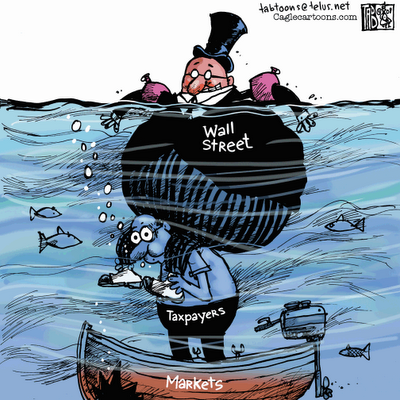
Screw that. They're still true, but they've been replaced by "You're bankrupt and Wall Street will help fix that."

So combine the two, the federal government shoving Wall Street at a problem, and you have the current "Huzzah!" moment Puerto Rico is going through.

 "But, Jenius," some of you will say, "it's just the feds coming in to set things straight. Who said anything about Wall Street?"

I did, I do and there's no hiding it. The federal government is trying to head off the financial collapse of Puerto Rico and who knows more about financial collapses than the banksters of the Street?

Look, We are bankrupt. Our debt and debt service are beyond Our current and estimated future capacity to repay. Anyone who argues the contrary is an idiot or ignorant of the facts. Puerto Rico's bond rating has not been properly classified as "junk" because there's too many billions of dollars of Our debt running around in too many pension funds and investment pools.


Yes, Puerto Rico, through bankster-like mismanagement and greed, has become "too big to fail." Woo.

And hoo.

The feds may have ordered the "rescue mission," but the banksters are going to do the actual """work""", and if history is any sort of teacher--and it is--We're about to get raped. Oh, not immediately, of course not, that would be counterproductive. No, the rape will be delayed, to a time well after the money-grubbing forced "pawing foreplay" has properly run its course. Then, when the banksters and their cronies, both federal and local, have had their fill of easy pickings, then We'll experience the full effect. Think of it as going roofied, by command.

But by then, the feds and the banksters and most of the local vermin will have moved on, to another target.

It's not called a "SWAT team" for nothing.

And yes, "rape" is a harsh and horrible word. But Puerto Rico is about to be forced, compelled and obligated to perform solely to please someone else's idea of "satisfaction." We will ultimately get nothing out of the "rescue the Island's financial status" process except a loss of self, an image tainted by contempt and lasting pain. That is economic rape.

We can demand transparency in the process. We won't get it.

We can demand a greater say in the process. We won't get it.

We can demand more control over Our economy. We won't get it.

We can demand to be left alone to solve it Ourselves. Nobody will believe Us.

We won't get any of the above because We haven't got the guts, brains or will to demand any of it. And even if We did, We'd get nothing.

What We'll get, is shafted. Economically stripped and plundered like a Roman vestal by rampaging Visigoths wearing $2,000 suits and the moral IQ of a lead bullet.

They'll get what they want. We'll just get older. And more screwed.


The Jenius Has Spoken.


18 November 2013

Low-Wage Corporate Welfare Must Die

Wal-mart. Taco Bell. McDonald's. KFC. Marshalls. Pizza Hut.

You know these places. You know what the offer. But did you know they are amongst the lowest-paying companies in the U.S of part of A?

According to a 24/7WallStreet.com article, these companies, along with Sears, Macy's, Target, Starbucks, Kroger, Olive Garden and Red Lobster are in the group of the 10 lowest-paying cheapskates.

But unless We work there, what do We care? "Bring on the low prices," We say!

To the employees of these companies, whose average wage is under $10 an hour and most are limited to part-time work to avoid getting benefits, the reality is very different. There's a reason the government tracks a category called "working poor."

Did you know there's a company that made $17 billion in annual profit, paid virtually no taxes in almost every state, has over 1.4 million employees and is by far the company with the most employees receiving food stamps and welfare support? In fact, in some states, their employees are the single-largest group of welfare recipients? Did you know that company is Wal-mart?

Now you do.

And what do you care, right? You don't work at Wal-mart. Bring on everyday low prices!

Okay, but who pays that welfare support to Wal-mart employees? It isn't Wal-mart, who protects its profits with canny accounting. It's Us. Our taxes subsidize Wal-mart underpaying its employees. In effect, We pay for these employees, as We do for those who work in McDonald's, Sears, Pizza Hut and the rest.

You might say that people have to work and at least these folks have a job. Wrong point. Look at the other end: $17 billion in annual profit. How much of that is needed to raise wages to a level that gets Us--you and I and Our taxes--off the hook, so We stop providing welfare to employees and the companies that underpay them? Did you make $17 billion in annual profit last year? So why should your money underwrite the company that made that much and expects to make more this year?

The argument for establishing a "living wage" minimum, which can range (according to whose numbers you believe) from $11 to $25 an hour, is based on the idea that when people earn enough money to sustain themselves, they need less welfare. They can thus consume more and as We have all learned from Saturday morning TV ads, consumption makes the world go round.

The companies listed above are vehemently opposed to a "living wage." Wal-mart and many of these companies are also vehemently opposed to unions, who can organize to negotiate one. Cynically, the opposition is because these companies will then have to get off the welfare teat and actually work for a living. The specific driving force is that the shareholders want profits and profits are harder to come by when the monies have to be paid to the employees, rather than letting the state and federal governments pay out.

But are profits really that hard to come by when paying a living wage? Costco has routinely kicked Wal-mart's Sam's Club ass year after year, generating more sales per square foot and far more sales per employee. Costco workers average just under $17.00 per hour in base pay, nearly all work full-time and thus enjoy benefits such as medical plans and retirement funds. Costco is not as large as Sam's Club, but it generates roughly the same level of profit per store, and that makes them just as attractive to shareholders.

McDonald's has a dominant position in one market, where the stores have above-average sales and wages are equivalent to about $15.50 per hour. There's even plans to open more stores, despite having to pay over twice Our national minimum wage. Where is this magical place of Happy Happy Joy Joy Meals? 

Australia.

Stick that in your low-wage pouch and smoke it.

The largest segment of workers in Puerto Rico are in the "Services" category. Just drive around and you'll see why, with many of the cheapskate companies listed above joined by Walgreens, Pep Boys, Burger King, Auto Zone, Wendy's and Office Max along with local retail chains like Pitusa, Econo, Selectos and Me Salvé. All have the same marginal-wage structure, trying to cap employee hours at 35 per week and letting the welfare system fill the gaps.

A friend of Mine, who has an MBA, lost her job when the multinational she worked for closed with barely 15 day's notice. She went to verify her unemployment benefits and to see if she could get a job through the government agency's resources. She was only offered jobs at Burger King. The pitch? "Take the job and we'll get you food stamps to help out."

She's living in Boston now.

Where Burger King and McDonald's and Wal-mart and Starbucks employees also qualify for food stamps.

You see the problem, right? "Blame it on the system," right?

But aren't We "the system"?  Damn right We are. So it's either fix it, destroy it or stay out of it altogether. 

We can do all three, and We should. Solutions are out there, but like with ideas, it's making them happen, the execution, that makes the difference.

Let's explore that, shall We?


The Jenius Has Spoken.


P.S. -- From today's Cleveland Plain Dealer website: A Wal-mart in Canton. Ohio is holding a Thanksgiving food drive "for their associates in need." Associates, what Wal-mart calls its employees, are in need? Of food? What the hell is Wal-mart paying them? Peanut shells? And how the hell does a company with a $17 billion annual profit have the totally unmitigated gall of asking its customers to directly help feed its employees? Is this the new image of America? 

Damn.


[Update: 20 Nov 2013: You vote more with your dollars than you do with your, uh, vote. Here's the explanation and how powerful it is, via Free From Broke.]

[Update: 21 Nov 2013: How Wal-mart Could Pay Workers a Decent Wage Without Raising Prices. From Mother Jones. The skinny? Take the money the company uses to buy back its stock, to enrich the Walton family, and put it into wages instead. And you thought I was just spewing gall about the $17 billion profit, of which $7.6 billion goes to buying back stock...

And from Bloomberg.com, How McDonald's and Wal-mart Became Welfare Queens. A few words, to sully the palate: "Wal-mart’s 'associates' are paid so little, according to Grayson, that they receive $1,000 on average in public assistance." That's over $1.4 billion a year that taxpayers shell out for "everyday low prices." Shit.

Speaking of which, from the good people that run the other welfare queen bitch: "McDonald's Tells Employees To Consider Returning Holiday Gifts To Get Out Of Debt."

Merry Christmas, everybody!]

[Update: 22 Nov 2013: Counterpoint, also from Bloomberg: Why Wal-mart Will Never Pay Like Costco. A quote: "Costco really is a store where affluent, high-socioeconomic status households occasionally buy huge quantities of goods on the cheap: That’s Costco's business strategy (which is why its stores are pretty much found in affluent near-in suburbs). Wal-Mart, however, is mostly a store where low-income people do their everyday shopping." The article makes, and supports, its valid points.]

22 October 2013

Time To Renew

Yeah, The Jenius is back

It's been over 10 months since I wrote My last post, and I didn't think it would mark the beginning of a long hiatus. It just simply happened, as a certain level of ennui and dissatisfaction reached a tipping point.

Doesn't mean I stopped caring or giving a damn about My Island. I just...went away, to do other things.

But a headline today proved to be another tipping point, as several weeks of pondering were coming together. Here it be:  How Wall Street Fed Puerto Rico's $70 Billion Debt Binge.

Courtesy of Bloomberg.com, Let's pause a moment and look at that headline:

1) "Wall Street": The code word here is "banksters."

2) "Fed": Ah, the banksters in cahoots with...

3) "Puerto Rico": Aw shit.

4) "$70 Billion": Now hardly anyone can actually imagine what 70 freaking billion dollars really is. Maybe Bill Gates, for whom the sum is "My next round number up." But almost everyone understands that 70 billion dollars is a freaking huge amount of money that they don't have. Hits you in the ol' bread basket, it does, pun intended.

5) "Debt Binge": Aw shit again. Now We're out-of-control mother-bleepin' fellow crooks with the freaking banksters. Yee. And haw.

You want the lowlights? Glad you didn't ask:

* Puerto Rico more than doubled its borrowing in the municipal bond market since 2004. To the average Brethren out there, let Me parse that for you: Both retarded political parties mucking up Our present and future added to that doubling, and "borrowing" you freakazoids doesn't mean "free ride," it means "debt." As in "crushing amount of it." How bad, you don't ask?

* "(T)he government kept selling enough bonds to saddle each man, woman and child with $19,000 in debt." You got $19,000 to pay your share of debt you don't care about and most likely didn't get but a few dollars' worth of services from? Me neither.

* Here's a fun stat: Over 77% of the muni funds in the U.S. of part of A. have investments in Puerto Rican bonds. "Too big to fail," anyone? Uh, think again.

* "Neither a U.S. state nor a sovereign nation, Puerto Rico and its debt-issuing agencies, such as the Aqueduct and Sewer Authority, aren’t eligible to file for bankruptcy the way Detroit and Jefferson County, Alabama, have. It must pay its debts or default." How do you like them aguacates, huh? Hey, statehooders, wanna make this your rallying cry for admission into the 50 Club? "We want the right to say We're fucking broke!"

* Oh, and what does "default" mean? Bottom line: We pay creditors through the nose, until Our brains are slop and Our innards are squeezed dry. Why? "Puerto Rico’s constitution guarantees that holders of general-obligation bonds are paid before any other creditors." And who could be listed as one of those "other creditors"? You and Me.

* Rescue plan? Puh-lease. "President Barack Obama’s administration isn’t moving to aid the commonwealth." And why should it? Yeah, $70 billion is a lot of money, but compared to the trillion-dollar fake meltdown-cum-bailout, it's a fart in a shitpile. And don't forget the previous paragraph: Our Constitution guarantees payment. You think the U.S. of part of A. isn't going to enforce that clause to the utmost limit? Here's the chaser: "The U.S. Treasury also said it isn’t taking any special measures."

* Tidbits tossed in, like sand in pus-flavored Jell-o: "Puerto Rico’s population has shrunk 4 percent since 2004 to 3.67 million, according to U.S. Census data... More than a quarter of the population depends on food stamps... Per-capita income of $15,000 is one-third the U.S. average... Labor-force participation rate of 35 percent for those age 16 to 24 is among the lowest in the world (My emphasis)... An unemployment rate of 13.9 percent, almost double the U.S. rate of 7.3 percent... Emigration is increasing... Rising crime is also persuading people to leave (as the) homicide rate is about 27 for every 100,000 people, compared with the U.S. average of 4.7... Puerto Rico’s leaders haven’t done enough to make local industry competitive in the global economy and are instead counting on tax incentives or other assistance from Washington to protect businesses."


Still with Me? Kudos.

Does any of this surprise you? If you're one of My Brethren, is anything mentioned above a true surprise to you?

Why? Why are We so accepting that this is the way things are and will be?

Well I didn't come back to keep yapping about what's wrong with Us and Our Island. I think I've covered that crap beyond the point of nausea. 

The next step is coming up.

And it won't take 10 months to happen. I guarantee it.


The Jenius Has Spoken.


24 October 2012

Burning Our Trash & Our Cash

Energy Answers, a company seeking to build a waste-to-energy plant in Arecibo, has just been handed a sweetheart deal that involves Our taxes, Our power bills and the verb "fornicate" in ample measures.

I won't belabor the point; the facts speak for themselves. Energy Answers gets to build its plant and the 30-year contract specifies that:

1) The government is obligated to provide Energy Answers enough garbage to be profitable. Now, sure, Our government (and Our society) produces enough garbage to sink an Island, but "obligated"? When the State serves the Corporation, it is Fascism. And no, the article doesn't state that the amount of trash ensures profitability, but do you think Energy Answers would ask for anything less? Unlike Our government, they are greedy, but not stupid.

2)  Energy Answers will raise electrical rates by 8-20% over current rates. Now, the fact is, Energy Answers may raise the rates, but the real power--pun intended--to do this rests with the Puerto Rico Electrical Power Authority, THIEF. They have a complete monopoly over the transmission of electricity over the established infrastructure, so if anyone is going to raise the rates, it will be THIEF.

Disclosure: I worked a waste-to-energy project earlier this year with a Texas-based company. Their contract with THIEF specified selling the electricity at 15 cents a kWh, where THIEF would then sell it at 26-29 cents. I doubt Energy Answers is getting more than 19 cents and thus there is NO REASON for THIEF to raise its rates. None except that they are a monopoly, are going broke and the dealmakers with Energy Answers are cackling thieves on their way out to live off Our dollars.

3) If a municipality doesn't pay its power usage, Energy Answers can obligate the government to collect the payment from the municipality itself or its residents. When the State serves as bill collector for the Corporation, there is only ONE word for that: Fascism.

4) Energy Answers can raise its rates by 2.5% yearly and the government can only stop the rate increase if it is deemed "highly unreasonable." Whatever the fuck that means. Remember, the power authority is a government-owned utility, a de facto monopoly. When the State hands over control of tis resources to the Corporation, that is Fascism.

5) The Environmental Quality Board, Our local "protection agency" that is neither environmental, nor quality nor even a board, is forcing municipalities to close their waste landfills ahead of schedule and blocking any effort to extend their use, even when such extensions are completely legal. Why? Because extending the use of landfills reduces the amount of trash that can be funneled to Energy Answers. When the State becomes the legal violator in favor of the Corporation, that is Fascism.

6) In fact, the contract has Our government serving as guarantor for Energy Answers' financing of the plant, to the tune of no less than $500 million.

To wit: Our government is guaranteeing investment money, raw materials to achieve profitability, rate increases to sustain profitability, debt collection to maintain profitability and illegally blocking competition to guarantee profitability to a corporation. That, My Brethren, is a textbook example of Fascism.

And here's the kicker: the deal was put together by one Jorge San Miguel, party platform director in 2008 and 2012 for...the statehood party...currently gutting Our government. 

Whee!

But Let's not forget that Energy Answers is not stupid. They wangled some support from the other side as well, as their Communications Director is one José Julio Aparicio, internal auditor of the commonwealth party. There's enough thieving for everyone to join the pillaging!

We do have a trash problem in Puerto Rico. There's hardly any more space to dump it in. Our electrical grid is barely competent enough to hold its own and can't help Us grow as it should. Yes, these are all problems.

But.

These problems cannot be allowed to be """solved""" by forcing Us, the taxpayers and consumers, to pay for the financing, pay for the trash hauling minimum, pay the increased rates, pay for municipalities' non-payments, pay for illegally blocking other solutions and pay for the reckless looting of Our pockets by vermin whose total value is less than that of a cockroach's fetid fart.

People, I keep telling you: The only way to put an end to this is either with ballots or with bullets. A rabid predator is a savage beast who can only grasp one concept in its disease-addled brain: pain means death.

Unless We hurt these beasts--hurt them badly, even fatally--they will continue to rape Our pockets, Our present and Our future.

They are burning Our trash and Our cash. It is way past time We burn them. To ash.


The Jenius Has Spoken.


19 October 2012

Prison Rape

"Consider the numbers. In the United States today, there are about 314 million people. One percent of the U.S. population, therefore, is 3,140,000. In our prisons today are 2.2 million people. We have a higher percent of our people in prison than any other country in the world and the percent of our population in prison has, shockingly, more than doubled since 1980. The people in prison make up over two thirds of one percent of the U.S. population."


"Some of these prisoners do make income, but their income is tiny, according to a study done in 2002 by the Washington-based Economic Policy Institute. Its author, Heather Boushey, found that Federal Prison Industries (FPI), which employs inmates in federal prisons, pays them between $0.23 and $1.15 per hour, with the average federal prisoner making $0.92 per hour. She noted, however, that from this gross pay, the government deducts funds for restitution, to offset the high cost of incarceration, and for other purposes, leaving the average federal-prison employee with a measly $0.18 per hour."

From another source:

"Unicor is a government-run enterprise that employs over 13,000 inmates -- at wages as low as 23 cents an hour -- to make goods for the Pentagon and other federal agencies.

Unicor, also known as Federal Prison Industries, is part of the U.S. Bureau of Prisons. It has been preparing inmates for jobs after they get out since 1934. The program has 83 factories and makes goods in seven industries -- apparel being the biggest ticket. Unicor made over $900 million in revenue last year...

Unicor is not required to pay its workers minimum wage... It doesn't have health insurance costs. It also doesn't shell out federal, state or local taxes."

What a sweet deal. Unfair competition using a burgeoning prison population, of which over 560,000--almost 25%--are in for drug-related, non-violent "crimes." And this little niche of fraud is clearing close to a billion dollars a year.


Billions of dollars wasted on a """drug war""" that has had ZERO--I repeat--ZERO impact on drug usage rates in 40 years.

Billions of dollars wasted pursuing minorities in order to create the LARGEST PRISON POPULATION IN HISTORY. Shove that up your patriotic ass, """Land of the Free."""

Billions of dollars in profits from a prison-industrial complex that links government, big business, the military, state governments and law enforcement, including the Justice Department, in a concerted attack against some of the citizens of the over-rated U.S. of part of A. 

"Who is being punished here?" John Palatiello, president of the Business Coalition for Fair Competition, said. "The inmates who have committed a crime against society, or the employees of private companies who play by the rules?"

Both, Mr. Palatiello, both. Which means We all are getting punished.


The Jenius Has Spoken.


09 October 2012

40-Year Flying Fuck: Revisited

Sometimes these things just write themselves...

I wrote about the idiocy and open thievery of the """privatization""" of Our International Airport, calling it--accurately, of course--a 40-Year Flying Fuck.

Move forward some weeks. Over at MuniLand, Cate Long's often-incisive blog about topics financial, with occasional glimpses in Our direction, comes this analysis of the "giveaway" of the Luis Muñoz Marín Airport deal. As ever, all emphasis is Mine:


"...The lease deal lasts 40 years. However, studying the financial terms of the deal, it is not clear that Puerto Rico will really benefit much financially from privatizing the airport."

"Looking at the financial data, which is sparse and hard to find, the deal is unlikely to generate any substantial cash for Puerto Rico. From the FAA application (page 9): Aerostar will make a one-time cash payment to the PRPA of $615 million (the “Leasehold Fee”) at the time of closing the Lease.  

The deal is structured with tiny annual cash payments from ASUR to Puerto Rico for the first five years. ASUR will pay $2.5 million per year for five years, for a total of $12.5 million. In years six through 30, ASUR will pay Puerto Rico five percent of gross airport revenues. It will pay ten percent of gross airport revenues in years 31 through 40. ASUR will also reimburse Puerto Rico $2.8 million per year for the costs of police and fire services. This amount will be adjusted once actual costs have been determined.

The airport lease also calls for “General Accelerated Upgrades” to the airport, but it does not require any major capital improvements. ASUR is not obligated to offer employment to airport employees. If the conditions are worked out, then ASUR can take control of the Puerto Rico Air National Guard facilities also."

"Juan Carlos Batlle, President and CEO of the Government Development Bank for Puerto Rico (GDB), was asked at the Bloomberg State & Municipal Finance Conference about the transaction. He said that the $615 million upfront payment would go to retire airport debt, and he did not know how financially advantageous the deal was for the buyers.

But knowing the advantages of the deal seems to be a basic fiduciary responsibility for the official in charge of the government agency that did the analysis of the deal. Batlle eventually conceded that Puerto Rico essentially receives no benefit from the upfront payment other than retirement of debt. He fudged his answer on any longer term benefits."

"The key to understanding the deal is knowing how much ASUR will earn. The company will receive $62 million per year from airlines that use the airport’s gates and facilities. ASUR will also earn approximately $36 million per year from “Passenger Facility Charges...


According to the financial statements of the Puerto Rico Port Authority for 2011, LMM generated $99 million in total revenue, including $70 million of operating revenue. Earnings (EBITDA) were approximately $40 million. 2011 was also the lowest year for passenger traffic (see chart above). 2012 numbers have already rebounded and are tracking to reach nine million passengers. This means that revenues and earnings will earn ASUR an even better deal.

"It was hard for me to do any deeper analysis because the financial statements of the Port Authority combines the activities of the airport and the marine terminals that provide bulk freight and cruise ship services. But the LMM deal is being lauded in financial circles, which means that investors will likely do very well."


So Cate does her thing and reaches the conclusion that We are being ungently screwed by The Larva's verminous horde of chancre-pocked thieves. (I use more colorful language...) Of course, investors are going ga-ga over the deal because--and this is a subtle point that My Brethren tend to miss--the deal is a steal.

On her blog, Juan Carlos Batlle, ol' "Mr. Waffle (Out)House" himself, piped in with a response. Here it (largely) be, with one comment, Mine:

"I am writing to clarify certain information on Cate Long’s October 5 MuniLand blog post, “Puerto Rico’s Airport Giveaway,” regarding remarks I made at the Bloomberg State Municipal & Finance Conference. With all due respect, her reference to my comments are, in fact, highly inaccurate, misleading and defamatory.

As a transcript of my remarks at the Bloomberg State Municipal & Finance Conference on October 3, 2012 clearly reflects about the Public-Private Partnership for the Luis Munoz Marin International Airport:

- It provides important and tangible financial benefits to the government of Puerto Rico and its citizens; to the tune of $615 million upfront cash payment, annual revenue sharing of over $550 (sic; or actually, quite accurate) and investment in capital improvements of $1.4 billion over the life of the lease

- Enables Puerto Rico to retire approximately 45% of the Ports Authority’s debt;

- Sets up funds to support regional airports and other purposes; and  

- Helps reestablish the financial stability of the Puerto Rico Ports Authority.

As I said at the Conference, given Puerto Rico’s high debt load, among the main objectives of our Public-Private Partnership Program are to reduce overall debt levels and reactivate infrastructure investment.

This transaction allows us to accomplish both objectives at the Ports Authority: “tackle the issue as we have to start lowering our debt load,” and “invest $1.4 billion over the life of the lease.” (these quotes taken directly from such transcript)."

Oh, brother, can you spare a whine? Let Me fire a few verbal bullets your pin-headed way, Mr. Waffle (Out)House:

1) You were accused--rightly--of incompetence for not knowing how this deal benefits the investors. Anything to say there? My thoughts are: Ms. Long was absolutely right and you are a baboon with a calculator. In any case, your time to answer that point was at the Conference, not some time later when you've had a chance for a flunky to draft your ape-like grunted response.

2) Who--who, goddammit--created the "high debt load"? Your so-called boss has limp-wristed his way to overseeing a massive increase in Our national debt, most of which has gone who-knows-where... but We've seen how a lot of it has gone to The Larva's cronies and party parasites. So you're saying the LMM deal is to "reduce overall debt levels" that were basically created by your own hyena pack's greed, corruption level and incompetence? Well isn't that special.

3) Your transcript quotes are ridiculous, lame and pusillanimous at best. "(T)ackle the issue as we have to start lowering our debt load,” is mealy-mouthed farting in the wind when the subject matter is facts and figures, dollars and cents, Waffle (Out)House, even when--or especially when--the cash seems to be going to crooks. And “(I)nvest $1.4 billion over the life of the lease” is merely a number anyone can toss out: where are the specifics? If you knew the amount (which I doubt, I'm sure a flunky gave it to you later), then why the hell didn't you have a breakdown of how it would or could be invested? Do you have ANY freaking idea how to do your job properly? Or are you just another lower primate in the monkey (out)house We laughingly call "Economic Development"?

4) And Let's be honest, Waffle (Out)House: you're supposed to be a banker. Ha-ha. You are writing a response to what you feel is an inaccurate portrayal of your presentation, on a government matter involving millions of dollars, you are responding in a public manner to said portrayal and you don't notice you have a humongously inaccurate number in your very own response? What are We to deduce from that?

That you're an idiot. That you don't know your job. That you were placed in it to facilitate financial shenanigans beyond your woefully-limited ken. And that the airport deal is just one of the many screwings We are having inflicted upon Us by your government cronies, ignorantly blessed by the full-scale incompetence of your fellow morons in """Economic Development."""

Ms. Long says it one way; I use more colorful--and truly--more accurate language.


The Jenius Has Spoken.


[Update: 19 Nov 2012: The Mexican half of the airport takeover, Grupo Aereopuerto del Sureste (ASUR), has been linked repeatedly to drug kingpins and trafficking. Hmm, seems like Our airport is part of some other business agenda...]

08 October 2012

Time To Topple: Banco Popular

Happy Birthday, Sis!!


Unrelated to that announcement:


"Chairman and Chief Executive Officer Richard Carrión’s sister and two of his nephews, one of whom is also a Popular director, have delinquent property loans to the San Juan-based lender, according to a regulatory filing. The bank has also restructured the loans of another director, the board’s head of corporate governance, and classifies his debts as “troubled,” the filing shows.

'The disclosures are seriously problematic,' said Orin Kramer, whose Boston Provident Partners LP hedge fund owns about 2 million Popular shares. 'The role of the board is to protect against credit losses, not create them.'

From another source:

“'This deal does smell like rotten fish,' said (James) Post, who was co-author of “Redefining the Corporation,” a study of governance and accountability. “It immediately raises the question: Have there been other deals of this sort that have gone on, and are shareholders entitled to know about that?”  

The loan is among the latest “related-party transactions” between (the nephew of Uncle Richard, José) Vizcarrondo and Popular, which paid companies linked to him at least $33 million since 2004, regulatory filings show. The bank posted $1.87 billion of losses from 2007 through 2009 under Carrión, who has been Popular’s CEO since 1994 and a director of the Federal Reserve Board of New York since 2008."

From the same source, further down:

"Desarrollos isn’t the only company linked to Vizcarrondo to gain from Popular contracts. The bank paid $33 million from 2004 through 2006 to Metropolitan Builders SE, a firm in which Vizcarrondo is a partner, proxy filings show. This company was awarded construction contracts valued at $52 million in 2002, the filings show."

And for losing $1.87 billion, how much does Uncle Richie Wretch make? "Carrión’s overall compensation, including stock, increased 67 percent last year (2010) to $1.8 million, according to the proxy filing." Woo-hoo!  A 67% raise and rampant nepotism, too! Way to go, Richie Dead Meat! ("Carrion" as it is properly defined, in this case...)

Another little fillip of rotting meat: Banco Popular still owes $935 million to TARP, the second-highest such debt in the U.S of part of A. banking system. They're #2! They're #2!

But then there's more back-office butchering going on here...

"Manuel Morales Jr., Popular director and chairman of the board’s corporate governance committee, owes the bank about $1.5 million through different lines of credit, according to a filing. The board agreed to restructure his debts in December, changing most of them to three-year term loans. While Morales is “current” on his obligations, the loans “would be classified as troubled debt restructurings,” according to the bank."

Oh. So if you're IN the bank, you don't have to deal with the pesky little rules of actually running the bank properly. That's good to know. Especially since the Feds noticed long ago (well, last year, at least) and placed Banco Popular under its direct scrutiny "due to failings in the bank’s management of documentation concerning property loans."

Gosh. It almost makes you forget the time Banco Popular's Old San Juan branch "forgot" to properly report $25 million in laundered drug money...

Banco Popular is the largest local bank, with over 40% of all Our deposits; its closest rival is at 17%. As an economic pillar, Banco Popular is more like a ragged toothpick, using its local weight to squat and crap on Our growth with its near-monopolistic powers.

Want a mortgage? Banco Popular handles over 55% of them (and The Larva's wife, Lucé "I Met 'Meat' Romney" handles over 2100 of them...for a cool $900,000+). Car loan? Ditto. Personal loan? Same. Credit card? Yeah. Construction loan? Uh-huh, especially if Uncle Richie Wretch is kin.

Banco Popular is weak, troubled and run by nincompoops. TARP cash kept them afloat and because no other bank in their right mind would deal with the Dr. Moreau-like scenario here, the Feds handed Banco Popular pretty much all of WesternBank's cherry-picked "good assets," in a deal that shut down a weakened bank and propped up another.

Some analysts are touting buying Banco Popular shares. One even compares that purchase to that of buying lottery tickets. But that same "lottery gamble" source thinks alternative good buys are Doral Financial Group (DRL) and First Bancorp (FBP), numbers 2 and 3 amongst local banks. So it's not that Banco Popular is a hidden gem: it's that Puerto Rico's hybrid faux-economy could yield good deals if it kicks back into high-consumption gear.

I'll repeat Myself: Banco Popular is an obstacle to Our growth. It is a massive financial roadblock sitting squarely in key industrial and business sectors: construction, commercial loans, mortgages and personal loans. It dominates a weakened economy that was weaker than it should have been because Banco Popular--through its near-total control of 936 funds--used that money to build a national base (now rebranded as "Popular Community Bank") rather than truly build Our Island. In effect, it colluded with Stateside firms to zip profits back home, rather than invest them locally, as Section 936 intended.

Given that Banco Popular has long been run like a friquitín's greasy cash box, where any José, Julio or Manny can grab a handful of dollars and waltz away, that its economic base has been self-eroded, that its strategy is more "survival" than "revival" and that it believes Uncle Richie is worth more than $1.8 million to lead them exactly nowhere, I say it's time to topple Banco Popular.

The sooner the better. For Our Island's best and brightest sake.


The Jenius Has Spoken.


26 September 2012

Countdown For A Cowardly Cartel

There's rumblings that We are about to get new daily newspapers. Two, to take the more specific part of the rumors. At a time when most markets are losing newspapers to web-based news sites, Puerto Rico is gaining--apparently--two dailies.

Why? Why now?

It's not like We are avid readers or consumers of news. I hate to say it: My Brethren look upon reading as akin to inserting suppositories, but less useful. And as far as news, Our general mind-set is geared to PUERTO RICO: GOSSIP/SCANDAL/TRAGEDY with a second set consisting of U.S. of part of A./NY/FL/Scandal and a dot that says "The rest of what other people call 'the world'".

So if it's not serving a reader/news consumer market, what could cause 2 new newspapers to jump into Our market in 2013?

Ad revenue.

Banners of the Farewell Tour


For some reason, the ad market locally is more like a dinosaur than an iPhone 5. Even now, the majority of overall ad dollars spent here goes to newspapers, an estimated 63%. That leaves a paltry 37% spread across TV, radio, Internet and several alternative media.

So newspapers still rule here. And who rules the newspapers and thus the ad revenue stream? The Ferré-Rangel cartel, owners of El Nuevo Día, Primera Hora and more than half the major local weeklies. They control about 65% of the newspaper ad revenue, which means they control about 41% of the total stream, a princely sum, when you consider it represents about $98 million.

Still, why? Why now?

First of all, Puerto Rico is a captive ad market. It's an island. But not just any island: it is an island filled with people who buybuybuy like drones. That means that companies will advertise like mad to lure the drones. It's what We've seen for decades.

Second, the Ferré-Rangel cartel is vulnerable. Their attempts to polish the face of the pig they call "the family corporation" have not helped improve its looks. So the big mega-millions sale they lusted for has not been completed, and as their position and the economy worsened, the prospects of umpteen dollars to bankroll personal ambitions have faded.

Third, thanks to a corrupt passel of smegma-licking thieves, a local failed daily is now a putrid propaganda puppy trainer given away for free. It broke the "free" price barrier and further eroded the ad revenue base for the Ferré-Rangel cartel.

Fourth, the ad market here is ripe for a competitor because the environment has become stagnant. The deaths of El Vocero (now a zombie) and The San Juan Star (a puny half-zombie called The Daily Sun or some such crap) have given one competitor a solid base...with huge cracks. And into those cracks comes a rival.

Yes, one. According to the rumors, the international chain of Metro papers is the King Kong moving in next year. {Disclosure: I worked on a project to bring that chain to Puerto Rico in 2008-2009. The big stumbling block: no large local advertiser would commit to placing ads in the new paper for fear of retaliation by the Ferré-Rangel cartel.} And again, according to the rumors, the cartel will launch its own free daily as a pre-emptive strike.

Which means that the cartel will actually cannibalize itself in a desperate attempt to survive.

Really.

Here's the thing: If a company dominates the newspaper industry the way the Ferré-Rangel cartel does, it would behoove said cartel to improve the quality of news coverage and community interaction so that future competitors would have a bigger entry barrier to their market. In essence, be a true newspaper and develop yourself into an integral part of the business, industrial and social fabric. Which means you become an integral part of all of Us.

Is it hard work? Yes. Does it take time? Of course. But the end result is a newspaper or a newspaper chain--in a closed market--that can only be beaten by the Internet, which is still in its infancy here and thus capable of being dominated even by something as horrendous as elnuevodia.com and primerahora.com.

Remember, this is a market where total ad revenue exceeds $210 million and one company is dragging down close to $100 million. Let Me put it this way: that represents roughly $26.50 per person. How many companies get at least $26.50 a year per person in their market?

But of course, the cartel won't do that: they haven't in the almost two decades they've cornered the market. They took the easy route, the exploitation route, and when the going got tough--as it will--they went into "survival" mode, short-term thinking. If they'd had a gram of vision or a smidgen of guts, they could have created a new paradigm for newspapers in Puerto Rico, a potential model for others to emulate.

Instead, they're going to launch a free daily to compete with their two newstand-sold dailies in order to fight off a free daily...with much deeper pockets, talent and vision.

And because the Ferré-Rangel cartel is not really a part of Us, never wanted to be except to exploit, threaten, browbeat, deceive, insult and manipulate Us, We really don't care what happens to them. They've taught Us to not care about the news, to not give a damn whether We read the Truth or not, to not have any concern for them as Our allies because they never were.

Now they need Us to fight off a rival that could become--blind hope--the ally We deserved these past three decades. Regardless of whether that ally emerges or not, the Ferré-Rangel cartel is headed for a crushing defeat. They will want--hell, they will desperately need--allies...and I for one am sure they won't get enough to survive.

I've said for years that the cartel is an obstacle to Puerto Rico's progress. Come 2014, their days as an obstacle may become a visible countdown. And they will have nobody--absolutely nobody--to blame but themselves.

Good riddance.


The Jenius Has Spoken.

[Update: 2 Oct 2012: The battle of the free dailies has its first salvo. The Ferré-Rangel cartel launches Indice and Metro launches a sneak peek of its offering. Oh, We won't be better informed...We'll just be entertained. I can't wait for the Ferré-Rangel cartel to file for bankruptcy.]

21 September 2012

Concrete Plans

In a concrete example of irony, Puerto Rico is getting a new mall, a luxury mall, no less. A $405 million private investment that will be anchored by Saks Fifth Avenue and Nordstrom's, nestled against the recently-privatized International Airport.

According to Our (non)governor--The Larva--"Puerto Rico doesn't have too many shopping centers." This twinkie also believes that "Puerto Rico has the lowest murder rate since the Garden of Eden," that "Puerto Rico's population is growing every day" and that "My wife's income is due to luck."

A rough count indicates that We have about 135 shopping centers, a ratio of roughly 1 per 27 square miles. That means than in an average 5.5 mile square, there's a shopping center. If the continental U.S. of part of A. had the same ratio, it would have 140,522 shopping centers. How many does the U.S. of part of A. actually have? 107,703 (Table 1061, 2010 data.)

So, The Larva is wrong. He is even more wrong when you take into account that We are dotted by 58 Walgreen's with more on the way and a growing number of CVS Pharmacies, over 520 fast-food and casual dining chain restaurants and several dozen stand-alone stores (furniture, rentals, auto parts, etc.) from U.S.-based companies.

For the record: Our murder rate per 100,000 residents is higher than Mexico's (where Mexico has been in the frank midst of an uncontrolled drug war since 2006), Our population has dropped from 3.96 million to 3.7 million and The Larva's wife makes money from political patronage and influence-peddling, not luck. (Uh, cough-cough, allegedly. Cough-cough. Wink.)

Okay, moving on.

The brilliance of this luxury mall plan, aside from the fact that it will definitely line the pockets of several Larva cronies, is that it takes reality and shoves a slimy hand of optimistic greed into its face. Too many shopping centers? Nonsense! Shrinking economy? Balderdash! Reduced tax base? Poppycock! Dwindling population? Superb! For you see, in this through-the-looking-glass, Mad Hatter-like view, propelled by greed and thuggish elán, the sky's the limit!


Let's cut to the chase. The vision these squinty-eyed tapeworms have is of a Puerto Rico slathered in concrete, a chalky mirror that powers a cash machine so hot it could burn a whole in the ozone layer. For that, you have to think big...really big. This luxury mall in the swampy grounds next to the airport is just small batatas. The big ideas are still to come. And you'll hear them here first.

El Morro: What the hell does Puerto Rico need a fort for? It's not like We're going to be invaded by anything except monkeys, lizards, Cuban frogs and lesser species (Republicans). So Let's turn that hunk of stone into a food court, a massive--dare I say?--historical food court filled with the finest European cuisine (Olive Garden, Scotch 'n' Sirloin, Romano's) and for statehooders, a McDonald's.

El Yunque: The only rain forest in the U.S. of part of A. is just so much wet vegetation, so the plan here is to level the hilltops--make it a true anvil--and build a mega-casino/galleria catering to the mondo crowd (as opposed to the mondongo crowd.) Toss in several multi-million dollar homes surrounded by concrete boxes filled with exotic plants (from Europe, of course) and you have both security and a metaphor for "being steps above the huddled masses."

Guánica Semi-Desert Tropical Forest: Good gravy, what kind of oxymoron is that? Ranks down there with "political leader" and "Fortuño's cojones." The Guánica forest is the only one left in the world, which of course means its time is past and extinction should be sped up. The plan: two golf courses with a spine of townhouses of which the southern ones have an infinity pool. Build a concrete wall topped by statues (European, of course) to keep iguanas and other riff-raff out.

GasoDildo: Under this new vision, a 93-mile gas tube is a micropenis, a useless bit in the creation of a new Puerto Rico. Extend that sucker by having it go from Ponce (parking) to Mayagüez, then cut across the entire Central Mountain Region, maker a left in Fajardo, slash through the northeastern mangroves, pass by the new San Juan Mall, cut across the bay to pass underneath La Perla and El Morro (hey, a food court needs cooking gas, right?) and keep going until it hits the electrical facility in Cataño. See? You just have to massage the original a little bit to see it grow into a monster shaft that could really fu--el Our future. Hell, it might reach 250 miles when all is said and done, wrapped, supported and protected by concrete from Mile One (the parking lot known as Ponce) and Mile 250.

The best part? There's fewer people living here to protest meaning there's more land to grab!

Now that also means that there's fewer consumers for the food court, to buy the mega-houses and townhouses with infinity pools, play the golf courses and the casinos, but by raising the airline rates, We can keep more people from flying off the Island and by creating a new Public-Private Alliance (a.k.a. major theft of public monies) to "manage" tourism, We can bring in outsiders by the pound. And you don't really think the skanky planners care if the stores, houses, casino and golf courses make money, do you? Condescending chuckle. The money's in the building, bay-bee! The hell with the rest!

This new vision of Puerto Rico takes your breath away, right? And to think it's only a few years from becoming a reality, making multi-millionaires out of scum toejam would look down upon with open disdain.

To quote a clown: What a country.


The Jenius Has Spoken.


28 June 2012

Puerto Rico Hangs Itself

"Puerto Rico’s financial condition is far worse than any U.S. state’s, and a default – though unlikely in the immediate future – is a possibility over the next few years."

"Puerto Rico is unique in its extensive use of public corporations to deliver public services. It directly and indirectly manages 48 public benefit corporations. This governance structure has tended to limit transparency and fiscal accountability in its public sector."

"The Puerto Rican economy entered recession in late 2006, and it has yet to emerge."


"...(M)edian household incomes in Puerto Rico remain at $15,000, and only 35% of Puerto Ricans are employed."

"Poor financial management has contributed to the length and depth of Puerto Rico’s recession. The Commonwealth is burdened by large annual deficits, a high debt burden, opaque financial practices, and severely underfunded pension plans, among other problems."


"Unlike healthy municipal issuers, the Commonwealth requires market access to meet payroll and other obligations."

"Annual deficit financing has caused the island’s debt-to-GDP ratio to rise. It is now 90%, compared to 57% in 2001. In fiscal years 2011 and 2012, the Commonwealth’s debt load grew while the economy contracted."


"Puerto Rico’s debt structure is less flexible than other municipal issuers’. The Commonwealth repays only 21% of its debt within 10 years."

"Puerto Rico consistently adopts aggressive economic and financial forecasts. The Government Development Bank has missed economic growth forecasts for three consecutive years. Politicians continue to tout progress on relatively weak financial and economic data."

"The Commonwealth’s major public corporations have significant and opaque financial relationships to each other and to the Commonwealth. These intra-governmental capital flows represent a significant portion of the island’s financial activities, and they are beginning to impact the island’s larger issuers. Last year, almost 28% of PREPA’s (Puerto Rico Electric Power Authority’s) unpaid bills were owed by delinquent public sector organizations."

"The Commonwealth’s vital Government Development Bank (GDB) is under stress. Roughly 35% of the GDB’s assets comprise loans to the Commonwealth and its public entities, and most of these loans are paid late. While the bank’s liquidity is ostensibly strong, it is weakly monitored. The GDB is unregulated by the Federal Reserve or Federal Deposit Insurance Corporation."

"The GDB’s loan book has become a bit politicized. In recent years, the GDB has entered into “fiscal oversight agreements” with several of the island’s large public corporations. These agreements require the public corporations to implement expense reductions, rate hikes, or submit to increased oversight to ensure the GDB is repaid. The bank’s intervention into areas traditionally reserved for policymakers increases its repayment risk."

"Puerto Rico’s public pension funds were 14% funded in FY 2010, and a staggering 22% of the funds’ assets include loans to members of the fund. The Employees’ Retirement System may deplete its net assets by FY 2014 despite recent reforms. The Commonwealth’s pension funding shortfall is far worse than any U.S. state."


"Conclusion: Although the threat is not imminent and the risk remains slim, Breckinridge believes the possibility of a default by Puerto Rico is sufficient to warrant the attention of municipal investors."

"We end with a graph that illustrates just how different Puerto Rico is compared a distressed U.S. state: Illinois. Illinois compares very favorably even though it faces several years of large structural deficits and large pension and retiree healthcare liabilities."


Taken from the Breckinridge White Paper, "Puerto Rico's Challenge," published in March on this year. All emphasis Mine.

The bad news is all Ours.


The Jenius Has Spoken.


Note: Due to a website change, the URLs for the images used had to be reloaded; 16 Sep 2012.


04 May 2012

We're #27...That's Great!

You've probably never heard of The Founder Institute. Some of you may have, but I bet most of you haven't. Don't feel bad: I only learned about them last year. But since that day, I've been a fan.

In a nutshell, The Founder Institute helps create "meaningful and enduring technology companies." It does so using a four-month "idea to execution" process that even allows entrepreneurs the capacity to launch their new venture while working a job. Their process is not for the wishy-washy toe-dipper: it requires a  healthy dose of commitment and sweat. But the results are often fantastic.

Given the paucity of entrepreneurial resources on My Island--a situation akin to finding monkeys in the Arctic--it is a true pleasure to learn that The Founder Institute is now launching its 27th chapter in Puerto Rico. For what can be considered the first time, We will have a world-class entrepreneurial resource helping Our high-energy start-up folks truly reach their potential. It's like the arrival of Major League Baseball to a sandlot park that looks more like a cattle yard.

Okay, maybe Our entrepreneurial environment is not that bad, but it certainly ain't anywhere near being average. Say a 2 on a scale of 1 to 10. But as Jenius Friend Ramphis Castro--he of TedX San Juan fame--said, this is a game-changer.

Now for those of you who want to participate in The Founder Institute development process, you have until May 13th to complete your submission. Yes, Mothers Day; deal. If you really believe you can create a new company that will change the world, or help others change it substantially, then I urge you to believe in yourself 100% and make your way to the Founder website and toss your name into the ring.

The Founder Institute's goal is to create 1,000 new tech companies a year in 30 cities worldwide. Only those of us who have slogged and slugged and struggled with what passes for an entrepreneurial "process" here can appreciate what this means: a chance to finally stand on the global stage as equal partners. We always had the talent to do so: now We have the toolkit to make it happen.

Let's make it happen, over and over and over again.


The Jenius Has Spoken.


19 April 2012

Money Matters: Idea 001

I've read several ideas about changing society's relationship with money, from giving people lump sums (from gift to zero-interest loan, $10,000 to $10 million) to canceling debts (student loans, mortgages) to invading a big country with enormous resources (that one was aimed at you, Canada.)

But Let's take the basic concept of fundamentally raising a society's economic average with barely one stroke and apply it to My Island. To frame the possible solution, We have to take into account that by global standards, My Brethren live in relative wealth, but by "Our standards," We are the poorest bananas in the bunch.

The reason I write "Our standards" is that We seldom compare Ourselves to Ourselves (how much progress We make or don't make versus Our past performance); We compare Ourselves to the 50 States of the richest, most powerful nation in history (even if it is in decline, it was all that.) So "Our standards" are skewed from "Our Island" to "Their Global-Motor Economy," a comparison akin to saying "Our electric fan versus that hurricane."

The fact is, We are not the U.S. of part of A., they treat Us like property, pillage profits from Us at a rate that would absolutely warm a pimp's heart and We are so wrapped up in Our desperate need to be taken care of that We fail to understand and thus act in Our own best interests.

But I digress. What's My plan to insert money into Our economy and make that "one wave of the magic wand" change?

Every adult in Puerto Rico is to receive $50,000 a year, non-taxable, for 10 years.

Before the why, here's the how:

At age 18, a person leaves fingerprints, retinal scans and a DNA sample and can begin receiving $50,000 a year at that time or any other time they choose. Shades of Big Brother, but it cuts down on fraud when you have that much ID evidence.

The money is given in one annual sum, the month of your birthday. Once you start receiving it, you have to continue receiving it, for any stoppage (death or request) ends the sequence. You are free to use the money in any way you choose.

At the same time this $50,000-a-year program begins, welfare--all welfare--is phased out over a 3-year period. No PAN, WIC, federal subsidies or any other social support, except unemployment, which is reduced every year by 10% until it is 40% of what it is now and then rises according to cost-of-living and capped at a maximum of 24 weeks. Health reform programs would continue and be expanded.

No one--no one--is allowed to receive more than 10 years, nor is it allowed to change the length of the 10-year sequence nor the amount of money given yearly. This is a de facto $500,000-over-10-years and it will not change until the first decade is complete. Then the amount given increases by the lesser of 10% or the inflation rate as evidenced by "Cost of basic goods" prices (food, gasoline, clothing, basic health care, rent, etc.)

If a person runs for elected office at any level, s/he cannot receive the $50,000 and renounces receiving it if still within their 10-year period. If still receiving the $50,000, any government employee, appointee or contractual hiring has his/her salary/fee capped at $50,000.

Prisoners cannot apply for their money while they are in prison. Once out, they can receive their money, but if they return to prison, they lose their future monies. And only residents of Puerto Rico with at least 5 years of proven residence are eligible, or can become eligible, to receive the money.

Now the whys:

1) Why $50,000? Because according to federal studies, a family of 3--notice the number--needs at least $44,700 to begin "climbing the economic ladder," rising from "lower class" to middle and upper. With $50,000, a local family could make that ascent, given that Our cost of basic goods is about 11% higher than Stateside.

2) Why 10 years? Because it focuses the person on doing something now with the money, or establishing it as a savings account to improve their future. Risk-takers could take their chances and the less risky can play it safe, but the money would be an incentive either way. If you want to start a business, great: you have a basic cashbox. Want to invest in mutual funds and use compound interest to become a millionaire? Great. Want to take your money and travel the world? Fine. Want to blow it all on drugs, gambling and drinking? Perfect. Hopefully you'll die before the decade is up.

3) Why non-taxable? Because it frees up use of the money for active investment or savings and forces the government to come up with ways to enhance the use of money in order to tax the increased revenue. Governments need taxes to function, but the incentive now is "tax whatever and spend whatever." With so much untaxable money, the incentive becomes "How to attract and support growth" rather than "How can We slice this pie to death?"

4) Why 5 years of residence prior to getting the money? Do you, Brethren, want to see an influx of millions of people just coming here to cash in on Our cash investment? Thought not. If you don't spend 5 years here, you can't say you have enough experience or concern for this Island to accept Our money and be trusted to use it wisely. Not that there;s any way to ensure it's used wisely, but why give it to Juanitos-come-lately who'll take it someplace else?

5) Why "No more if you say 'Stop'? The purpose of this money is to transform the economy now, not serve as some stop-gap measure when you get in trouble. That's called welfare and it doesn't work as a long-term economic solution. For another, becoming successful enough to not need the money becomes a badge of honor and a major pre-requisite for elected office, so We cut down on the "do-nothings" that use politics to line their pockets. And lastly, even a benefit should not be unilaterally imposed on anyone.


Where is the money coming from?

To give every adult in Puerto Rico $50,000 a year amounts to roughly over $116 billion a year. Round it up to $120 billion what with all the support systems. Heck, crank it up to $135 billion to cover future expenses. Who has that kind of money?

Banks. With an interest rate of 2%, banks would be receiving $22-28 billion a year, and the principal can be repaid from...wait for it...taxes and fees collected in Puerto Rico.

Not new taxes, but some new fees. The tax base stays the same (not very likely, but play along), but the revenue rises as there is more money spent, invested and created in and through the Island. And what new fees would We add? Let's add by subtraction, eliminating current incentives, which give away practically-free power and water to major companies. When the business world hears that a major--and I mean, MAJOR--consumerist society like Us is getting $50,000 per adult to spend as s/he wants, Our doors will be battered by frantic knocking.

Will We generate enough tax revenue to cover roughly $130 billion a year? Why not? Think of what will happen with an injection of roughly $115 billion into Our economy in one year. That alone roughly triples Our Gross National Product (GNP), which means a major change in the Island's socioeconomic profile. Can you imagine the buying spree unleashed as most of Us turn this money into empty wish fulfillment?  I daresay every major retailer in Puerto Rico would quickly adopt a 24-hour schedule and roughly double its employment base. Not to mention Disney World would see profits rise 20-25%.

Note I mentioned a buying spree. Corporations here are woefully under-taxed now and get free rides on other expenses to boot, so under the new system, with a greater number of purchases, more tax money would come into government coffers. Not to mention that personal income, even without counting the $50,000, would rise as the average income increases from the lack of welfare "stay-at-home" incentives and business expansion. And the current federal transfers could be eliminated in exchange for a more liberal trade policy, allowing Puerto Rico a better chance to expand its market reach and economic potential, instead of crawling along its belly as it does now.

WiIl this plan work? Why not? And if you disagree, what's yours?


The Jenius Has Spoken.

[Update: 26 April 2012: Happy Birthday, Zoila! From the good people at LearnVest comes this little tidbit: the new "price" of happiness is a $50,000 salary. I claim no psychic powers.]

04 April 2012

We're Number 43! Or Something!

The International Finance Corporation, a division of The World Bank, issued its 2012 Report on Doing Business: Measuring Business Regulations. It ranks all its researched nations and sub-nations (their term, not Mine) from 1 to 183 in several categories related to the how easy or difficult it is to set up and operate a business operation. If you want to know how they came to their conclusions, you can read the IFC's methodology here.

[A non-casual aside: Local economists whoring for political parties and the folks who perpetrate the "Internet Study" in Puerto Rico would be well-advised to do the same: show your work. Although I fully understand that there isn't much methodology to "Pulling numbers from one's ass."]

As you already know, Puerto Rico finished in the overall 43rd place on the list, behind those economic powerhouses the Republic of Georgia (the one without Atlanta), Macedonia, Mauritius, Estonia, Cyprus and Colombia. (Yes, Colombia.) Who were the Top 5? Singapore, Hong Kong, New Zealand, the U.S. of part of A. and Denmark.

The highlight:
We ranked 12th in "Starting a Business," whereas the U.S. of part of A. ranked 13th (tied with Ireland.) Woo. And hoo.


The midlights:
We ranked 17th in "Protecting Investors," tied with Saudi Arabia, Georgia, Japan, Macedonia, Belgium and Peru in what must be the "B-" division. Let's now crow as ranking higher than Us are Kazakhstan, Albania and the Kyrgyz Republic, which you just found out exists. And you almost certainly don't know where Kazakhstan and Albania are, either.

In "Getting Credit" We ranked 24th (meaning We're heading into debt like a crazed hyena plunges into a dead elephant's bowels), 27th in "Resolving Insolvency," good to know since We're headed for bankruptcy and 35th in "Getting Electricity"...unless you want to steal it and are a government official, in which case We rank in the Top 1.


The lowlights:
A miserable 97th place in "Enforcing Contracts," possibly due to (a) corruption, (b) a near-useless legal system, (c) an over-abundance of laws, rules and regulations or (d) all of the freaking above with hemorrhoids.

As for "Paying Taxes," We rank 113th. Our taxes and tax system are definitely not helping Us compete on the global market, but then again, We knew that. We didn't need the IFC and the World Bank to remind Us of this simple, devastating fact. And by "We" I mean "folks not in government."

How does the number "126" grab you? That's where Puerto Rico ranks in "Registering Property," the kind of slap-with-a-wet-fish wake-up call most civilized and legally-organized countries would resent...only We have a double-faceful of damp sushi when We notice Our ranking of 152nd in "Dealing with Construction Permits."


Unless, of course, you are a government official, in which case, "Permits shmermits, suckers."


I did ignore the 101st place ranking for "Trading Across Borders" because that's not Our fault, entirely. Sure, We can use the Internet to sell anything anywhere, but Our colonial status allows Us to sell to anyone so long as that anyone is the U.S of part of A. or whoever the U.S. of part of A. allows Us to. (Had to double-up on the verb to make sure commonwealthers get the hint.)

Will We see progress in the 2013 Report? I'll say it depends a lot on who wins the November elections: the candidates....or the voters.


The Jenius Has Spoken.

10 December 2011

TEDx San Juan: We're Not Alone

Oh yeah, I was wrong.

TEDx San Juan was a rousing success. As I tweeted: I'll eat some of My words, happily.

Let Me dismiss My off-targets first: I sill don't agree with hiding the speakers line-up until just before the event. Sharing of anything is enhanced by symmetry and symmetry means We have the same or as much of the same (information) as possible. I would have gone to TEDx San Juan no matter the line-up, and...

Given that over 1,000 people applied and only 100 were allowed (My second point) by TED guidelines (for a first event), then there would have been no problem filling up the event. Only 100 was a stipulation, not a whim: I would have liked to know that beforehand. So picking Me to attend was not a mistake (I don't know what criteria applied), but a a pondered decision that actually honors Me.

Now for the positives: TEDx San Juan is the first event I have ever attended locally that exceeded My expectations. My biggest Congratulations go to the organizing team: Ramphis Castro, Iván Ríos, Marcos Polanco, José Padilla, Arelys Rosado and Héctor Ramos. They did a magnificent job.

A special Congratulations goes to Marcos Polanco for coordinating the speakers. I understand the selection was made by a group, but Marcos had the direct responsibility for the line-up and the agenda and his choices in both regards were impeccable.

Another special shout-out goes to Jenial Friend Luis Herrero as his company was in charge of the video and livestreaming, which I understand was world-class.

The speakers deserve their own recognition, to wit:

Justo Méndez, Nuestra Escuela: Born from the tragic loss by auto accident of his daughter, Nuestra Escuela takes in troubled kids and gives them back their capacity to dream and reach that dream.

Fernando Lloveras described why he created an organization to rescue Puerto Rico's rapidly-diminishing land area, preserving it for Our future.

Jorge Rigau presented his two proposals, a Metropolitan Walking Paths project that could easily and economically provide San Juan with some 3,000 miles of "urban walking paths," rescuing little-used spaces and a project, already done once, to convert a 35-kilometer irrigation canals infrastructure into a passive recreation/tourism attraction.

Dr. Daniel Colón talked about the exponential impact and importance of basic research, so strongly-maligned now, in healthcare and broad-based public benefits.

Tara Rodríguez described her Department of Food company, linking organic farm products with urban and suburban deliveries of high-quality vegetables and fruits.

Jorge Gaskins spoke about microalgae and the enormous potential they have for both food and fuel. Key number: microalgae can produce over 10,600 gallons of biofuel per acre per year; no plant can produce more than 780 gallons per acre per year.

Noel Quiñones spoke about and showed excerpts of his documentary about a school in Maricao that after 9 years of failing the standardized department-wide tests, and facing closure if it failed again, dramatically rocketed its scores to pass the tests...in 60 days.

Lawrence La-Fountain spoke of "sexiles," Puerto Ricans who leave the Island or are marginalized because of their homosexuality and how they respond through artistic expression to that exclusion.

Andrea Pérez (daughter of My Friend Lovely Laura) spoke about her personal decision to truly give, consciously developing sustainable charitable work, based on her experiences in Sudan (yes, Sudan) and Haiti.

Giovanni Rodríguez reconnected with his Puerto Rican roots and described his path to becoming a (cheer)leader for social engagement, social media use that foments change amongst Latinos, the "original retweeters." (In joke...)

Mayra Santos, accomplished writer and teacher, told Us two powerful truths: We need to lose Our fear of literature (We don't read enough) in order to tell the world Our stories, for without Our stories, the world and Us are diminished from full potential.

Four videos were shown: Emiliano Salinas on the attitude change needed to properly face up to the horrendous crime wave in his native Mexico; the Khan Academy's re-framing of education; Joan Halifax on the powerful nature of compassion and a brief video with Joachim de Posada indicating that delayed gratification--not eating the marshmallow for 15 minutes (watch the video)--is an almsot 100% predictor of success.

Three artistic presentations, a TED conference requirement, had strong impact as well: Y No Había Luz, Andanza and Time Machine Squad.

For My money, every speaker was a huge hit. I was especially moved by Andrea Pérez, Noel Quiñones and Lawrence La-Fountain, intrigued by Fernando Lloveras, Jorge Rigau and Jorge Gaskins and I fell in love with Mayra Santos (who is a sex symbol and rightly so.)

I must give a special thanks to Dana Montenegro who served as an energetic, quirky and hugely engaging emcee. I can offer no greater praise than "I couldn't have done it better."

Suggestions? Tables so attendees can sit and share, better monitoring of time so We can start/finish and explore with each other during the event and some stronger form of "connecting," like maybe setting up the tables with names so that you end up sitting with a group of (hopefully) strangers that you can then engage with.

But these are minor quibbles, at best. TEDx San Juan was interesting, dynamic, moving and impressive. Three thoughts came together during the event:

1) I'm so used to events like these being "what could have been" that I have become too cynical about "what could be." I won't do that again.


2) I, and We, are not alone. There are plenty of My Brethren who not only want to make a difference, they actually are making a difference.


3) The next TEDx has already begun. And it will be even better than this one.


The Jenius Has Spoken.


[Update: 11 December 2011: Videos of the TEDx San Juan speakers are here.]